Constructing a basefile for simulating Kunming’s medical insurance scheme of urban employees
Xiong Linping, Tang Weidong, Liu Hong
Department of Health Services Management, Second Military Medical University, China; The National Centre for Social and Economic Modelling, University of Canberra, Australia; Bureau of Labour and Social Security of Kunming, China; Office of Medical Insurance at No. 43 General Hospital, China
Cite as: X. Linping, T. Weidong, L. Hong; 2011; Constructing a basefile for simulating Kunming’s medical insurance scheme of urban employees; International Journal of Microsimulation; 4(3); 3–16. doi: 10.34196/ijm.00056
Abstract
Focusing on China’s medical insurance scheme which covers all employers and employees in urban areas, this research aims to assess the distributional impacts of medical insurance policies and to predict medical expenses by using microsimulation techniques. As an important part of the project, this article provides a brief overview of China’s medical insurance reform of urban employees and detail the techniques and processes to construct a basefile in 2005 for projecting the medical expenditures for urban employees over the period of 2006–2010. The main data used are administrative medical records of medical insurance participants provided by the Bureau of Labour and Social Security of Kunming, Yunnan Province. Along with the initial analysis for the raw datasets and age processing and adjustment for the individual records, monthly income information was imputed and personal savings accounts were established for each individual record. Important modelling parameters such as death rates and income adjustment factors were constructed. Furthermore, this article identifies medical insurance for government officials by using the combination of logarithm curve fitting and binary discriminant analysis. Based on this basefile, a static microsimulation model can be built to assess the implementation effects of the medical insurance policy and analyse the impact of the medical insurance scheme on urban employees.
This article contains 3 figures and 15 tables.
Figures
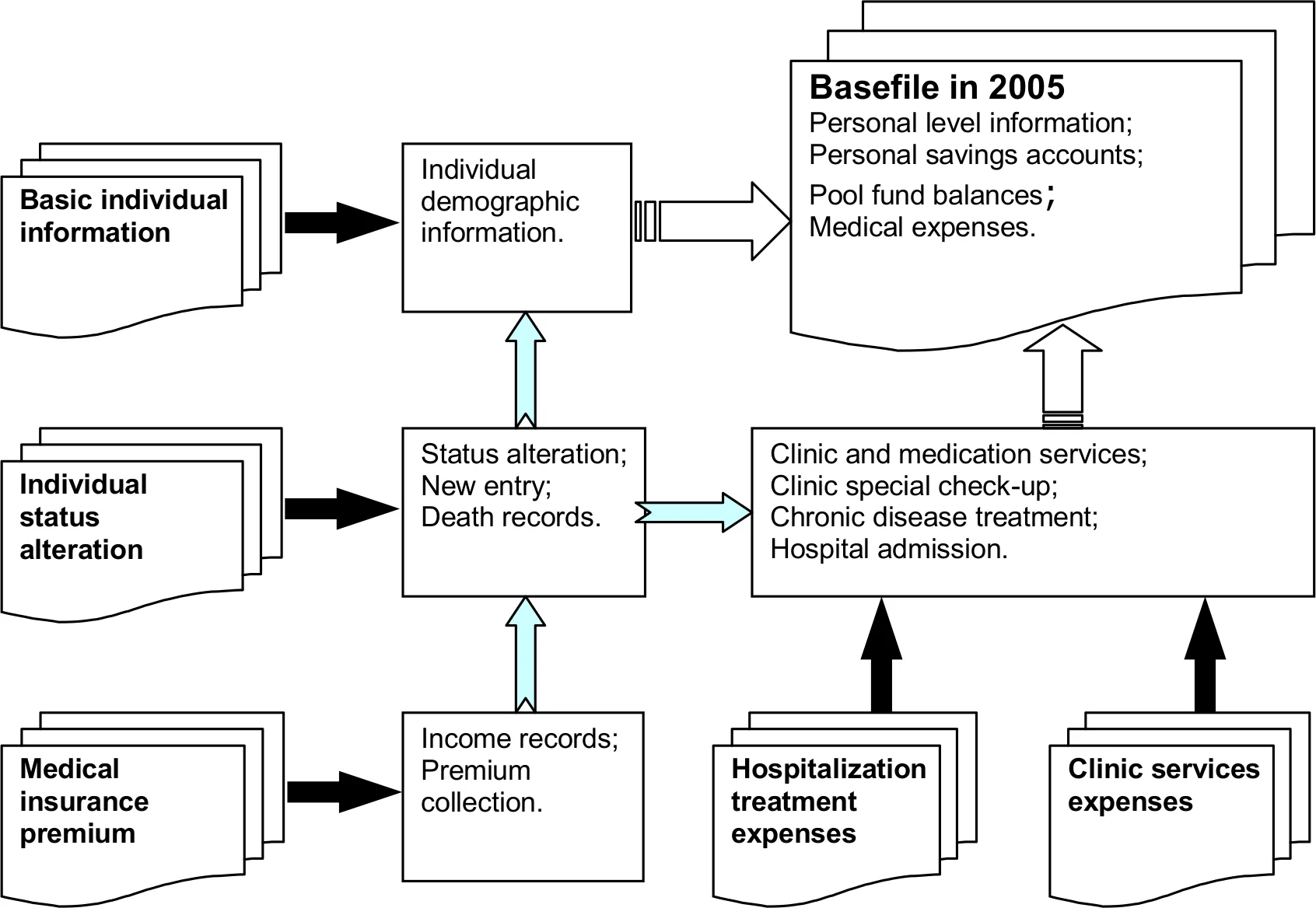
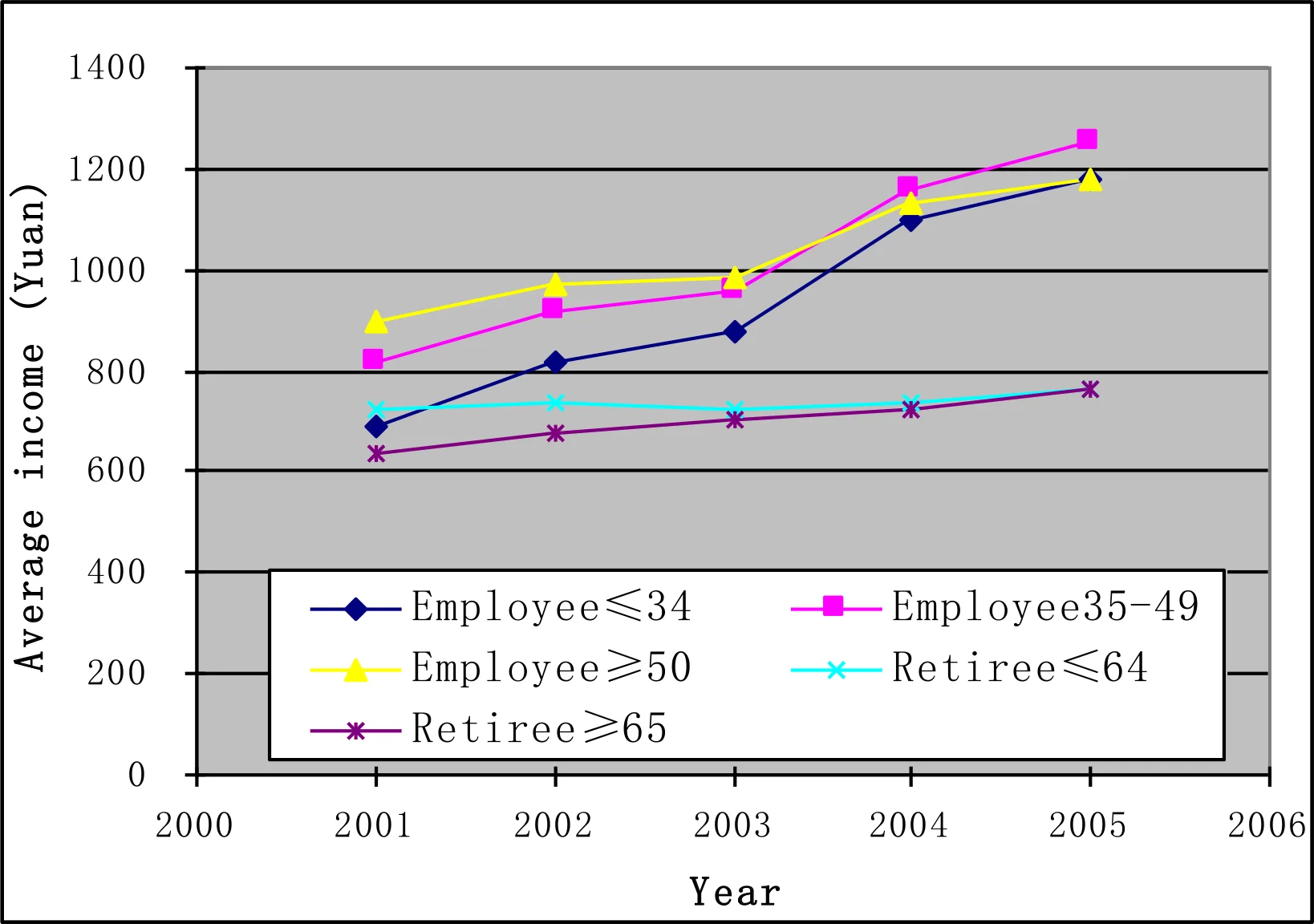
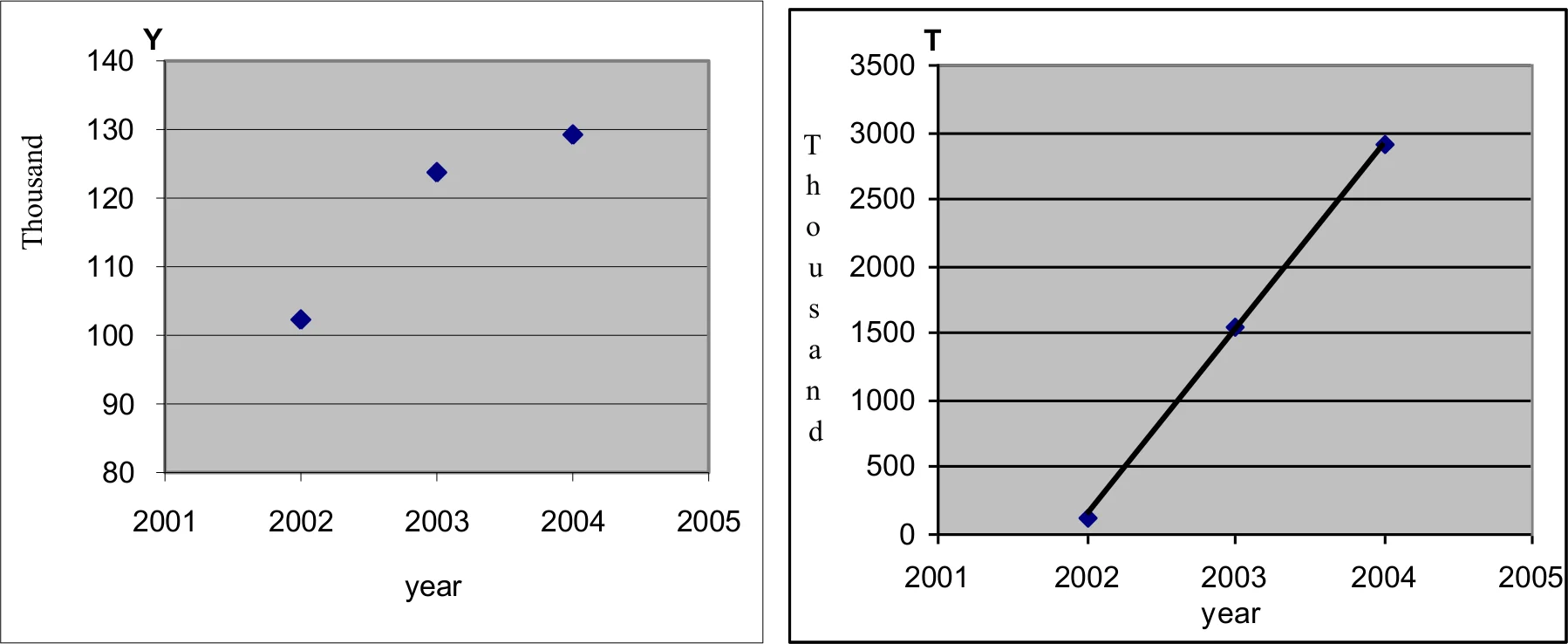
Figure 1. Datasets used in the research and their functions.Figure 2. The income trends of 2001–2005 by age group.Figure 3. Exponential curve fitting for estimating the number of officials.
Tables
Table 1. Administrative datasets used in modelling medical insurance scheme.
Datasets
Description
Basic individual information
Individuals’ basic demographic information under the urban medical insurance scheme over the period of 2001–2005
Individual status alteration
Individual status alteration records of medical insurance scheme participants over the period of 2001–2005
Medical insurance premium
Amount of contributions by individuals and their employers to the basic medical insurance scheme over the period of 2001–2005
Hospitalization treatment expenses
Medical expenditure records of insured participants in both hospitalization and special disease services for the year 2002–2005
Clinic services expenses
Medical expenditure records of clinic services and medications in pharmacies of insured participants over the period of 2001–2005
Table 2. Death of medical insurance participants in 2001–2005.
Year
Number of participants
Number of deaths
Accumulative frequency
Proportion of death (%)
2001
3,77,676
291
291
0.0771
2002
5,32,706
2,373
2,664
0.4455
2003
6,61,038
3,573
6,237
0.5405
2004
7,56,996
3,823
10,060
0.5050
2005
7,93,987
4,064
14,124
0.5118
Table 3. Age group specific death number and death rate (0.1%) of male (2001–2005).
Year
≤ 34
35–49
50–64
≥ 65
Total number
≤ 34
35–49
50–64
≥ 65
Total rate
2001
4
16
47
127
194
0.0804
0.2543
0.8673
4.3571
0.9899
2002
35
99
374
1,095
1,603
0.5003
1.0766
4.4636
23.1903
5.4724
2003
43
152
525
1,653
2,373
0.5057
1.3631
5.0157
27.3214
6.5605
2004
66
178
612
1,808
2,664
0.6881
1.4875
5.2957
27.7599
6.7226
2005
60
195
761
1,725
2,741
0.5678
1.5188
6.1504
23.6195
6.3623
Average death rate over 2002–2005 (0.1%)
0.5655
1.3615
5.2314
25.4728
6.2795
Table 4. Age group death number and death rate (0.1%) of female (2001–2005).
Year
≤ 34
35–49
50–64
≥ 65
Total number
≤ 34
35–49
50–64
≥ 65
Total rate
2001
2
11
23
61
97
0.0431
0.2008
0.4777
3.0511
0.5728
2002
16
57
160
537
770
0.2545
0.6833
2.2372
17.0563
3.0886
2003
29
77
248
846
1,200
0.3892
0.7402
2.8507
20.7135
3.9168
2004
21
82
256
800
1,159
0.2527
0.7132
2.7311
17.7054
3.4392
2005
21
83
335
884
1,323
0.2312
0.6878
3.3030
17.6004
3.6430
Average death rate over 2002–2005 (0.1%)
0.2819
0.7061
2.7805
18.2689
3.5219
Table 5. Monthly premium information by age group in 2005.
Age group
Number of participants
Number of participants with payment
Payment rate (%)
Average monthly income (Yuan)
Minimum income (Yuan)
Maximum income (Yuan)
Emp ≤ 34 years
1,96,410
1,89,614
96.54
1,176
450
3,342
Emp 35–49
2,43,227
2,40,111
98.72
1,249
468
3,342
Emp ≥ 50 years
91,893
91,424
99.49
1,179
336
3,342
Ret ≤ 64 years
139,362
137,544
98.70
763
111
3,320
Ret ≥ 65 years
1,23,095
1,18,424
96.21
760
108
3108
Total
7,93,987
7,77,117
97.88
Note: Emp – Employee, Ret – Retiree
Table 6. Distribution of number of monthly payments to the scheme in 2005.
Number of months
Participant frequency
Percentage
Accumulative frequency
Accumulative percentage
1
5,576
0.70
5576
0.70
2
4,545
0.57
10,121
1.27
3
6,211
0.78
16,332
2.06
4
5,309
0.67
21,641
2.73
5
4,417
0.56
26,058
3.28
6
4,856
0.61
30,914
3.89
7
4,816
0.61
35,730
4.50
8
9,043
1.14
44,773
5.64
9
4,597
0.58
49,370
6.22
10
5,506
0.69
54,876
6.91
11
12,472
1.57
67,348
8.48
12
709,769
89.39
777,117
97.88
99
16,870
2.12
793,987
100.00
Note: ’99 in the first column indicates missing records.
Table 7. The monthly income by age group in 2005 after imputation.
Age group
Actual population
Population after imputation
Average income (Yuan)
Minimum income (Yuan)
Maximum income (Yuan)
Emp ≤34 years
1,96,410
1,96,410
1,175.67
450.00
3,342.25
Emp 35–49 years
2,43,227
243,227
1,249.58
468.25
3,342.25
Emp ≥50 years
91,893
91,893
1,179.26
336.00
3,342.25
Ret ≤64 years
1,39,362
1,39,362
763.59
111.00
3,319.71
Ret ≥65 years
1,23,095
1,23,095
760.58
108.00
3,107.50
Total
7,93,987
7,93,987
Note: Emp – Employee, Ret – Retiree.
Table 8. The accumulative amount in personal savings accounts at the end of 2005 (Yuan).
Age group
Population
Average accumulate
Standard deviation
Minimum
Maximum
Emp ≤ 34 years
1,96,410
1,116
754
69
5,014
Emp 35–49 years
2,43,227
1,698
900
69
5,758
Emp≥50 years
91,893
1,989
1,033
39
6,484
Ret ≤64 years
1,39,362
1,402
766
28
6,382
Ret ≥65 years
1,23,095
1,385
714
35
7,257
Total
7,93,987
Notes: Emp – Employee,Ret – Retiree.
Table 9. Estimation of number of officials using exponential curve fitting.