Using statistics Canada LifePaths microsimulation model to project the disability status of Canadian elderly
Jacques Légaré, Yann Décarie
Département de démographie, Université de Montréal, Canada; Programme de démographie, Institut national de la recherche scientifique, INRS – Urbanisation Culture Société, Canada
Cite as: J. Légaré, Y. Décarie; 2011; Using statistics Canada LifePaths microsimulation model to project the disability status of Canadian elderly; International Journal of Microsimulation; 4(3); 48–56. doi: 10.34196/ijm.00060
Abstract
Complex population projections usually use microsimulation models; in Canada, Statistics Canada has developed a global dynamic microsimulation model named LifePaths in the Modgen programming language to be used in policy research. LifePaths provides a platform to build on for our research program, conjointly with Dr Janice Keefe from Mount Saint Vincent University, on projections of the Canadian chronic homecare needs for the elderly up to 2031 and of the human resources required. Beside marital status, family networks and living arrangements, future disability status of the elderly is a key variable, but an intricate one. Since disability status transitions were previously conditioned only on age and sex, we will use here the current disability module of LifePaths with longitudinal data from Canada’s National Population Health Survey (NPHS). These new disability status transitions are considering other significant explicative variables like marital status, education etc. We will then present projections of future Canadian elderly by disability status and a comparison with nine European countries for the Future Elderly Living Conditions in Europe (FELICIE) Research Program which has used the same approach. Our previous researches have shown the importance of future disability level for the management of an elderly society. The main output of the present paper would first produce, with new health scenarios, new estimates for Canada of elderly in poor health, for those aged 75 and over. Secondly, it would produce an interesting comparative analysis, useful especially for implementing new policies for the well-being of the Canadian elderly.
This article contains 3 figures and 5 tables.
Figures
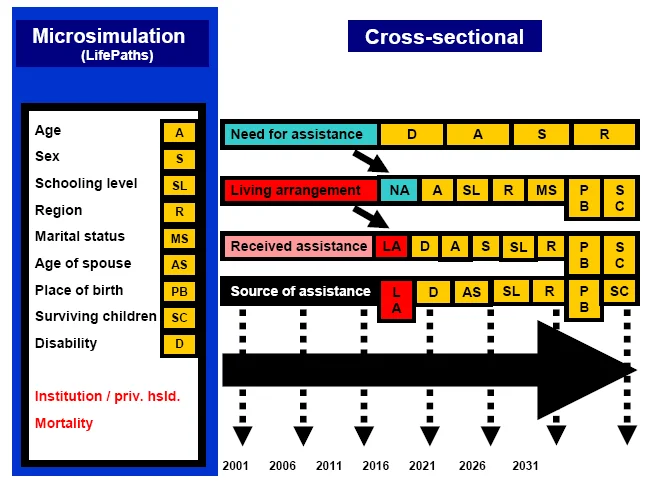
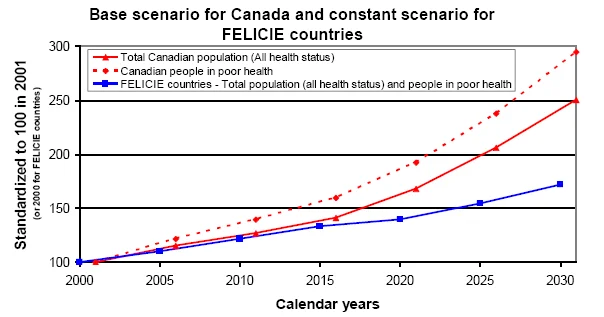
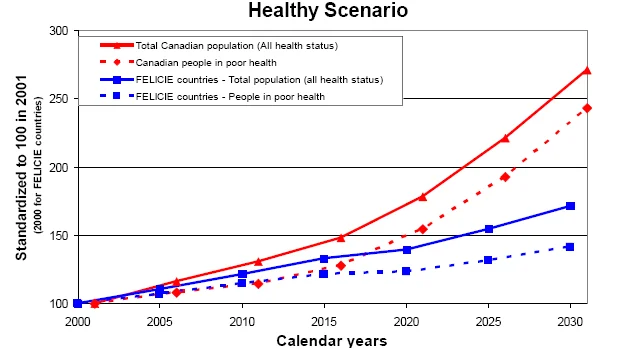
Figure 1. The projection model.Figure 2. Trends in total population (all health status) and people in poor health, aged 75+, Canada and FELICIE countries.Figure 3. Trends in total population (all health status) and people in poor health, aged 75+, Canada and FELICIE countries.
Tables
Table 1. Trends in Canadian life expectancy and disability free life expectancy at birth with the base scenario.
Year
Life expectancy (LE)
Disability free life expectancy (DFLE)
Life expectancy with disability (LEWD)
2001
78.0
63.8
14.2
2011
79.7
64.6
15.1
2021
81.2
65.2
15.9
2031
82.4
65.7
16.7
Source: Results from LifePaths model.
Table 2. Trends in Canadian life expectancy and disability free life expectancy at age 45 with the base scenario.
Year
Life expectancy (LE)
Disability free life expectancy (DFLE)
Life expectancy with disability (LEWD)
2001
34.8
23.5
11.3
2011
36.1
24.0
12.1
2021
37.3
24.4
12.9
2031
38.3
24.7
13.7
Source: Results from LifePaths model.
Table 3. Canadian people aged 75+ in poor health*, according to two scenarios, 2001 to 2031.
Year
MEN
WOMEN
Base scenario
Healthy scenario
Base scenario
Healthy scenario
n2001
196 019
192 900
307 787
302 924
Standardized to 100 in 2001
2001
100
100
100
100
2011
149
122
134
110
2021
213
170
180
145
2031
333
271
270
226
Source: Results from LifePaths Model.
People in poor health are those moderately or severely disabled.
Table 4. Canadian people aged 75+ in poor health* without surviving children, according to two scenarios, 2001 to 2031.
Year
MEN
WOMEN
Base scenario
Healthy scenario
Base scenario
Healthy scenario
n2001
49 606
48 768
59 125
58 421
Standardized to 100 in 2001
2001
100
100
100
100
2011
128
106
108
89
2021
163
131
127
103
2031
277
223
224
182
Source: Results from LifePaths Model.
People in poor health are those moderately or severely disabled.
Table 5. Canadian people aged 75+ in poor health* not married* and without surviving children, according to two scenarios, 2001 to 2031.
Year
MEN
WOMEN
Base scenario
Healthy scenario
Base scenario
Healthy scenario
n2001
29 590
29 063
49 744
49 131
Standardized to 100 in 2001
2001
100
100
100
100
2011
137
113
106
87
2021
178
142
120
96
2031
323
255
204
161
Source: Results from LifePaths model.
People in poor health are those moderately or severely disabled.
Married people include people in Common Law Union.