
This article contains 1 figure.
Figures
Health, Dynamic microsimulation
Research articles · Jun 30, 2012
Centre for Health Economics (CHE), University of York, United Kingdom; Alcuin A Block, University of York, United Kingdom; Department of Economics and Related Studies (DERS), University of York, United Kingdom
Cite as: E. Zucchelli, A. Jones, N. Rice; 2012; The evaluation of health policies through dynamic microsimulation methods; International Journal of Microsimulation; 5(1); 2–20. doi: 10.34196/ijm.00064
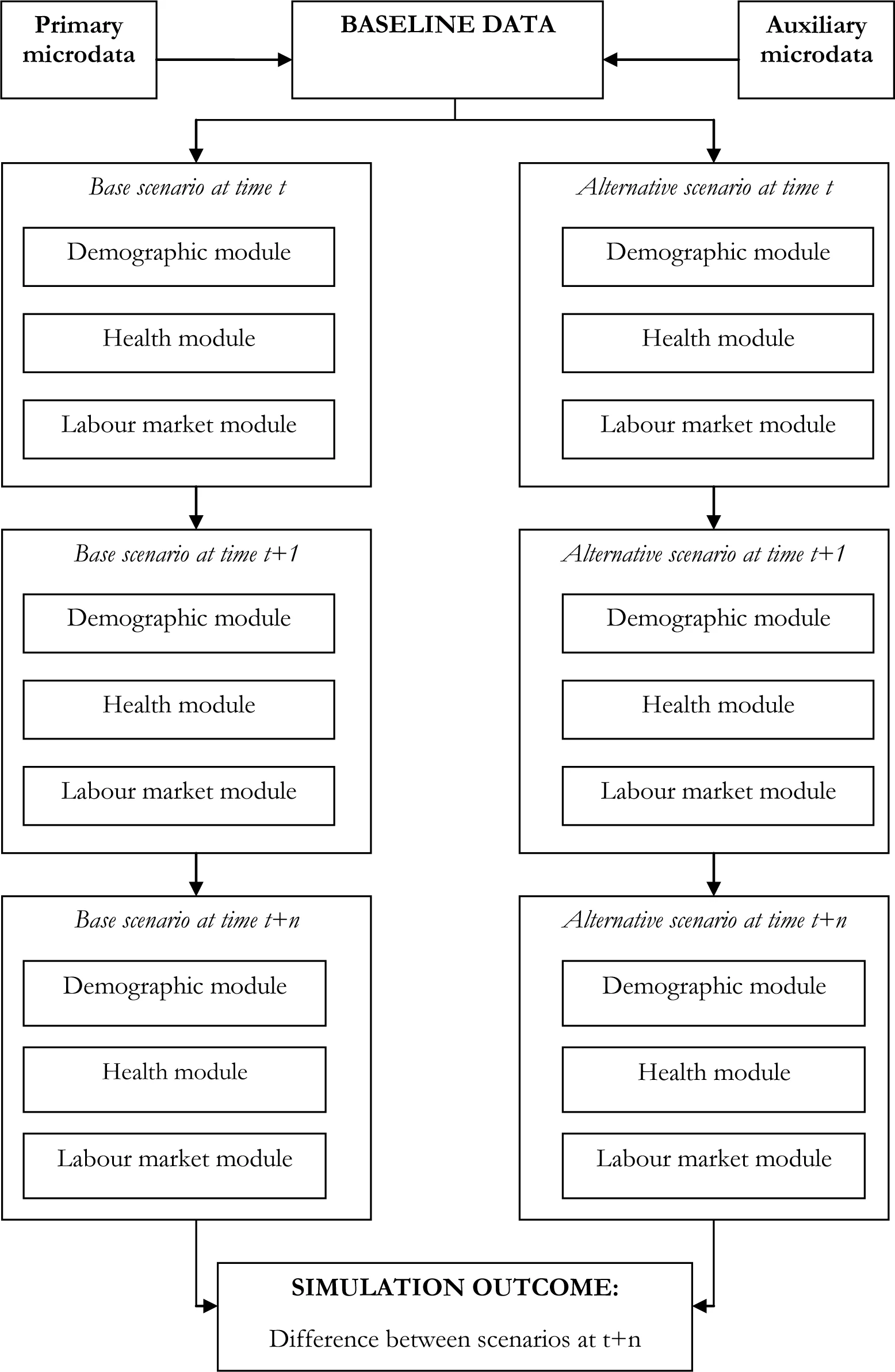
This paper presents an overview of microsimulation as a method to evaluate health and health care policies and interventions. After presenting a brief survey of microsimulation models and applications we describe the main features of the approach and how these are implemented in practice. We pay particular attention to the innovative features of dynamic microsimulation as a method of ex-ante policy evaluation. The final section presents a critical overview of the most recent health-dedicated dynamic microsimulation models including POHEM and FEM, two of the most comprehensive dynamic microsimulation models for health. We describe how these models are used to simulate lifecycle health trajectories and associated health care costs under competing policy scenarios to illustrate the power of microsimulation as a valid and relevant tool for policy evaluation.
This article contains 1 figure.