Cite as: A. Jousten, S. Perelman, F. Sigismondi, E. Tarantchenko; 2012; Accrued pension rights in Belgium: Micro-simulation of reforms; International Journal of Microsimulation; 5(2); 22–39. doi: 10.34196/ijm.00070
Abstract
We simulate different reform scenarios of the Belgian pension system using a microsimulation approach. Using a rich administrative dataset with extensive information on individual earnings histories, we evaluate the impact of the scenarios for the individuals as well as the system as a whole. Our main metric for these analysis is the notion of accrued to date pension rights, i.e. the pensions rights that would be due if the system were shut down today and all accrued rights under current legislation were honoured. Our analysis illustrates that partial reforms have limited effects, both in distributional and in fiscal terms. To achieve more substantial effects, a more comprehensive approach is needed. Regional differences within the country are mostly due to differences in regional GDP rather than the pension system itself.
This article contains 13 figures and 4 tables.
Figures
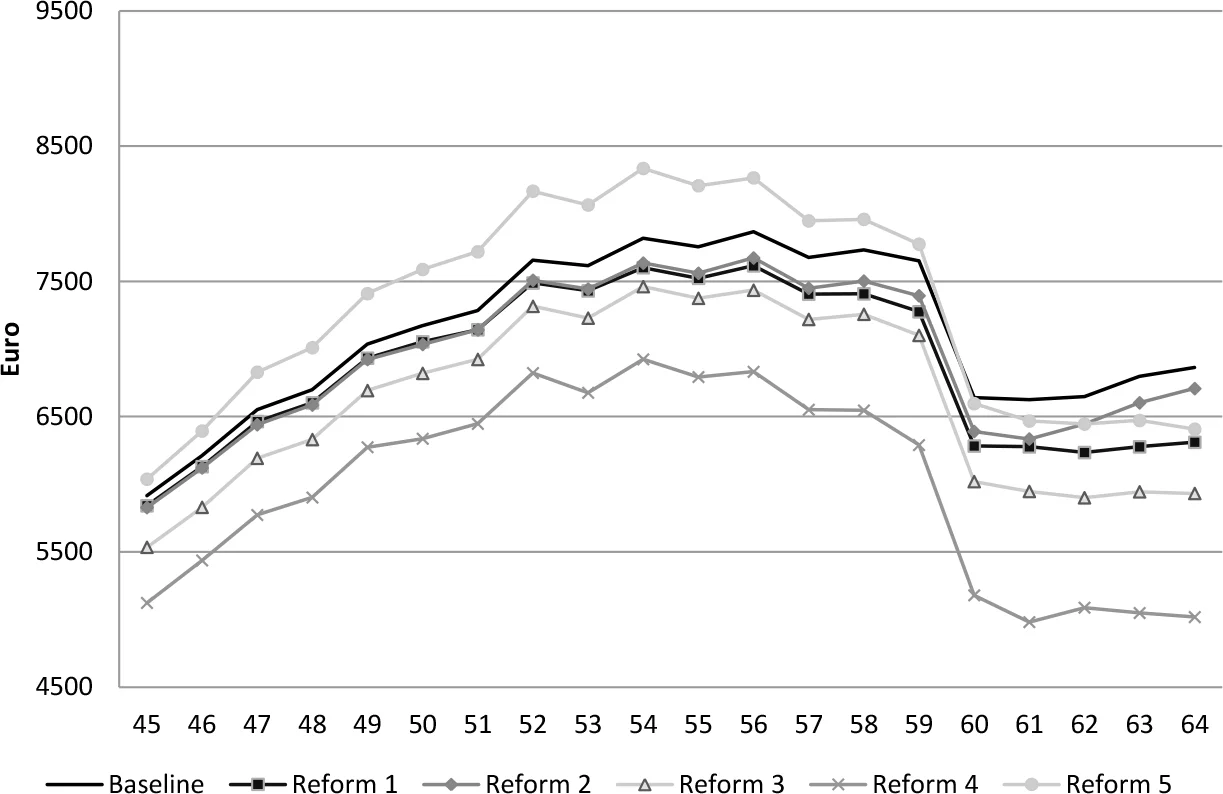
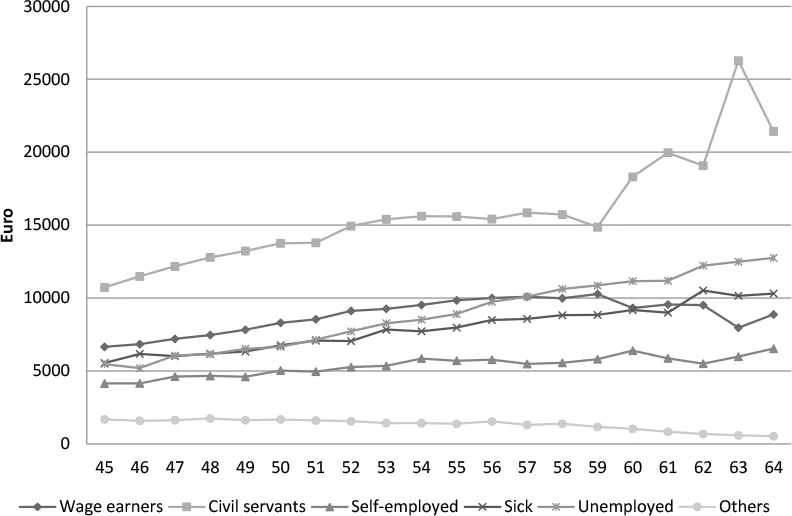
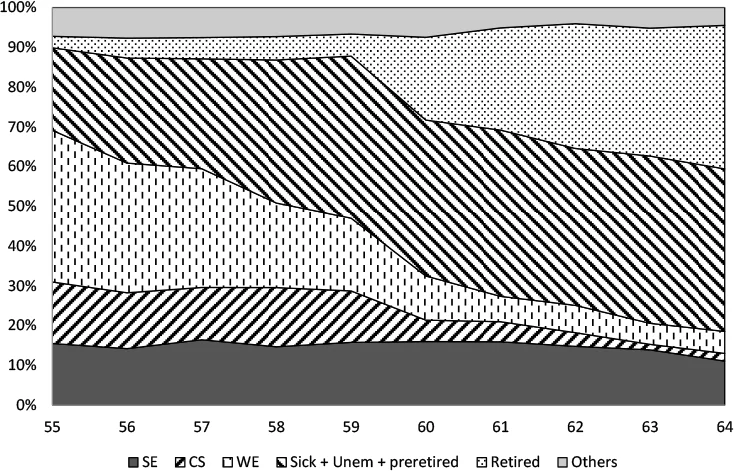
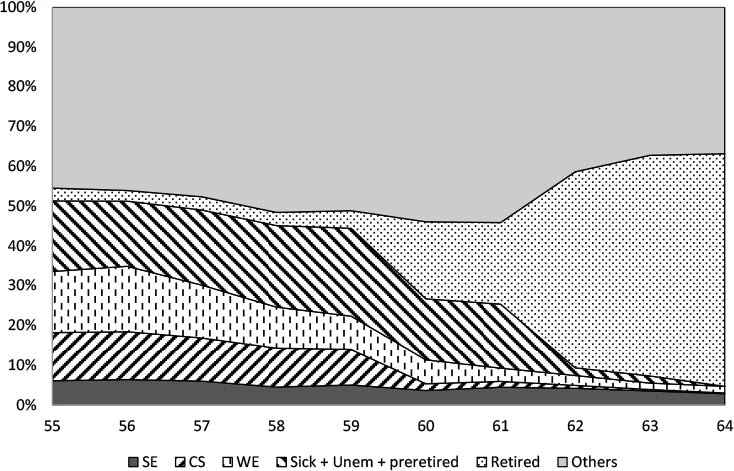
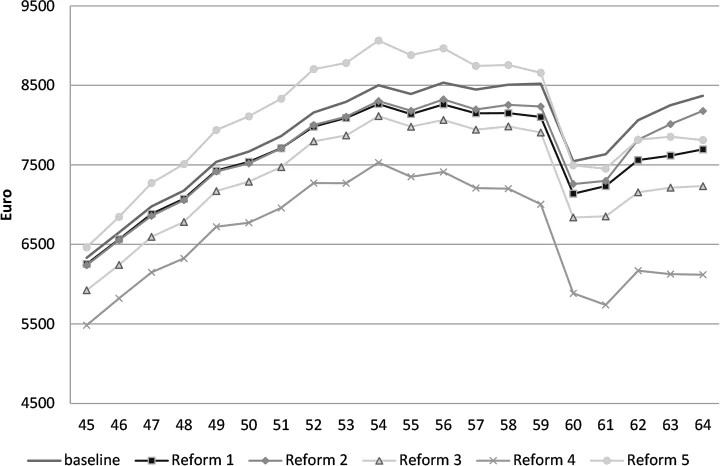
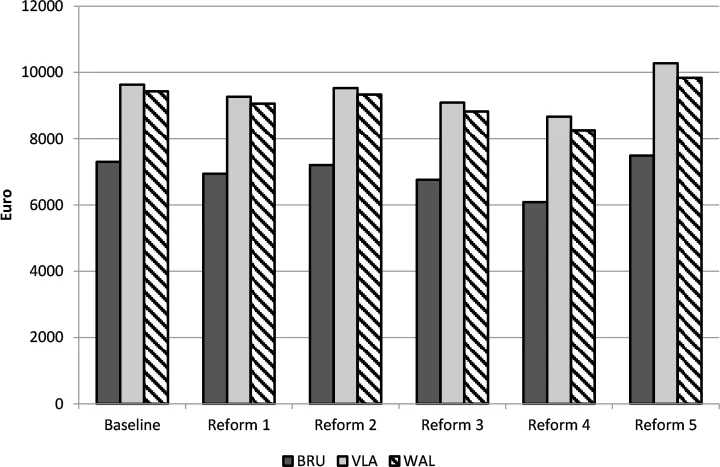
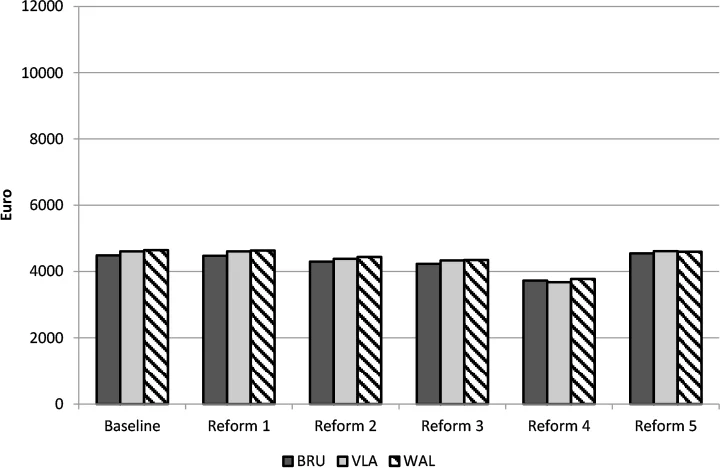
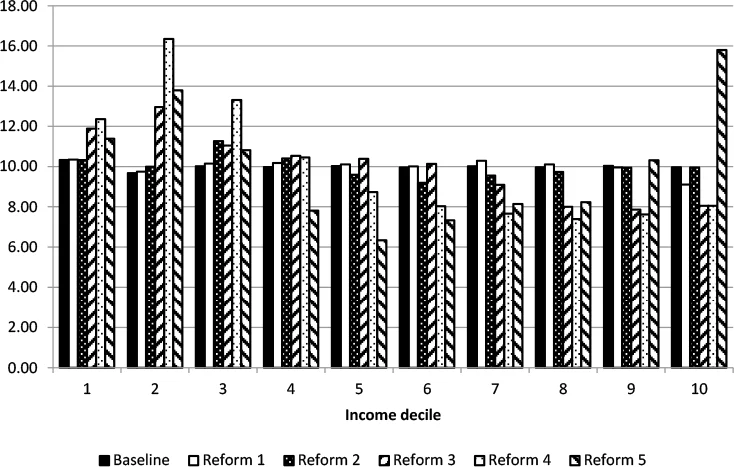
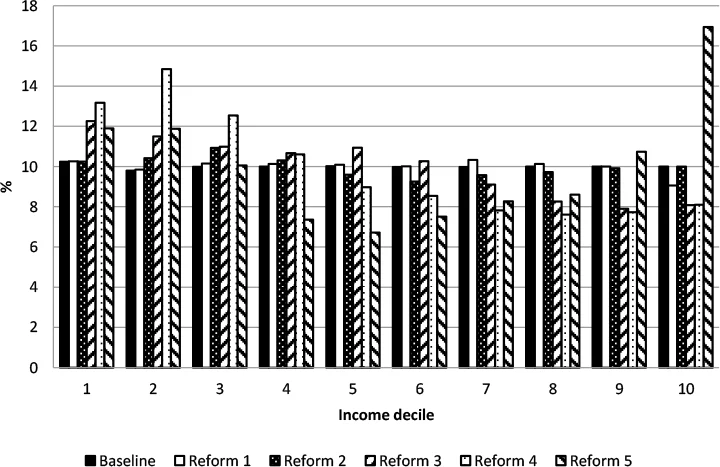
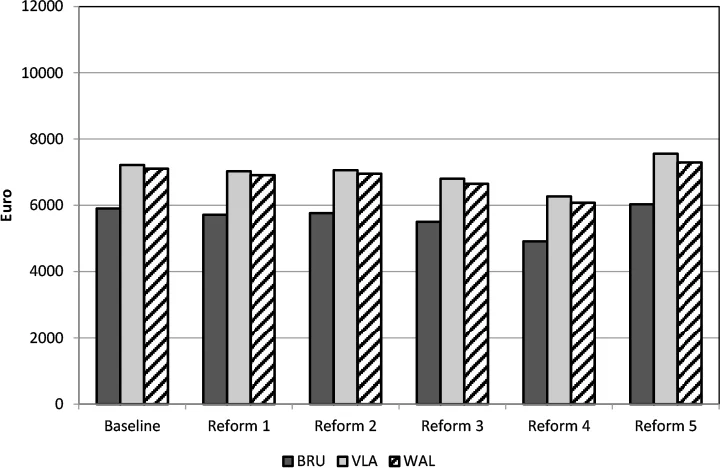
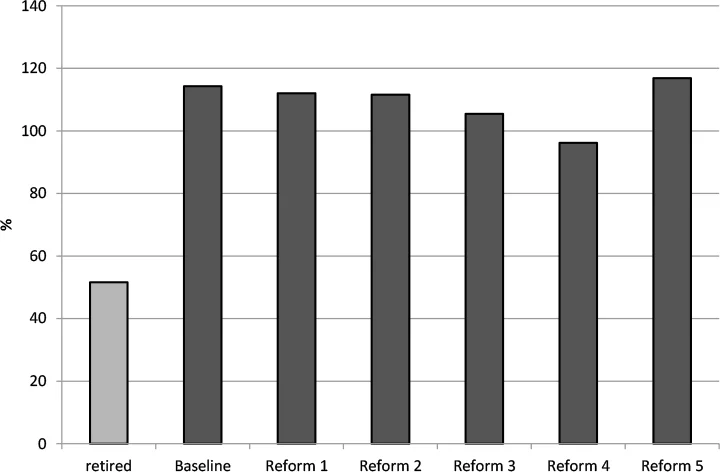
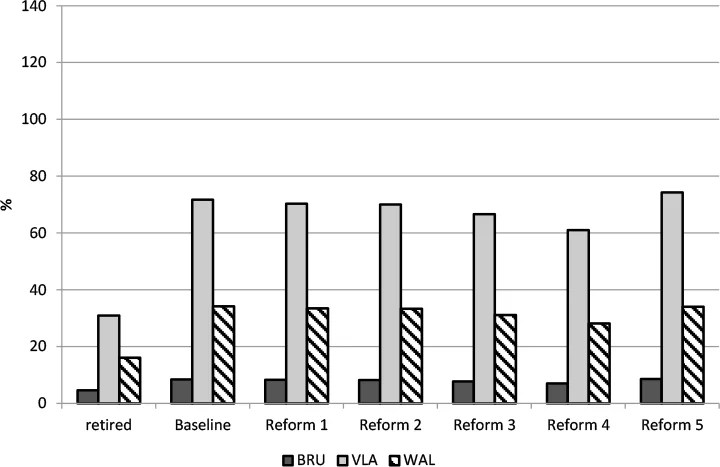
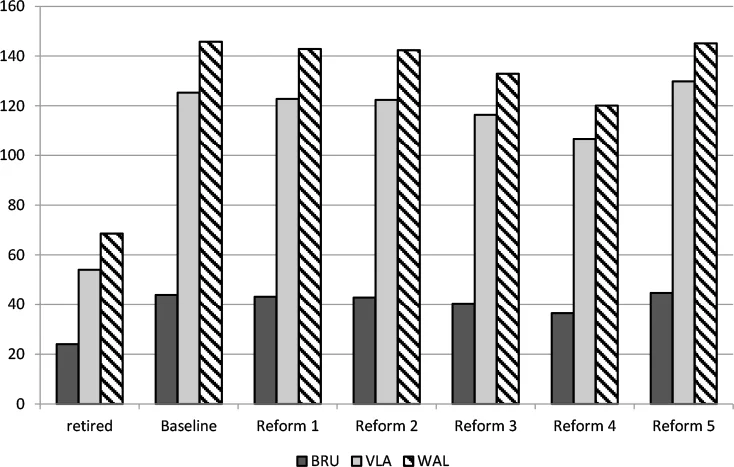
Figure 1. Average ATD pension by age cohort – sample (2001 EUR).Figure 2. Average ATD pension by status: baseline scenario – sample (2001 EUR).Figure 3a. Population structure – Men ages 55–64 (2001).Figure 3b. Population structure – Women ages 55–64 (2001).Figure 4. Average ATD pension by age cohort (ATD>0) – sample (2001 EUR).Figure 5a. Average ATD pension rights: Men ages 45–64 – sample (2001 EUR).Figure 5b. Average ATD pension rights: Women ages 45–64 – sample (2001 EUR).Figure 6a. Distribution of individuals according to the ATD pension rights, Baseline deciles – Population Belgium 2001.Figure 6b. Distribution of individuals according to the ATD pension rights, Baseline deciles – Population Flanders 2001.Figure 7. Average ATD pension rights by region – sample (45–64 years old – 2001 EUR).Figure 8. Present discounted value of pension rights as % of national GDP – Belgium, 2001 (black – non pensioners, grey – current pensioners).Figure 9. Present discounted value of pension rights as % of national GDP (18–64 years old, pensioners excluded) – Regional decomposition, 2001.Figure 10. Present discounted value of pension rights as % of regional GDP(18–64 years old, pensioners excluded) – Regional decomposition, 2001.
Tables
Table 1. Population aged 18–64, excluding pensioners and dependent children (in %) Belgium (1/1/2002).
Gender and labor market situation
Age
Total
18–24
25–34
35–44
45–54
55–64
Gender
Men
52.8
50.4
50.5
50.3
51.3
50.3
Women
47.2
49.6
49.5
49.7
48.7
49.7
Labor market situation
Wage earners
78.6
60.6
50.9
37.8
16.8
46.9
Self-employed
4.2
8.8
11.9
11.3
11.5
10.4
Civil servants
2.0
5.2
11.7
16.0
9.6
10.1
Sick / Disabled
1.1
1.1
2.2
4.5
6.9
3.1
Unemployed / Pre-retired
14.1
9.5
7.5
9.8
23.6
11.6
Others
0.0
14.7
15.8
20.6
31.5
17.9
Population (×1000) % of total population
439.0
1,392.9
1,580
1,399.5
881.0
5,692.5
7.7
24.5
27.8
24.6
15.5
100.0
Note: sample weights used.
Table 2. Key characteristics of reforms.
Reform 1
No spousal benefits
Elimination of the more generous “married couple” replacement rates
Reform 2
No minima
Elimination of minimum pensions and of minimum earnings by year of work
Reform 3
No imputed earnings
Imputed wages for periods of inactivity valued at 0 (assimilated days)
Reform 4
Interaction effects
Reforms 2 and 3 together
Reform 5
Career length
Elimination of minimum earnings by year. No imputed earnings. Pension benefits computed on the best 35 years of career. Full career: 35 years.
Table 3. Distribution of gains and losses of annual ATD pensions: Ages 45–64 – sample (2001 EUR).
Reform 1
Reform 2
Reform 3
Reform 4
Reform 5
% of losers
11.9
28.0
65.2
70.3
24.9
% of neutrals
88.1
71.5
32.4
27.4
13.8
% of winners
0.0
0.5
2.4
2.2
61.3
mean loss (k EUR)
−1,620
−573
−665
−1,406
−1,348
mean gain (k EUR)
0
587
271
505
992
biggest loss (k EUR)
−4,386
−6,620
−8,538
−13,727
−10,472
biggest gain(k EUR)
0
2,478
2,078
2,903
7,956
Gini coefficients
Baseline = 0.441
0.439
0.454
0.453
0.502
0.465
Table 4. Distribution of gains and losses of annual ATD pensions by sex: Ages 45–64 – sample (2001 EUR).