Cite as: H. Buddelmeyer, N. Hérault, G. Kalb, M. van Zijll de Jong; 2012; Linking a microsimulation model to a dynamic CGE model: Climate change mitigation policies and income distribution in Australia; International Journal of Microsimulation; 5(2); 40–58. doi: 10.34196/ijm.00071
Abstract
This paper extends the ‘top-down’ framework developed by Robilliard et al. (2001) to link a computable general equilibrium (CGE) model to a microsimulation (MS) model. The proposed approach allows for the linking of an MS model to a dynamic (rather than static) CGE model. The approach relies on altering the sample weights in order to reproduce long-term population projections and changes in employment as estimated by the CGE model. The approach is applied to assess the effects of climate-change mitigation policies in Australia from 2005 to 2030 at five-yearly intervals.
This article contains 5 figures and 5 tables.
Figures
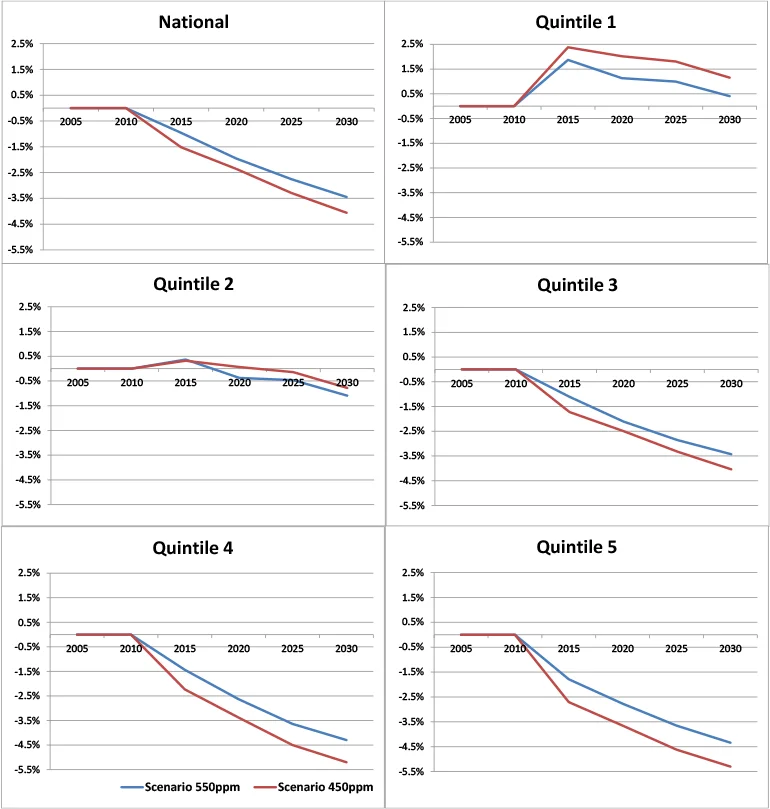
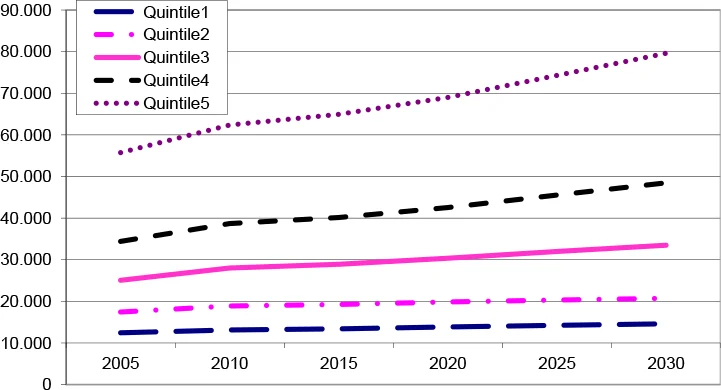
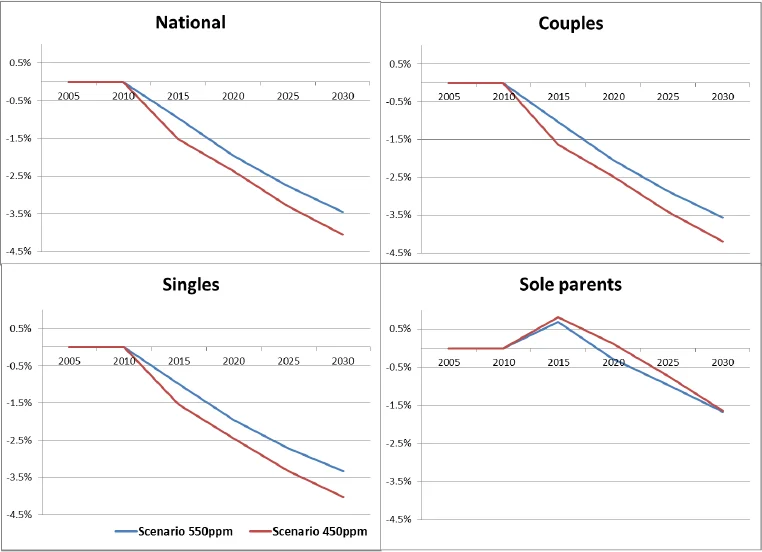
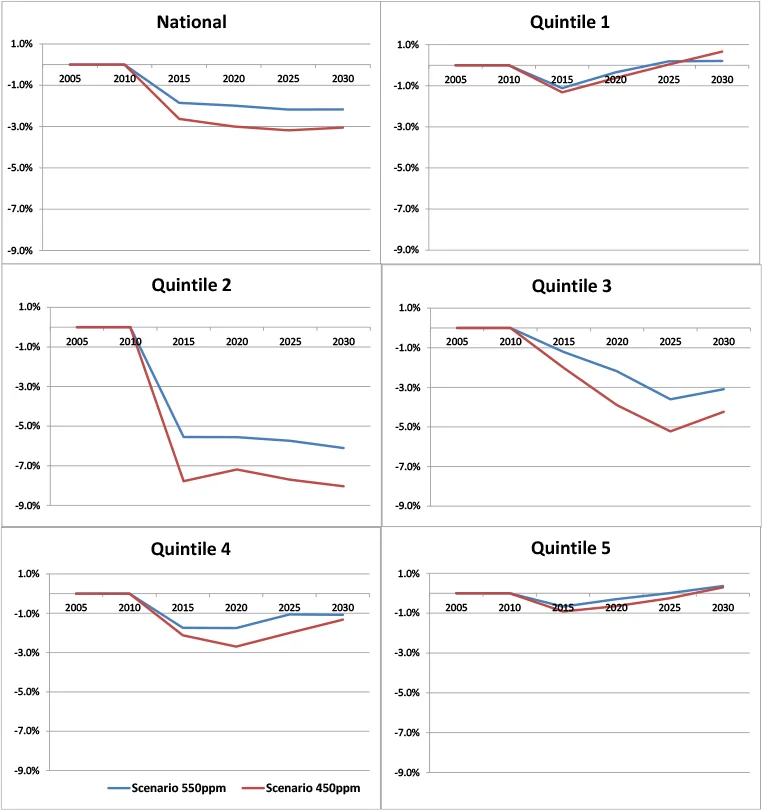
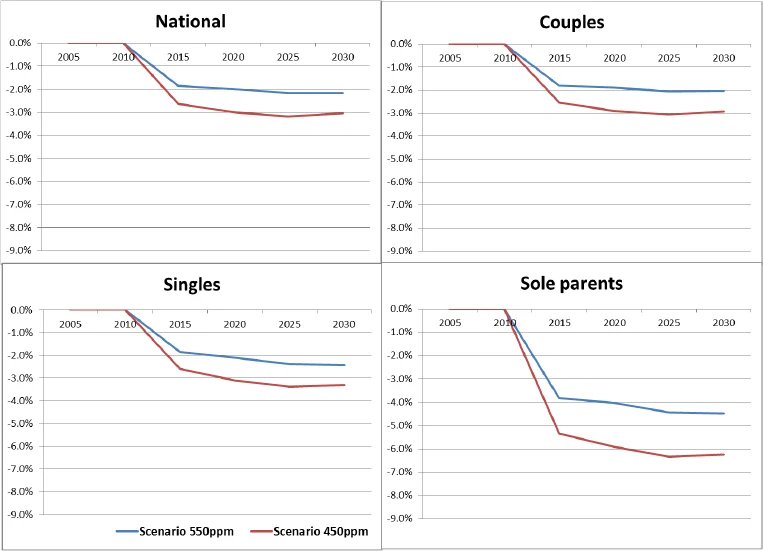
Figure 1. Average real net income per adult equivalent by income quintile: percentage deviations from the reference case.Figure 2. Average real net income per adult equivalent by quintile in the reference case (in financial year 2005/2006 dollars).Figure 3. Average real net income per adult equivalent by household type: deviations from the reference case.Figure 4. Gini coefficient within income quintiles: deviations from the reference case.Figure 5. Gini coefficient by household type: deviations from the reference case.
Tables
Table 1. Computation of household real income for one particular household.
2005 (base)
2010
2015
2020
2025
2030
Nominal household income
y0
y1
y2
y3
y4
y5
Cumulative price changes (63×1 vector)
P1
P2
P3
P4
P5
Budget shares (63×1 vector)
B0
B1
B2
B3
B4
B5
Real household income
y0
Table 2. Household income (in millions of dollars).
2005/2006 financial year
CGE model (MMRF)
MS model (MITTS)
Total household income
886,422
562,478
Labour
447,962
371,716
Non-labour factor income
361,125
121,770
Individual benefit payments
77,336
68,992
Unemployment benefits
5,665
5,758
Disability support pension
8,257
7,148
Age pension
21,407
22,477
Other individual benefit payments
42,007
33,609
Direct taxes on individuals
114,624
113,795
Direct taxes on enterprises
45,435
NA
Household disposable income
726,363
448,683
Table 3. Aggregate income results: reference case.
Note: (a) Aggregate budget shares at percentage points. the national level (in per cent). Changes are expressed in percentage points.
Table 4. Lump sum transfers to households.
2005
2010
2015
2020
2025
2030
Amounts in $ per year per capita
Government handout
Reference Case
0
274
475
855
1,149
1,411
Scenario – 550ppm
0
274
303
546
760
948
Scenario – 450ppm
0
274
190
437
650
845
Exogenous change in household income from carbon permit revenue
Reference Case
0
0
0
0
0
0
Scenario – 550ppm
0
0
495
584
663
699
Scenario – 450ppm
0
0
727
844
928
939
Total transfer
Reference Case
0
274
475
855
1,149
1,411
Scenario – 550ppm
0
274
798
1,130
1,423
1,647
Scenario – 450ppm
0
274
917
1,280
1,577
1,785
As a percentage of GDP
Total transfer
Reference Case
0
0.50
0.81
1.36
1.71
1.98
Scenario – 550ppm
0
0.50
1.37
1.81
2.16
2.36
Scenario – 450ppm
0
0.50
1.57
2.06
2.40
2.58
Table 5. Ratio of new weights to original sample weights: reference case.
2005
2010
2015
2020
2025
2030
Decile 1
0.64
0.63
0.63
0.59
0.53
0.47
Decile 2
0.77
0.79
0.82
0.80
0.77
0.71
Decile 3
0.87
0.90
0.94
0.95
0.93
0.91
Decile 4
0.94
0.99
1.05
1.09
1.08
1.07
Decile 5
1.02
1.08
1.16
1.22
1.26
1.28
Decile 6
1.10
1.18
1.27
1.38
1.42
1.50
Decile 7
1.18
1.30
1.44
1.55
1.69
1.77
Decile 8
1.30
1.45
1.61
1.77
1.95
2.15
Decile 9
1.51
1.76
1.94
2.15
2.40
2.71
Note: This table should be read as follows: for 10 per cent of the records, the ratio of the new weight for 2005 (after reweighting) to the original sample weight is smaller than 0.64. For another 10 per cent of the records it is higher than 1.51.