Cite as: S. Rogers, J. Rineer, M. Scruggs, W. Wheaton, P. Cooley, D. Roberts, D. Wagener; 2014; A geospatial dynamic microsimulation model for household population projections; International Journal of Microsimulation; 7(2); 119–146. doi: 10.34196/ijm.00102
Abstract
Forecasting Populations (FPOP) is a microsimulation model (MSM) that is the demographic core of an extensible modeling framework. The framework, with FPOP at its core, enables the geospatial projection of a population under purely demographic processes or under the additional influence of exogenous factors such as disease, policy changes and prevention programs, or environmental stressors. Empirically-derived transition probabilities of life events such as birth, death, marriage, divorce and migration, captured in lookup table format, drive the simulation. These transition probabilities can be modified dynamically by external user-defined functions or other external MSMs. The use of MSM structures and methodologies enables FPOP to portray the impact of heterogeneity in the geospatial dimension (e.g., distribution of environmental factors or distribution of intervention programs), as well as the social dimension (e.g., household or social network correlates), on the projections. POP is designed and structured to: enable linking with external MSMs of any kind; support inclusion or configuration of more detailed transition probabilities; be scalable to millions of agents; use either an existing baseline synthetic population or a custom synthetic population of the user’s design; and, run under computing environments that don’t require a high degree of specialized software or hardware. In this paper we describe the design and structure of FPOP and then apply FPOP first under purely demographic processes and, secondly, in conjunction with an external disease model of obesity.
The objective of FPOP is to provide a demographically realistic projection of the size, structure, and movement of populations and households decades into the future.
This article contains 6 figures and 2 tables.
Figures
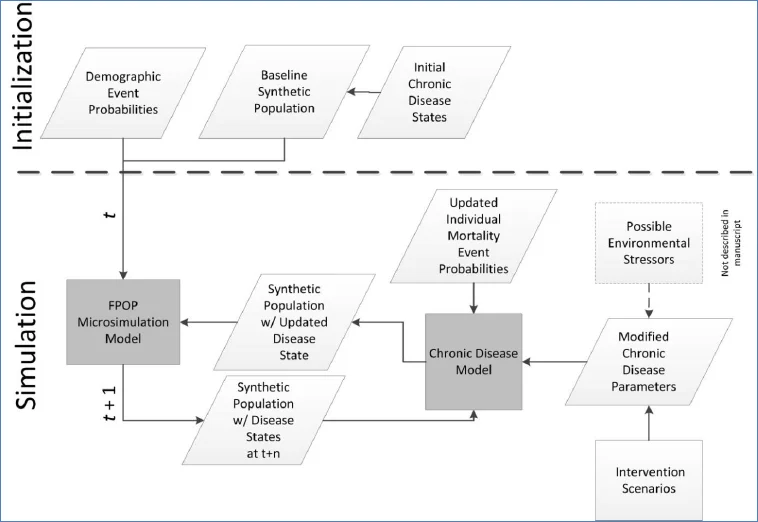
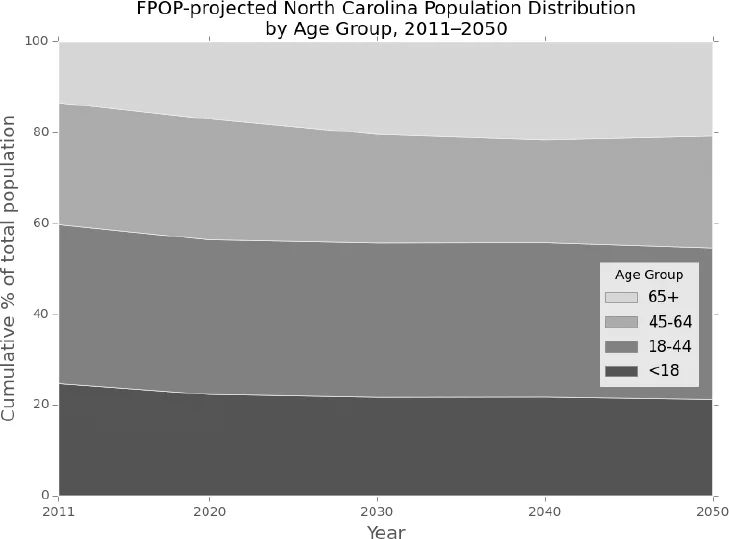
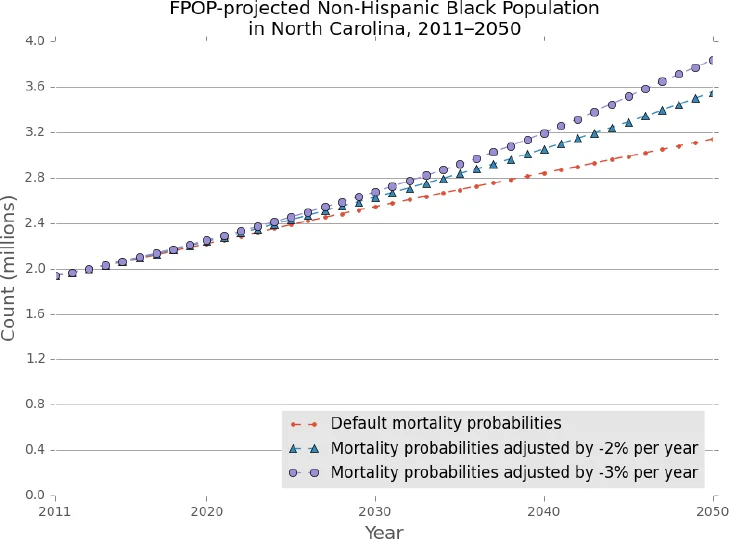
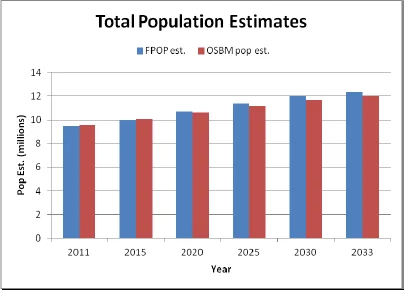
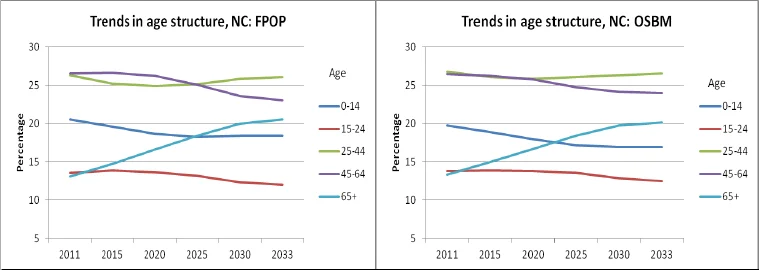
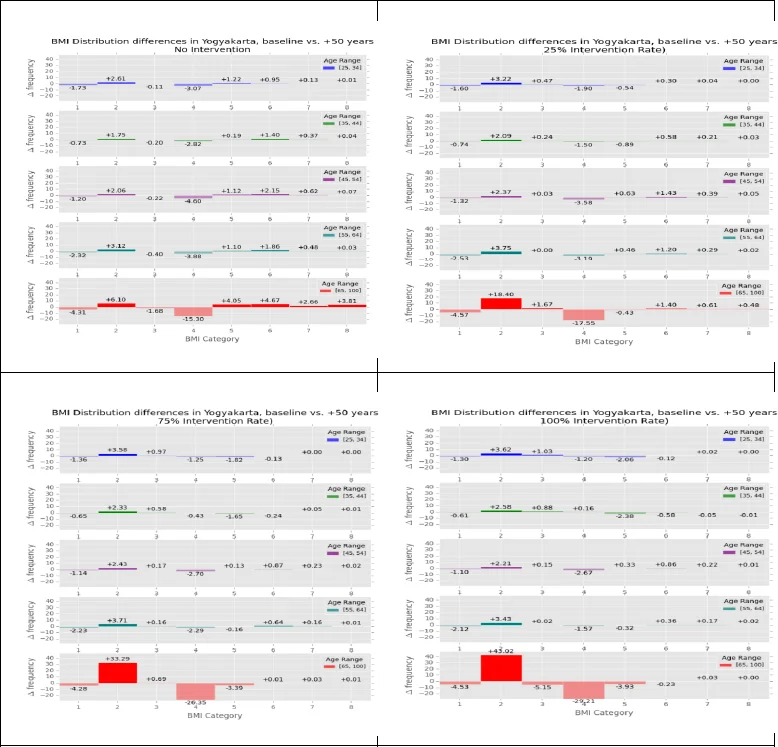
Figure 1. A model framework showing FPOP as the demographic core for a chronic disease scenario.Figure 2. Projected age distribution of North Carolina, 2011–2050: FPOP.Figure 3. Projected non-Hispanic Black population, North Carolina 2011–2050 with default and adjusted mortality probabilities.Figure 4. Population projections, North Carolina 2011–2033: FPOP and NC OSBM.Figure 5. Trends in age structure by age groups, North Carolina 2011–2033: FPOP and NC OSBM.Figure 6. Estimated change in body mass index (BMI) for men and women in urban and rural settings by different participation rates in intervention programs.
Tables
Table 1. Initial demographic parameters applied to FPOP for a U.S. population.
ACS is the American Community Survey; NCHS NVSS is the National Center for Health Statistics / National Vital Statistics System.
Table 2. Components of population growth, North Carolina 2011–2033: FPOP and NC OSBM.
Base Pop (2011 FPOP, 2010OSBM
Nat. Incr.
Net in-migration
Projected 2020 Pop
Nat. Incr.
Net in-migration
Projected 2030 Pop
Nat. Incr.
Net inmigration
Projected 2033 Pop
2010(1)–2020
2020–2030
2030–2033
FPOP Projections, 2011–2033
9,490,337
336,507 3.55%
863,210 9.10%
10,690,054
187,820 1.76%
1,128,992 10.56%
12,006,866
2,058 0.02%
363,861 3.03%
12,372,785
NC OSBM, 2010–2033
9,535,471
319,121 3.35%
762,267 7.99%
10,616,859
166,140 1.56%
899,263 8.47%
11,682,262
16,607 0.14%
301,691 2.58%
12,000,560
Ratio: OSBM/FPOP Projections
1.005
0.993
0.973
0.970
Nat. Incr.: Natural Increase=Births-Deaths; NC OSBM projections tabulated for 10-year periods beginning April 2010 and ending July 2033. FPOP estimates tabulated for 10-year periods beginning April 2011 and ending April 2033.