Health

Research articles · Dec 31, 2014

LifeLossMOD: A microsimulation model of the economic impacts of premature mortality in Australia

Hannah E Carter, Deborah J Schofield, Rupendra Shrestha

NHMRC Clinical Trials Centre, University of Sydney, Australia

Volume 7(3) Winter 2014

Cite as: H. Carter, D. Schofield, R. Shrestha; 2014; LifeLossMOD: A microsimulation model of the economic impacts of premature mortality in Australia; International Journal of Microsimulation; 7(3); 33–52. doi: 10.34196/ijm.00106

Abstract

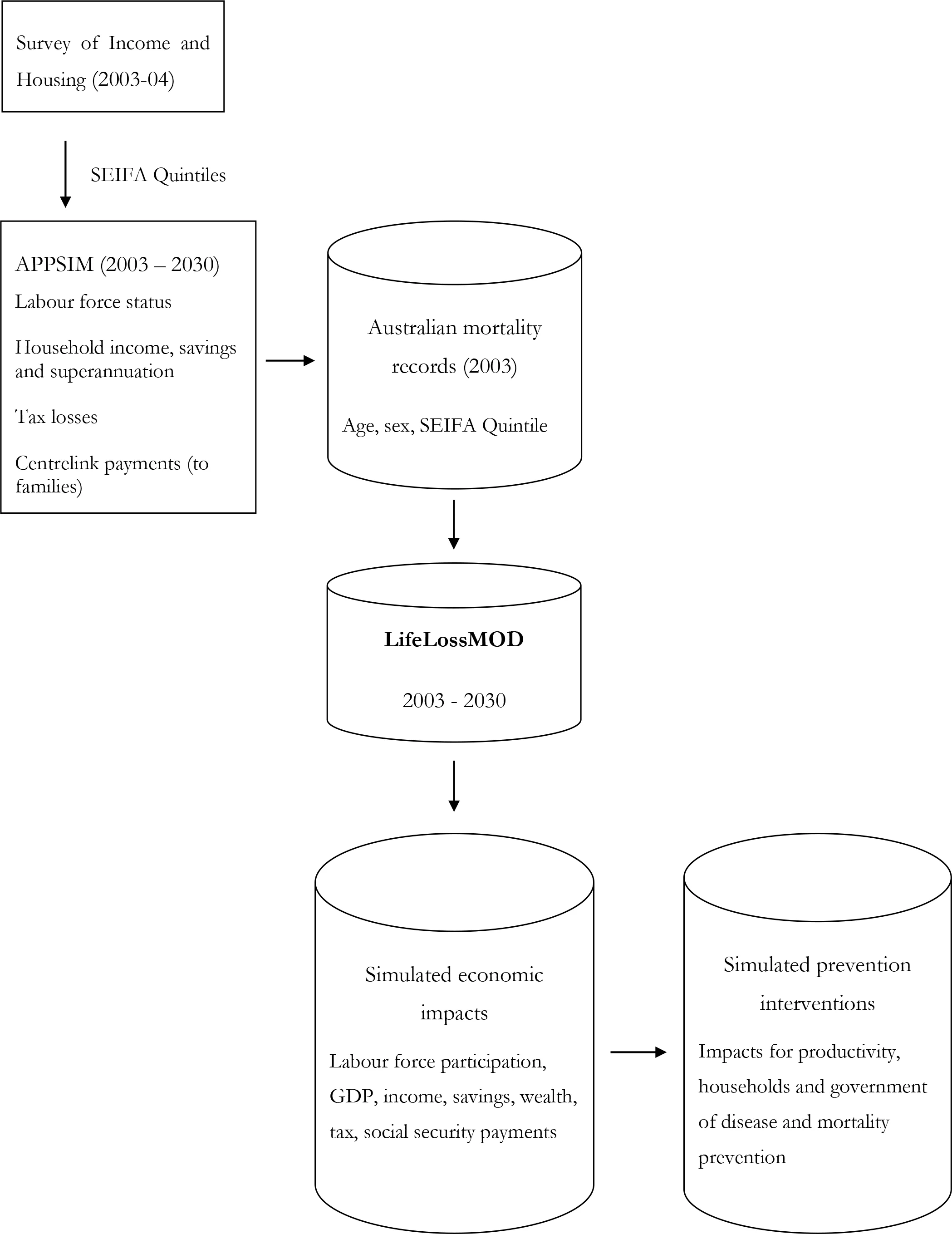
While the direct costs of mortality to the health care system are known to be significant, there is less information regarding the wider economic impacts of mortality including the implications for productivity, household incomes and government revenue. This paper outlines the development of LifeLossMOD, a new microsimulation model to estimate the economic impacts of premature mortality in Australia. The model is based on a census of 2003 mortality records and applies projections from the APPSIM microsimulation model to estimate the counterfactual lifetime trajectories forgone to the year 2030. We estimated that mortality in 2003 accounted for over 280,000 full time working years lost to the Australian economy. Future applications of LifeLossMOD will explore the distributional impacts of mortality on employment, GDP, government revenue and household income, wealth and retirement savings. These estimates will allow decision makers and others to more accurately determine the full economic impacts of mortality by cause. In addition, the model will be able to quantify the financial gains likely to accrue with preventative health care interventions, which can in turn be reported on in cost effectiveness analyses.

This article contains 1 figure and 3 tables.

Figures

Figure 1. LifeLossMOD.

Tables

Table 1. Number of premature deaths in the 2003 mortality cohort by age and sex.
Age Group Male Female Total
< 15 954 738 1,692
15–24 1,028 370 1,398
25–34 1,455 591 2,046
35–44 2,259 1,246 3,505
45–54 4,012 2,454 6,466
55–64 7,549 4,468 12,062
64–80 25,027 16,508 41,535
TOTAL 42,329 26,375 68,704
Table 2. Benchmark analyses (in %).
Benchmark category Proportion in aggregate Aust. mortality data Proportion in LifeLossMOD * Absolute difference in overall proportions
Marital status
    Never married 18 26 7
    Married 52 50 2
    Widowed 16 17 1
    Divorced 11 7 3
    Not stated 3 - -
State of usual residence
    NSW 35 36 1
    Vic 24 25 0
    Qld 18 18 0
    SA 9 8 1
    WA 9 9 0
    Tas 3 2 1
    NT 1 1 0
    ACT 1 2 0
Country of birth
    Australia 69 76 7
    Overseas 31 24 7

Values represent the mean of 100 simulations.

Table 3. Modelled estimates of working years lost between 2003 and 2030 due to all cause premature mortality in 2003.
FTE working years lost by SEIFA quintile
Q1 Q2 Q3 Q4 Q5 TOTAL
Male 95% CI % of total male
47,690 47,622 45,358 39,591 32,542 212,802
46,713–48,816 46,759–48,630 44,287–46,288 38,771–40,456 31,620–33,379 210,693–214,826
22% 22% 21% 19% 15% 100%
Female 95% CI % of total female
14,199 14,947 14,221 12,732 11,408 67,506
13,627–14,924 14,446–15,565 13,697–14,860 12,269–13,318 10,914–11,872 66,542–68,599
21% 22% 21% 19% 17% 100%
Total 95% CI % of total cohort
61,888 62,569 59,579 52,323 43,949 280,308
60,577–63,294 61,452–63,686 58,186–60,858 51,468–53,307 42,906–44,897 278,151–282,547
22% 22% 21% 19% 16% 100%