
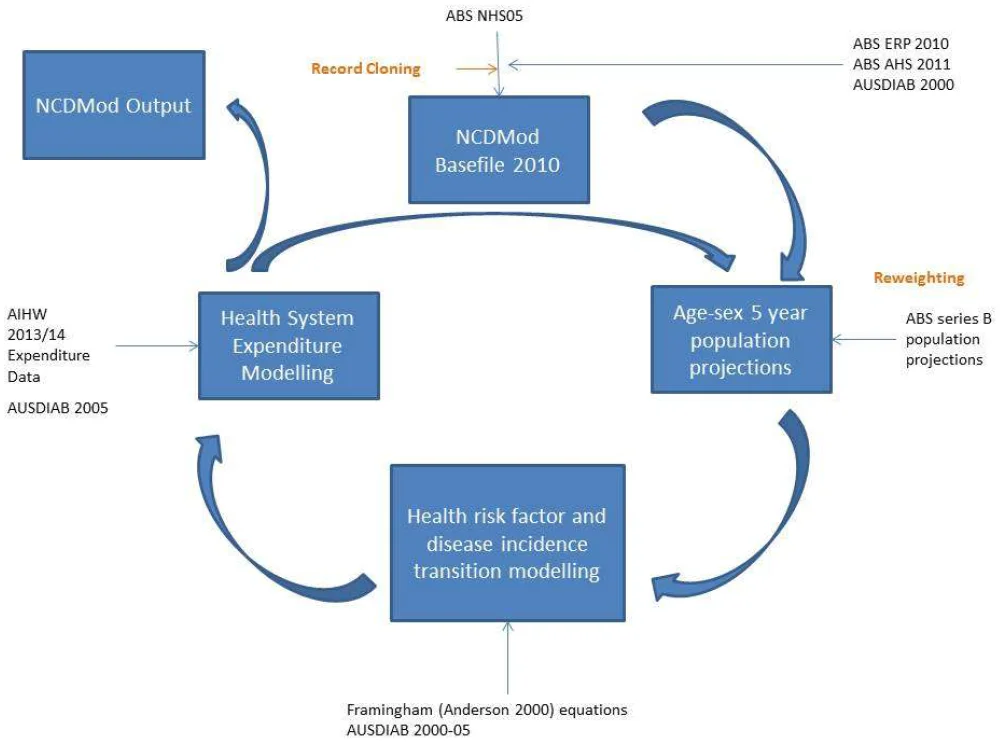
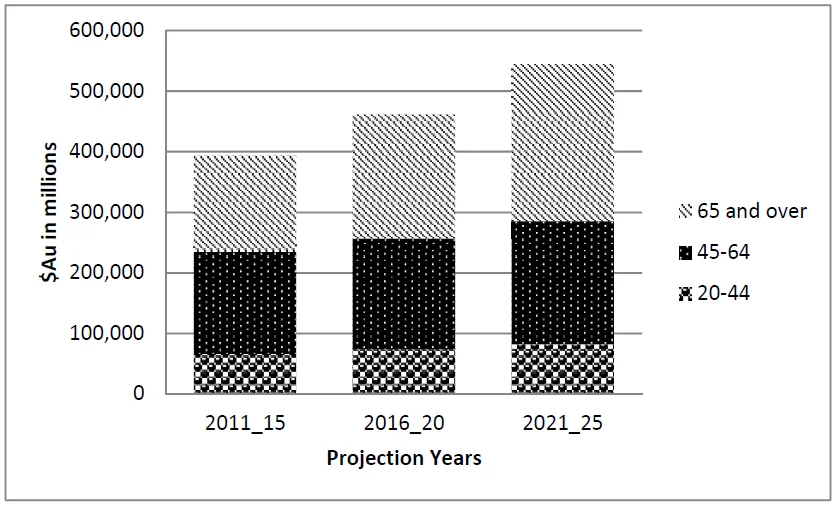
This article contains 2 figures and 8 tables.
Figures
Tables
| Model Module | Variable |
|---|---|
| NCDMod Basefile | |
| Demography | Age
Sex Ethnicity Family type Socio-economic status |
| Chronic Illness | Diabetes
Cardiovascular disease Peripheral vascular disease Arthritis Cancer Asthma Renal failure Depression Dementia |
| Risk Factors | BMI category
Reported high cholesterol Reported high blood pressure Reported high blood sugar Smoking status Alcohol consumption Physical activity level |
| Population Projection | |
| Demographics | Age
Sex |
| Health Risk Factor and Disease Transition Modelling | |
| Risk Factors | BMI
Total cholesterol Systolic blood pressure Smoking status |
| Chronic Illness | Diabetes incidence
Heart disease events Stroke events |
| Mortality | CVD deaths |
| Outcomes | |
| Health Outcomes | YLL (Years of life lost)
DALY |
| Expenditure | Intervention costs
Health System costs |
| Scenario Comparator | ICER (Incremental cost effectiveness ratio) |
| 2010 Baseline Characteristics | Gender | ||
|---|---|---|---|
| Obese | |||
| Male (%) | Female (%) | Total (%) | |
| BMI < 30 kg/m2 | 72.0 | 73.6 | 72.8 |
| BMI ≥ 30 kg/m2 | 28.0 | 26.4 | 27.2 |
| Known T2DM | |||
| Known T2DM | 5.7 | 6.7 | 6.3 |
| Not | 94.3 | 93.3 | 93.7 |
| Ever had a heart attack | |||
| Yes | 3.3 | 1.4 | 2.3 |
| No | 96.7 | 98.6 | 97.7 |
| Ever had a stroke | |||
| Yes | 1.6 | 1.4 | 1.5 |
| No | 98.4 | 98.6 | 98.5 |
| Overall | 100.0 | 100.0 | 100.0 |
| Total Population (in thousands) | 8,194 | 8,764 | 16,958 |
Source: NCDMod version June 2016.
Notes: BMI = Body mass index; T2DM = Type 2 diabetes mellitus.
| Baseline Distribution | Gender | ||
|---|---|---|---|
| Male | Female | Total Population | |
| Age 2010 (in years) | |||
| Mean | 46.5 | 48.7 | 47.6 |
| Median | 45.0 | 47.0 | 46.0 |
| Standard Deviation | 77.29 | 82.10 | 79.97 |
| BMI2010 (kg/m2) | |||
| Mean | 27.9 | 26.9 | 26.4 |
| Median | 27.1 | 25.4 | 26.4 |
| Standard Deviation | 25.91 | 29.02 | 27.65 |
| Systolic Blood Pressure 2010 (mmHg) | |||
| Mean | 130.0 | 127.4 | 128.7 |
| Median | 125.8 | 121.0 | 123.7 |
| Standard Deviation | 56.86 | 74.51 | 66.84 |
| Total Cholesterol 2010 (mmol/L) | |||
| Mean | 5.5 | 5.6 | 5.6 |
| Median | 5.4 | 5.5 | 5.4 |
| Standard Deviation | 2.66 | 2.53 | 2.60 |
Source: NCDMod version June 2016.
Notes: BMI = Body mass index.
| Population Characteristics | NCDMod | AHS | % Difference |
| % 65 years and over | 19.4 | 17.8 | 9.0 |
| % male | 48.3 | 49.4 | -2.2 |
| % type 2 diabetes (self-reported) | 6.3 | 5.8 | 8.6 |
| % obese (BMI ≥ 30 kg/m2) | 27.2 | 28.8 | -5.6 |
| Population Size | 16,957,458 | 16,393,424 | 3.4 |
Source: NCDMod version June 2016.
Notes: BMI = Body mass index; AHS = Australian Health Survey 2011.
| Outcome | 2010 | 2015 | 2020 | 2025 |
| BMI (kg/m2) | ||||
| Total | 27.4 | 28.1 | 28.7 | 29.4 |
| Female | 26.9 | 27.7 | 28.4 | 29.2 |
| Male | 27.9 | 28.5 | 29.0 | 29.7 |
| SBP (mmHg) | ||||
| Total | 128.7 | 130.3 | 130.9 | 131.9 |
| Female | 127.4 | 129.0 | 129.9 | 131.2 |
| Male | 130.0 | 131.6 | 132.0 | 132.7 |
| Total Cholesetrol (mmol/L) | ||||
| Total | 5.6 | 5.6 | 5.5 | 5.4 |
| Female | 5.6 | 5.6 | 5.5 | 5.5 |
| Male | 5.5 | 5.5 | 5.5 | 5.4 |
Source: NCDMod version June 2016.
Notes: BMI = Body mass index; SBP = systolic blood pressure.
| Variable | 2011–2015 | 2016–2020 | 2021–2025 |
|---|---|---|---|
| New Known Type 2 Diabetes | 261,496 | 288,503 | 325,301 |
| CVD Events (excl. CVD deaths) | 461,566 | 600,715 | 697,050 |
| Years Lived in Disability | 1,380,228 | 1,826,728 | 2,085,673 |
| CVD Deaths | 258,948 | 378,091 | 445,225 |
| Years of Life Lost | 2,527,629 | 3,276,962 | 3,669,757 |
| New Known Type 2 Diabetes Rate (per 100,000 population) | 287.6 | 285.0 | 296.3 |
| CVD Events (excl. CVD deaths) Rate (per 100,000 population) | 507.6 | 593.4 | 635.0 |
| CVD Deaths Rate (per 100,000 population) | 284.8 | 373.5 | 405.6 |
Source: NCDMod version June 2016.
Notes: CVD = cardiovascular disease.
| Population Characterstics | NCDMod 2015 | NHS 2014/15 | Absolute % point difference | %Difference |
|---|---|---|---|---|
| % Ever Smoke | 20.9 | 17.4 | 3.5 | 20.1 |
| % Obese (BMI ≥ 30 kg/m2) | 26.1 | 27.9 | 1.8 | -6.5 |
| % High Blood Pressure | 18.4 | 21.5 | 3.1 | -14.4 |
| % High Total Cholesterol | 34.3 | 32.8 | 1.5 | 4.6 |
| % T2DM | 5.5 | 5.1 | 0.4 | 7.8 |
| % CVD prevalence | 3.2 | 5.2 | 2.0 | -38.5 |
Source: NCDMod version June 2016 and ABS NHS 2014/15 (Australian Bureau of Statistics, 2015b).
Notes: Adults aged 18 years and over, aligning with ABS definitions used in reporting. T2DM = Type 2 diabetes mellitus. CVD = Cardiovascular disease.
| Model Element | HealthAgeingMod | NCDMod | ||
|---|---|---|---|---|
| Basefile | NHS 2005 | NHS 2005 | ||
| Cloning of Records | No | Yes | ||
| Number of records in basefile | Approximately 26,000 records | Approximately 1.15 million records | ||
| Basefile reweighting | No | SAS macro GREGWT (Bell, 2000) was used to reweight the basefile to 2010 based on benchmarks of ABS ERP 2010 in 5-year age group-sex numbers; ABS 2011 in 5- year age group-diabetes numbers, 5-year age group- obesity numbers, 5- year age group high blood pressure numbers and 5- year age group-smoker numbers. | ||
| Projection reweighting | Reweighted 2005 to 2010 using ABS population projections series B(Australian Bureau of Statistics, 2008) routinely. | Reweighted 2010 to 2015, 2020 and 2025 using ABS population projections series B (Australian Bureau of Statistics, 2013b) routinely. | ||
| Alignment | Alignment of CVD deaths according to the trend of ABS causes of death data 2000–2006, such that in 2005 there were approximately 35,000 CVD deaths (Walker et al., 2013) | Alignment of number obese by age-sex groups in 2015 using GREGWT and benchmarks from 2014/15 ABS NHS data. | ||
| Age: imputation of single years | Monte Carlo simulation with allocation across each single year within the 5 year age group, with 20% going into each year | Monte Carlo simulation by gender, with allocation across each year within the 5 year age group based on ABS ERP 2010 as the distribution of age within 5 year group. | ||
| Imputation of parental history of diabetes | No | Allocated by Monte Carlo simulation. Age based probability from AUSDIAB00. | ||
| Ethnicity | Based on NHS05 country of birth variable made binary Australian born or not. Additional flag of ethnicity to mark “Southern European, Asian, ATSI” is a random allocation of 0.33 those not “Australian born”. | |||
| Education level | Binary variable – post school or not based on NHS05 education data | Same as HealthAgeingMod. | ||
| BMI: imputation of continuous values | Imputed randomly using uniform distribution with 8 BMI bands on NHS05 | Same as HealthAgeingMod. | ||
| BMI transition | Models BMI at end of 5 year period using OLS: 3.225 – 0.021 * (AGE) -0.135 * HBA1C * HBA1C scale + 1.000 * BMIvalue – 0.005 * SBP – 0.147 * cholesterol + 0.129 * female Based on USDIAB 00–05 | Models BMI change across 5 year period: 2.694 – 0.022 * (aget+1) + 0.151 * sex -0.047 * cholesterol -0.005 *SBP + 0.192 * smoker -0.354 * diab2 -0.092 * ED level
Based on AUSDIAB 00–05. |
||
| Smoking status transition | Nil | Models smoking status at end of 5 year period using logistic regression to determine probability.
If smoker: 1.429 – 0.012 * age10 -0.012 * male +0.092 * EDlevel If non-smoker: 2.116 + 0.056 * age10 -0.010 * male -0.372 * EDlevel Monte Carlo simulation used to allocate state. |
||
| Total cholesterol: impute continuous value | OLS modelling to allocate a total cholesterol value.
If high cholesterol: 5.339 + 0.002 * AGE + 0.012 * BMI value + 0.048 * hba1c Value + 0.003 * BP value -0.008 * ED level If normal cholesterol: 4.038 + 0.005 * AGE + 0.012 * BMI value -0.036 * hba1c Value + 0.002 * BP value -0.037 * Exercise_3+0.005 * ED level Based on AUSDIAB 2000. |
If self-reported high cholesterol:
Exp(1.635 – 0.0026*male + 0.003 * age + 0.007 * BMI value -0.0001 * BMIvalue2 + 0.007 * smoke + 0.015 * HB -0.003 * diabetes). If not self-reported high cholesterol: Exp(1.262 + -0.028*male + 0.001 *age + 0*age2 + 0.023 * BMI value -0.0003 * BMI value2 + 0.032 * smoke + 0.039 * High BP -0.206 * diabetes) Based on AHS2011 data. |
||
| HDL Cholesterol: impute continuous value | No | Modelled using OLS with exponential transformation: Exp(0.599 + 0.001*age – 0.088 * male -0.074 * smoker + 0.033 * e3 -0.016 * BMI value + 0.036 * Cholesetrol value + 0.040 * male_smoke – 0.004*male_bmi). | ||
| Systolic blood pressure: impute continuous variable | If High BP: 128.185+0.346*AGE + 1.007*female + 0.139*BMI value+1.665*E1
If normal BP: 99.183+0.212*AGE-5.521*female+0.582*BMI value+1.153*Hi Cholesterol – 0.749*Exercise_2-1.093*SMOK- 0.071*ED level Based on AUSDIAB 2000. |
Same as HealthAgeingMod. | ||
| Systolic blood pressure transition | Model SBP at end of 5 year period: 23.551 + 0.201*(AGE)+0.437*BMI value * BMI scale +0.618 *BP value * BP scale – 2.703 * female
Based on AUSDIAB 00–05. |
Annual change in SBP modelled as:
If aged less than 35 years there is no change. If female aged 35 and over: 35–45 years. :2.445+0.107*(SBP -117.891 45–55 years : 2.278 +0.039*(SBP -127.312) 55–65 years :2.052+- 0.003*(SBP -137.656); 65y.o.+ : 2.296 + 0.024*(SBP -125.177); If male aged 35 and over: 35–45 years: 1.321 + 0.015*(SBP -124.825); 45–55 years: 1.1915 + 0.064*(SBP -127.948); 55–65 years: 2.860 + 0.058*(SBP -128.675); 65 years + : 1.85 + 0.048*(SBP-126.722); Based on Wu et al. (1980). If on antihypertensive medication then SBP remains unchanged. |
||
| Systolic blood pressure medication | Nil | If SBP greater than 160 allocated to start antihypertensives. | ||
| Diabetes duration | Allocated such that:
If 35<=AGE<55 then duration is 7.5 years If 55<=AGE<65 then duration is 10 years if aged 65 years and over then duration is 15 years |
Same as HealthAgeingMod. | ||
| Impute has undiagnosed diabetes | Monte Carlo simulation amongst those without diabetes
Probability based on logistic regression model: -29.242+0.038*AGE-0.073*female+3.783*hba1c Value+0.030*BMI value +0.021*BP value-0.048*Hi Cholesterol -0.164*E1- 0.143*Exercise_2-(-0.164- 0.143)*Exercise_3 – 0.057*SMOK+0.070*ED level |
Same as HealthAgeingMod. | ||
| Transition to self- reported diabetes | Logistic regression model: – 23.200 – 0.020*(AGE) +0.835*female + 3.344*hba1c + 0.041*BMI + 0.011*SBP +0.403*SMOK
Based on AUSDIAB Same as HealthAgeingMod. |
|||
| Transition to known diabetes | Logistic regression model: – 28.826 + 3.887 * hba1c + 0.078 * BMI + 0.015 * SBP Based on AUSDIAB | Random effects model of probability develop known diabetes across 5 year period:
-9.429 -0.063 * age10 – 0.717 * sex + 0.022 * BMI + 0.015 * SBP -0.449 * ed level – 0.657 * ethnic + 0.092 * previous Hx Diab – 0.344 * total cholesterol + 0.005 * age * bmi + 0.841* sex * previous Hx Diab Based on AUSDIAB00-05-11. |
||
| Year diabetes commenced | Random allocation so 50% in year 2 and 50% in year 4 of five year transition period. | Random allocation into single years across the 5 year period. | ||
| Impute has IFG | Monte Carlo simulation amongst those without diabetes or undiagnosed diabetes.
Probability based on logistic regression model : -15.915 + 0.017*AGE-0.947 * female + 2.172 * hba1c Value + 0.063 * BMI value -0.003 * BP value – 0.111 * Hi Cholesterol – 0.027 * Exercise_1 + 0.064 * Exercise_2-(-0.027+0.064) * Exercise_3 -0.109 * SMOK + 0.038 * ED level |
Same as HealthAgeingMod. | ||
| Impute pre-diabetes IGT | ||||
| Monte Carlo simulation amongst those without diabetes or undiagnosed diabetes.
Probability based on logistic regression model : -16.650 + 0.029 * AGE + 0.308 * female + 1.924 * hba1c Value + 0.050 * BMI value + 0.014 * BP value – 0.031 * Hi Cholesertol-0.094 * Exercise_1 – 0.087 * Exercise_2-(- 0.094 * E1 – 0.087) * Exercise_3 – 0.065 * SMOK -0.138 * ED level |
Same as HealthAgeingMod. | |||
| Life expectancy to calculate YLL | By gender single years based on Australian Government Actuary Life Tables 2005–07 | By gender single years based on ABS life tables 2010–12. | ||
| HbA1c impute continuous value | If has self-reported high sugar model hba1c Value = 7.172 -0.0235* AGE + 0.013 * BP value – 0.408 *
Hi Cholesterol If self-report not having high sugar levels then hba1c Value = 4.455 + 0.007 * AGE -0.070 * female + 0.0113 * BMI value +0.0003 * BP value + 0.032 * Hi Cholesterol + 0.035 * Exercise_1 + 0.029 * Exercise_2 + 0.013 * SMOK -0.004. |
Same as HealthAgeingMod. | ||
| HbA1c transition | OLS to calculate the new HbA1c value at the end of 5 year projection 1.545 + 0.002 * (AGE in 2010) + 0.691 * HBA1C value + 0.008 * BMI value
Based on AUSDIAB 00–05. |
Same as HealthAgeingMod. | ||
| Impute Left Ventricular Hypertrophy (LVH) status | Nil | Logistic regression model to model probability: -7.167 + 0.054 * age + 6.043 * male -0.156 * BMI value + 0.027 * BP value- 0.075 * male_age Based on AUSDIAB 05. Monte Carlo simulation to allocate condition. | ||
| CVA incidence | Logistics regression model: -9.550 + 0.050 * AGE + 0.027 * BMIvalue
Based on AUSDIAB 00–05. Monte Carlo allocation of events. |
Non-proportional hazards Weibull accelerated failure time model to calculate probability of CVA event: 26.512 + 0.202 * female – 2.374 * log(age) -2.464 * log(SBP) – 0.391 * SMOK -0.023 * log(total chol/HDL) -0.309 * diab2 – 0.263 * female * Diab2 – 0.236 * LVH
Based on Framingham ( Anderson et al., 1991). Monte Carlo simulation to allocate event |
||
| Allocate year of CVA incident | Random allocation so 50% in year 2 and 50% in year 4 of five year transition period. | Random allocation into single years across the 5 year period | ||
| Heart disease incidents | Probability of event in 5 year period using logistic regression model: -10.021 + 0.046 * AGE – 1.031 * female + 0.051 * BMI + 0.016 * SBP – 0.478 * CVD history + 0.346 * ED level Based on AUSDIAB 00–05. Monte Carlo allocation of events | Non-proportional hazards Weibull accelerated failure time model: 11.471 + 10.511 * female – 0.797 * log(age)-5.422 * log(age)*female + 0.710 * log(age)*log(age)*female – 0.662 * log(SBP)- 0.268 * SMOK -0.428 * log(total chol/HDL)-0.153 * diab2 -0.117 * female * diab2 -0.159 * LVH*male;
Based on Framingham (Anderson et al., 1991). Monte Carlo simulation to allocate event |
||
| Allocate year of heart disease event | Random allocation so 50% in year 2 and 50% in year 4 of five year transition period. | Random allocation into single years across the 5 year period | ||
| CVD deaths | Used Anderson (1991) Equation. Adjustment of population weights to reflect total population after these records removed for the next time period due to their “death”. | Used Anderson(1991) Equation to flag those records to reflect the deaths in the 5 year transition period. The records are reused with the population weights to reflect the whole population for the end of transition period | ||
| DALY weights | Used Begg et al. (2007) and Lopez et al. (2006) as Source. | Used GBoD study 2010 (Salomon et al., 2012) as basis of estimates | ||
| Imputation of children’s risk factors i.e. the records that become adults across the projection period | Imputes BMI to new 18+ year olds in proportion to NHS 2005 distribution of BMI categories for 18–19 years. Individual given mid- point for continuous value of BMI Total Cholesterol level allocated as 4.7
HbA1c allocated as 4.8 Systolic blood pressure allocated as 120 |
BMI imputed by gender, allocate BMI category based on distribution of AHS 2011. Then randomly allocated continuous variable using uniform distribution across group BMI band they in which they were allocated. Allocated exercise as 180 minutes for boys and 140 minutes for girls
Used ABS AHS 2011 age 18–34 years with 0.5 prevalence of diabetes to allocate T2 diabetes Future adult education was randomly allocated using probabilities from logistic regression model :-1.347 + 0.033*sex + 0.651 *obese Rest of risk factors as per HealthAgeingMod. |
||
| Annual disease costs | Models the direct health costs associated with diabetes and CVD incidents. Both the cost of diabetes and the cost of CVD were Sourced from the literature. Persons with both diabetes and a CVD event in the time period had the costs added together and given 20% extra cost.
Direct health costs based on if has diabetes and/or CVD. Costs Sources mainly from Clarke et al. (2008) 0.20 factor added to those with both CVD and diabetes. |
Based on AUSDIAB 05 for health service usage and costs based on MBS, PBS and AIHW hospital costs data. The equation was estimated using a linear regression model. The predictive variables included were: BMI, diabetes status and CVD status. This method provides a cost across the complete Australian population, calculating individual annual health system costs: 7599.91 + 3112.04*diab2 + 9330.60*CVD – 1830.25*BMI_normal – 1456.55*BMI_overweight – 4762.96 * age25 -3141.65 * age45 | ||
| Language/software used to write the code and run the scenarios SAS v9.2 | SAS v9.4 |