Cite as: G. Ballot, G. Eliasson, E. Taymaz; 2024; The Role of Commercialization Competence in Endogenous Economic Growth; International Journal of Microsimulation; 17(2); 297–323. doi: 10.34196/ijm.00300
Abstract
While innovation supply is creative, unpredictable, and not necessarily related to future economic usefulness, resource provision is focused on economic returns, experience based and narrower, implying a positive economic risk of not understanding innovative commercial winners. We demonstrate through simulation experiments on an economy wide firm-based model that industrial growth is explained by industrially competent identification and financial support of winners that are carried on to industrial scale production and distribution. The simulations capture the dynamic economic systems effects on the entire economy, from micro responses to macro and the feedback on micro behaviour of expectational mistakes. Competence bloc theory is used to model the supply of innovations and their commercialization in what we call an Experimentally Organized Economy. We demonstrate that lack of commercialization competence, notably industrial competence embodied in venture capitalists´ ability to identify, select and finance radically new innovations breaks the conventionally assumed linearity between innovation supply and economic growth. We also demonstrate the existence of long-term and possibly very large losses in output from the loss of winners during the commercial filtering of the competence bloc, and that the economy wide costs incurred by protecting losers may be large.
This article contains 1 figure and 2 tables.
Figures
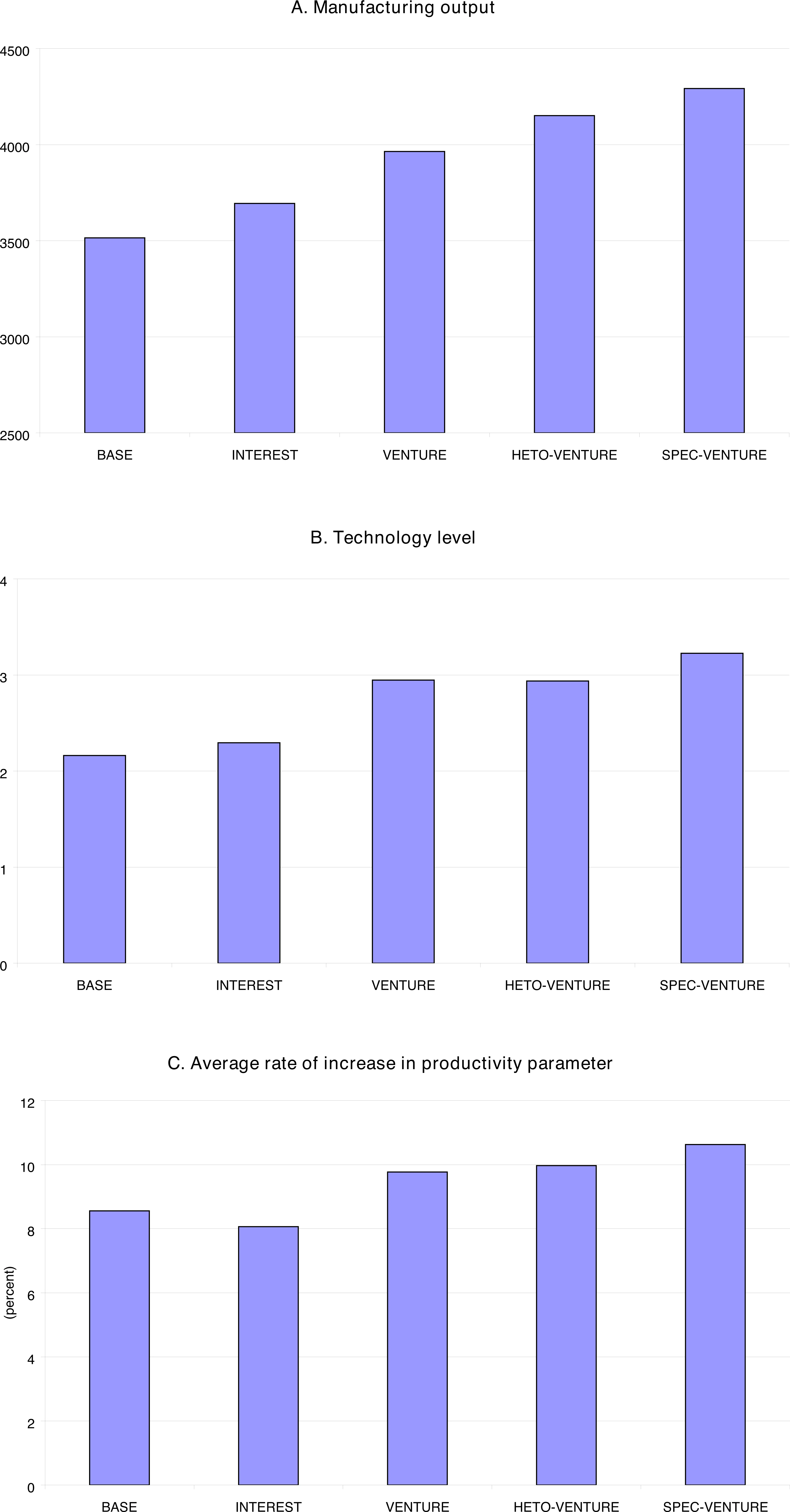
Figure 1. Simulation Results (end of period average values for 50 runs).
Tables
Table 1. (A) The two types of economic mistakes. (B) Actors in the competence bloc.
The two types of economic mistakes
Type I: Losers kept too long
Type II: Winners lost
Actors in the competence bloc
1. Competent and active customers
Innovation Supply
2. Innovators who integrate technologies in new ways
Markets for innovation and commercializing intermediaries
3. Entrepreneurs who identify profitable innovations
4. Competent venture capitalists who recognize and finance the entrepreneurs
5. Exit markets that facilitate ownership change
6. Industrialists who take successful innovations to industrial scale production
Source:Eliasson (1995), “The Economics of Technical Change: The macroeconomic Consequences of Business Competence in an Experimentally Organized Economy”, Revue D’economie Industrielle: Developpements Recent, Numero Exceptionell, 1995:53-82.