
This article contains 7 figures and 10 tables.
Figures
Tables
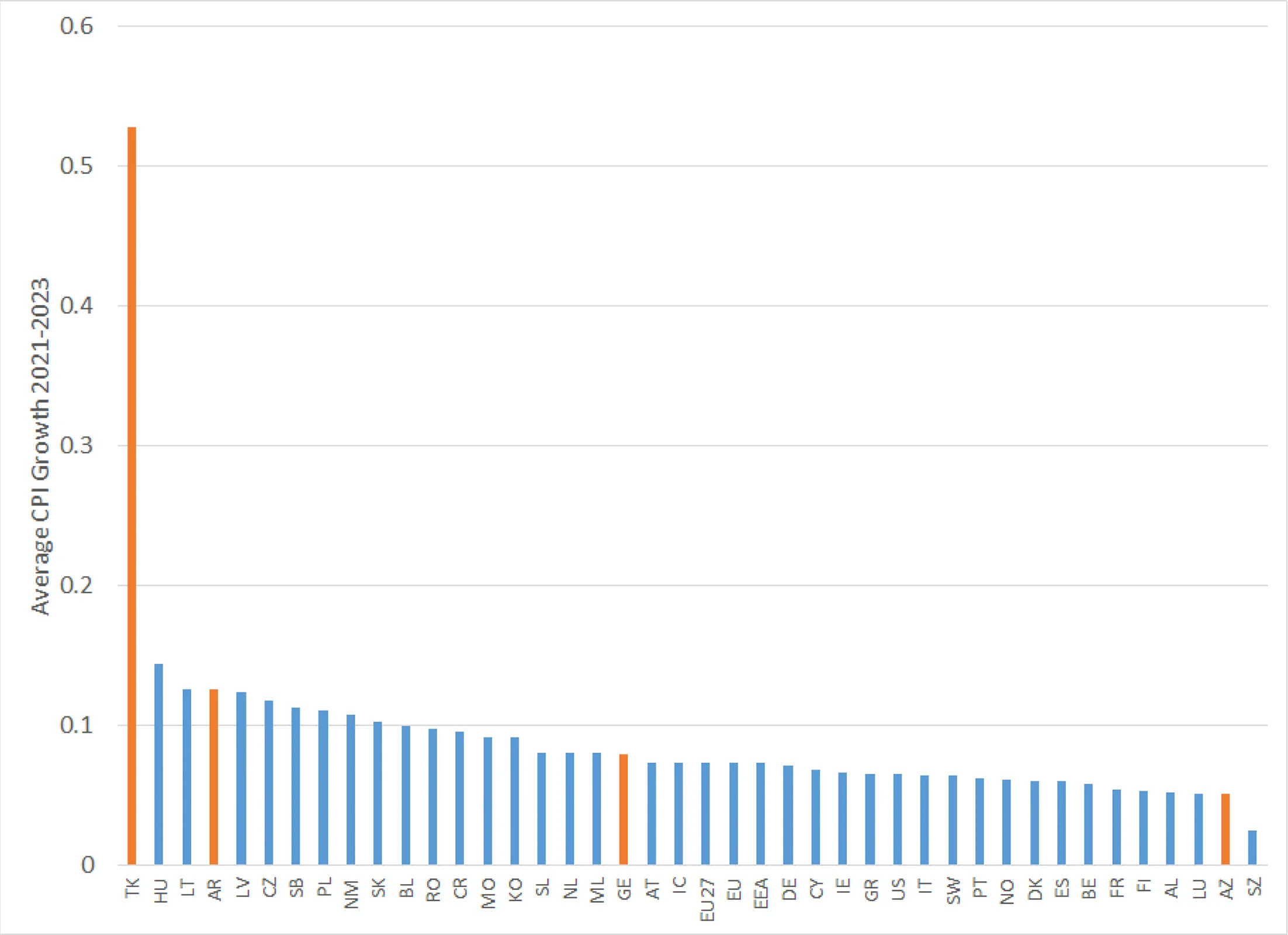
| 1996-1999 | 2000-2004 | 2005-2009 | 2010-2014 | 2015-2020 | 2021-2023 | |
|---|---|---|---|---|---|---|
| Turkey | 0.737 | 0.308 | 0.083 | 0.073 | 0.124 | 0.528 |
| Armenia | 0.056 | 0.031 | 0.039 | 0.038 | 0.007 | 0.056 |
| Azerbaijan | 0.118 | 0.037 | 0.062 | 0.058 | ||
| Georgia | 0.017 | 0.018 | 0.015 | 0.053 | ||
| EU | 0.016 | 0.021 | 0.023 | 0.019 | 0.013 | 0.073 |
| Turkey Rank | 1 | 1 | 2 | 1 | 1 | 1 |
Source: Eurostat, IMF.
| Expenditure Category | AR | GE | TR | |||
|---|---|---|---|---|---|---|
| Budget | Price | Budget | Price | Budget | Price | |
| Food and Non-alcoholic beverages | 0.699 | -0.799 | 0.941 | -0.671 | 0.626 | -0.455 |
| Alcoholic Beverages | 0.848 | -0.873 | 1.798 | -1.007 | 0.517 | -0.309 |
| Tobacco | 0.451 | -0.468 | 0.372 | -0.263 | 0.098 | -0.060 |
| Clothing and Footwear | 0.954 | -0.983 | 0.365 | -0.213 | 0.876 | -0.530 |
| Home fuels | 1.573 | -1.569 | 0.699 | -0.398 | 1.521 | -0.912 |
| Electricity | 1.008 | -1.037 | 0.677 | -0.346 | 0.880 | -0.531 |
| Rents | 0.274 | -0.289 | 1.154 | -0.652 | 0.250 | -0.162 |
| Household services | 1.580 | -1.585 | 0.983 | -0.558 | 1.611 | -0.963 |
| Health | 1.182 | -1.212 | 0.983 | -0.592 | 1.015 | -0.616 |
| Private transport | 1.514 | -1.522 | 1.800 | -1.009 | 1.367 | -0.828 |
| Public Transport | 0.913 | -0.942 | 0.941 | -0.671 | 0.748 | -0.455 |
| Information & Communication | 0.969 | -0.998 | 1.798 | -1.007 | 0.881 | -0.535 |
| Recreation and culture | 1.369 | -1.350 | 0.372 | -0.263 | 1.270 | -0.790 |
| Education | 1.126 | -1.156 | 0.365 | -0.213 | 0.962 | -0.585 |
| Restaurants and hotels | 0.873 | -0.903 | 0.699 | -0.398 | 0.776 | -0.484 |
| Other goods and services | 1.159 | -1.167 | 0.590 | -0.346 | 1.055 | -0.677 |
| Childcare costs | . | . | 1.154 | -0.652 | . | . |
| Motor fuels | 1.008 | -1.037 | 0.983 | -0.558 | 0.599 | -0.363 |
| Durables | 0.858 | -0.886 | 0.983 | -0.592 | 1.208 | -0.763 |
| COICOP Heading | Expenditure item | HCPI Price change (in %) | ||
|---|---|---|---|---|
| AR | GE | TR | ||
| All-items HICP | 16.94 | 23.1 | 123.5 | |
| CP01 | Food and non-alcoholic beverages | 24.17 | 32.6 | 155.7 |
| CP02 | Alcoholic beverages and tobacco | 18.88 | 15.1 | 98.2 |
| CP03 | Clothing and footwear | 20.42 | 2.0 | 51.2 |
| CP04 | Housing, water, electricity, gas and other fuels | 10.21 | 60.3 | 131.3 |
| CP05 | Furnishings, household equipment and routine maintenance of the house | 21.25 | 23.2 | 143.9 |
| CP06 | Health | 6.15 | 2.4 | 100.8 |
| CP07 | Transport | 12.06 | 19.6 | 137.3 |
| CP08 | Communication | 1.51 | -1.0 | 44.2 |
| CP09 | Recreation and culture | 22.78 | 7.9 | 88.1 |
| CP10 | Education | 6.17 | 11.8 | 61.0 |
| CP11 | Restaurants and hotels | 14.72 | 28.5 | 137.3 |
| CP12 | Miscellaneous goods and services | 16.78 | 17.6 | 107.9 |
| AR | GE | TR | AR | GE | TR | |
|---|---|---|---|---|---|---|
| Price Inflation | Share of Total Price inflation | |||||
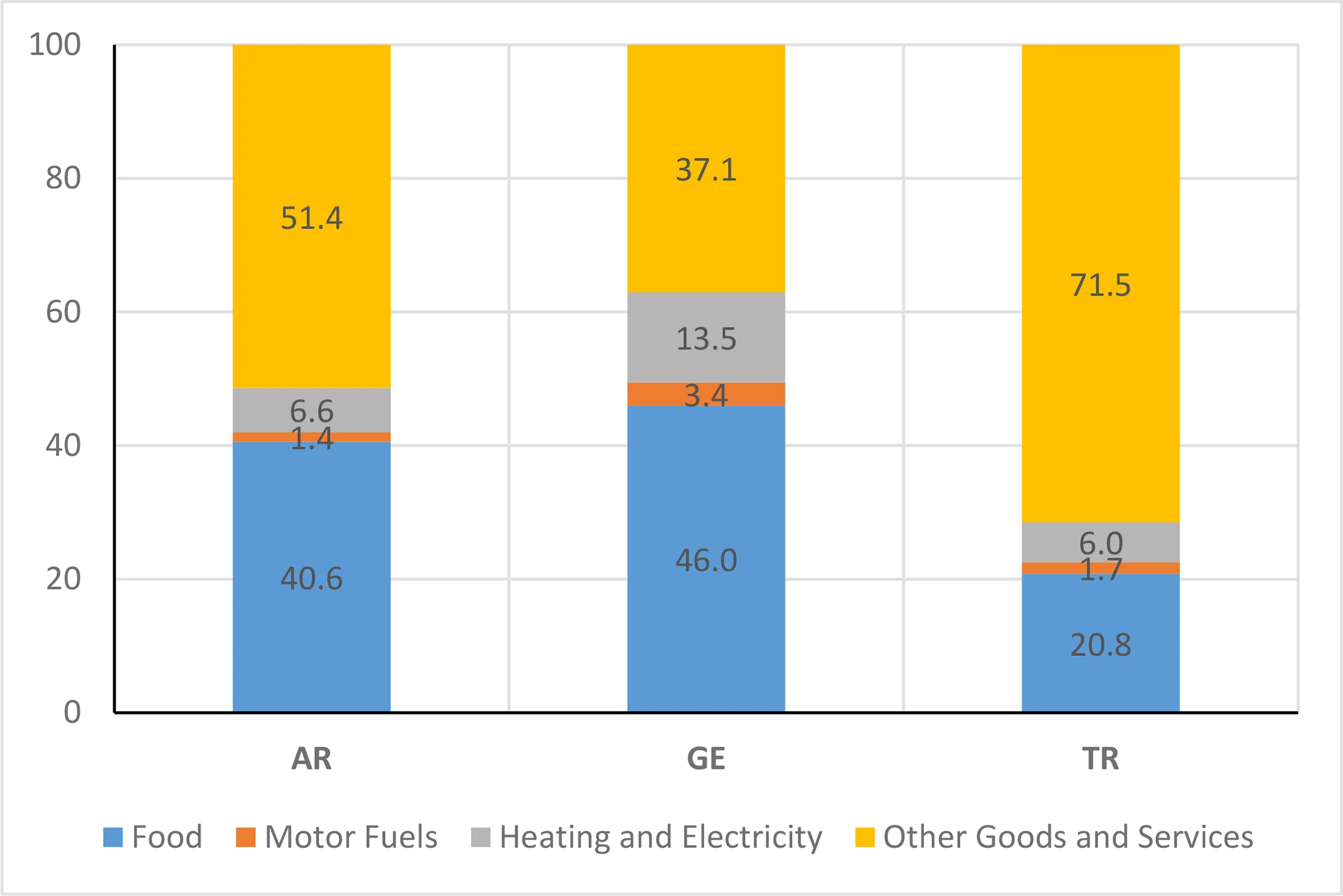
| Food | 16.3 | 10.9 | 46.0 | 0.558 | 0.470 | 0.246 |
| Motor Fuels | 0.2 | 0.7 | 4.2 | 0.006 | 0.029 | 0.022 |
| Heating and Electricity | 0.8 | 3.3 | 15.5 | 0.028 | 0.141 | 0.083 |
| Other Goods and Services | 11.9 | 8.4 | 121.6 | 0.408 | 0.359 | 0.649 |
| Total | 29.2 | 23.3 | 187.3 | |||
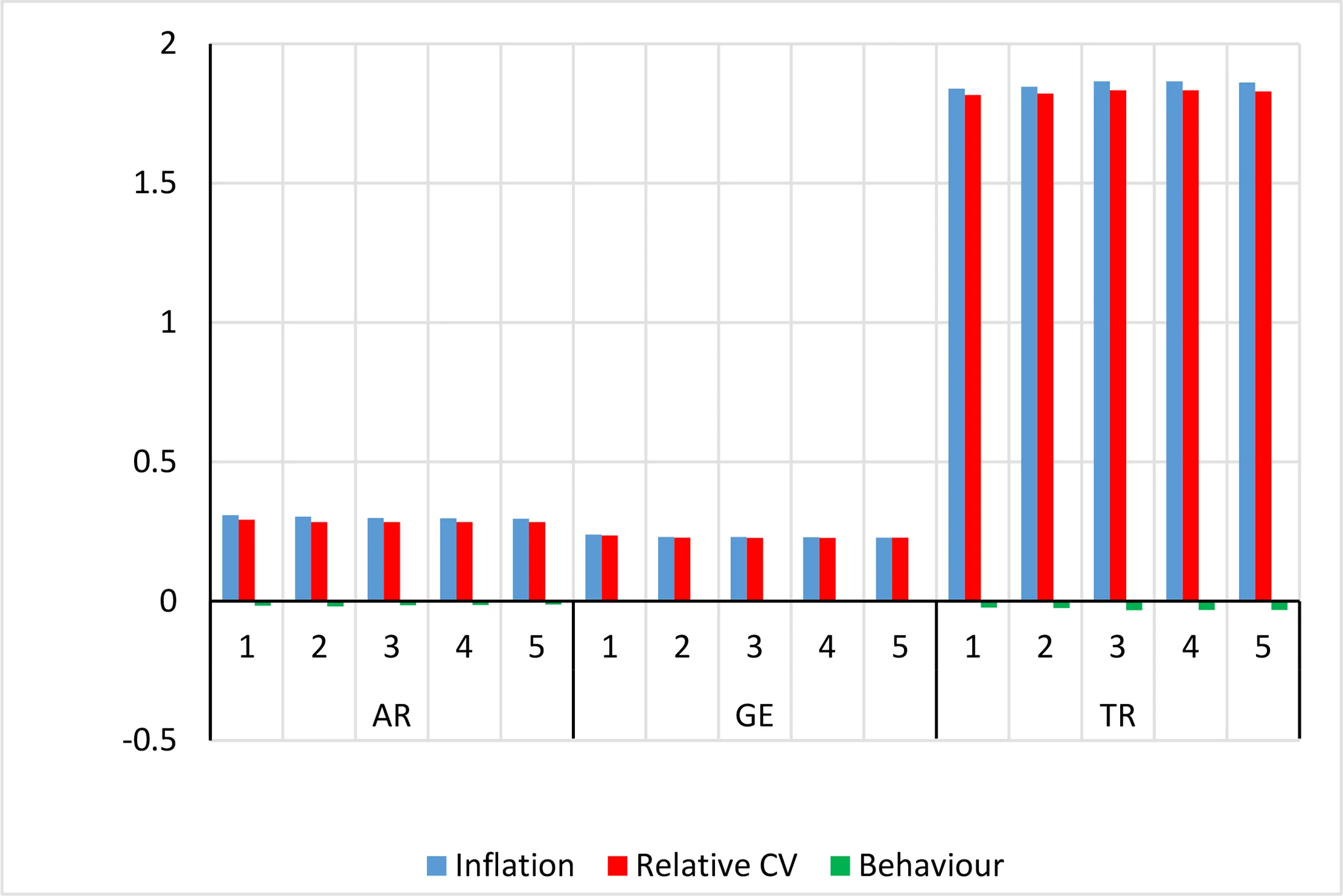
| CI pre-change (X) | Avg. r. | |||||
|---|---|---|---|---|---|---|
| (1) | (2) | (3) | (4) | (5) | (6) | |
| AR | ||||||
| Total Expenditure | 0.139 | 0.133 | 0.138 | -0.001 | -0.005 | 0.292 |
| Food | 0.112 | 0.135 | -0.004 | -0.026 | 0.163 | |
| Motor Fuels | 0.159 | 0.138 | 0.000 | 0.020 | 0.002 | |
| Heating and Electricity | 0.180 | 0.139 | 0.000 | 0.041 | 0.008 | |
| Other Goods and Services | 0.158 | 0.140 | 0.002 | 0.020 | 0.119 | |
| GE | ||||||
| Total Expenditure | 0.212 | 0.202 | 0.211 | -0.002 | -0.010 | 0.229 |
| Food | 0.155 | 0.206 | -0.005 | -0.057 | 0.105 | |
| Motor Fuels | 0.415 | 0.213 | 0.002 | 0.203 | 0.008 | |
| Heating and Electricity | 0.188 | 0.211 | -0.001 | -0.024 | 0.000 | |
| Other Goods and Services | 0.245 | 0.215 | 0.003 | 0.033 | 0.085 | |
| TR | ||||||
| Total Expenditure | 0.170 | 0.171 | 0.175 | 0.001 | 0.001 | 1.873 |
| Food | 0.142 | 0.161 | -0.009 | -0.028 | 0.460 | |
| Motor Fuels | 0.314 | 0.176 | 0.006 | 0.144 | 0.042 | |
| Heating and Electricity | 0.155 | 0.169 | -0.002 | -0.015 | 0.155 | |
| Other Goods and Services | 0.180 | 0.000 | 0.005 | 0.009 | 1.216 |
Note: X = initial expenditure; = concentration index of the cost increase in item i, ; = CI of the increase in total expenditure due to the cost increase in item i, ; = Reynolds-Smolensky and Kakwani of ; r = average inflation rate; RS = (3)-(1); K =(2)-(1).
| Component | Formula | Relative contribution of each component in (%) | ||
|---|---|---|---|---|
| AR: Regressive | GE: Regressive | TR: Progressive | ||
| Food | -0.063 | -0.0150 | -0.0237 | |
| Motor fuels | 0.000 | 0.0070 | -0.0005 | |
| Heating & Electricity | 0.005 | -0.0155 | 0.0104 | |
| Other goods and services | 0.037 | 0.0049 | 0.0208 | |
| Total | -0.20 | -0.0095 | 0.0071 | |
| Atkinson Index (2) | Mean | ||||||||
|---|---|---|---|---|---|---|---|---|---|
| Pre -change | Post -change | Relative change | Pre -change | Post -change | Relative change | Pre -change | Post -change | Relative change | |
| AR | 0.303 | 0.305 | 0.91% | 91625 | 71217 | -22.27% | 63895 | 49467 | -22.58% |
| GE | 0.373 | 0.376 | 0.91% | 735 | 598 | -18.59% | 461 | 373 | -19.04% |
| TR | 0.313 | 0.302 | -3.35% | 7676 | 2740 | -64.31% | 5274 | 1911 | -63.76% |
| AR | AR | AR | AR | AZ | AZ | AZ | AZ | GE | GE | GE | GE | TR | TR | TR | TR | |
|---|---|---|---|---|---|---|---|---|---|---|---|---|---|---|---|---|
| Food | H&E | Transport | Other | Food | H&E | Transport | Other | Food | H&E | Transport | Other | Food | H&E | Transport | Other | |
| 1 | 0.208 | 0.070 | 0.007 | 0.715 | 0.827 | 0.063 | 0.013 | 0.097 | 0.425 | 0.131 | 0.054 | 3.213 | 0.205 | 0.033 | 0.017 | 0.745 |
| 2 | 0.403 | 0.034 | 0.009 | 0.554 | 0.797 | 0.072 | 0.014 | 0.117 | 0.469 | 0.106 | 0.058 | 3.747 | 0.229 | 0.043 | 0.020 | 0.707 |
| 3 | 0.483 | 0.029 | 0.008 | 0.480 | 0.781 | 0.077 | 0.016 | 0.127 | 0.485 | 0.101 | 0.065 | 3.786 | 0.252 | 0.046 | 0.023 | 0.680 |
| 4 | 0.539 | 0.025 | 0.007 | 0.429 | 0.763 | 0.085 | 0.016 | 0.136 | 0.497 | 0.098 | 0.066 | 3.805 | 0.258 | 0.055 | 0.022 | 0.664 |
| 5 | 0.590 | 0.022 | 0.006 | 0.382 | 0.750 | 0.090 | 0.017 | 0.142 | 0.510 | 0.101 | 0.066 | 3.517 | 0.276 | 0.056 | 0.024 | 0.643 |
| 6 | 0.632 | 0.019 | 0.006 | 0.342 | 0.734 | 0.094 | 0.018 | 0.153 | 0.504 | 0.102 | 0.067 | 3.540 | 0.282 | 0.062 | 0.023 | 0.632 |
| 7 | 0.676 | 0.016 | 0.005 | 0.303 | 0.719 | 0.101 | 0.020 | 0.160 | 0.509 | 0.101 | 0.066 | 3.525 | 0.270 | 0.065 | 0.026 | 0.640 |
| 8 | 0.716 | 0.015 | 0.004 | 0.265 | 0.701 | 0.108 | 0.021 | 0.169 | 0.489 | 0.129 | 0.064 | 2.718 | 0.277 | 0.070 | 0.026 | 0.627 |
| 9 | 0.766 | 0.012 | 0.004 | 0.218 | 0.669 | 0.126 | 0.022 | 0.183 | 0.452 | 0.182 | 0.061 | 1.866 | 0.271 | 0.079 | 0.027 | 0.623 |
| 10 | 0.851 | 0.008 | 0.002 | 0.138 | 0.594 | 0.158 | 0.028 | 0.219 | 0.338 | 0.356 | 0.047 | 0.816 | 0.182 | 0.206 | 0.018 | 0.594 |
Note: H&E - Heating and Electricity
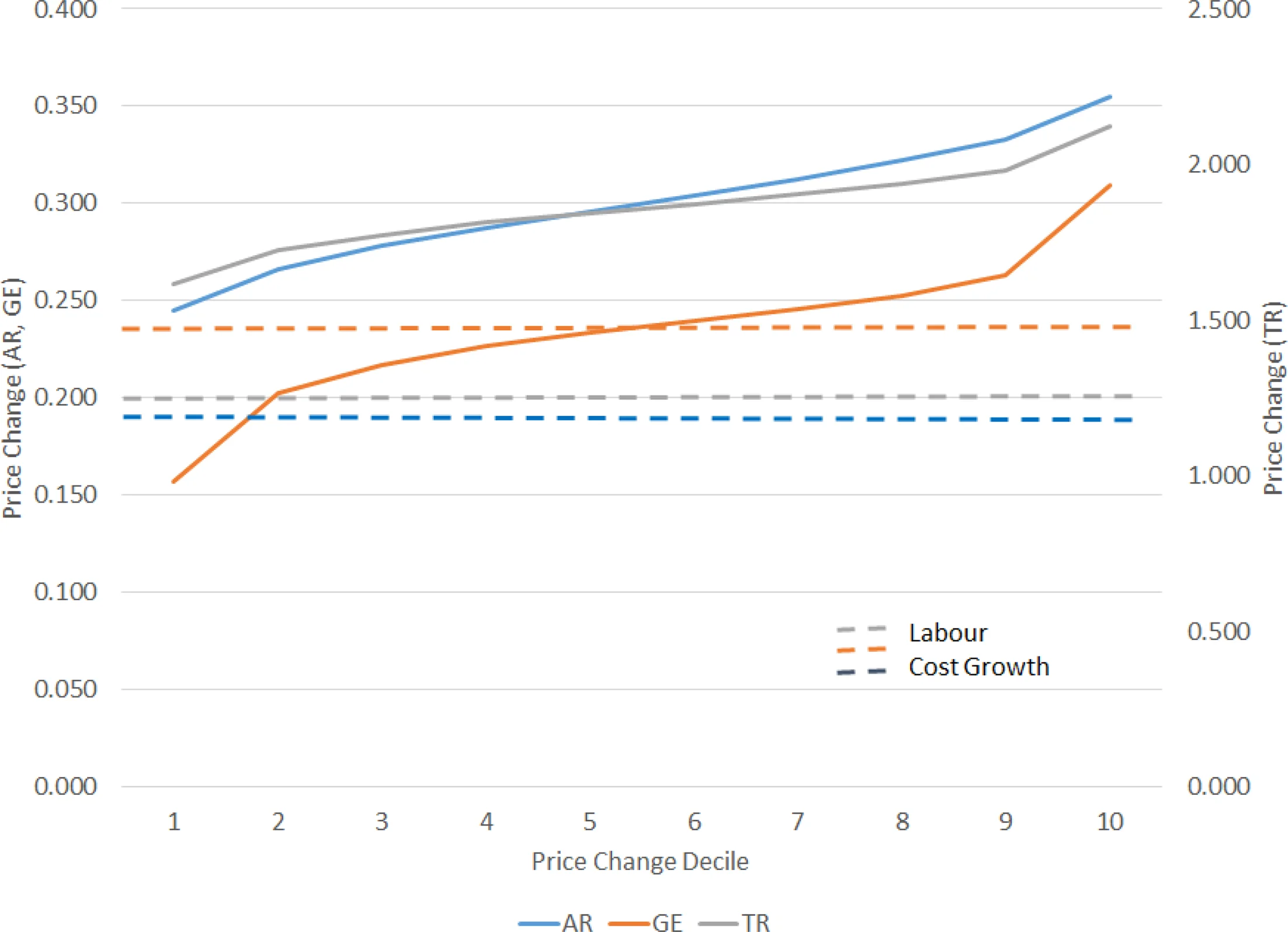
| AR | AZ | GE | TR | |
|---|---|---|---|---|
| 1 | 0.318 | 0.222 | 0.230 | 1.618 |
| 2 | 0.308 | 0.210 | 0.235 | 1.724 |
| 3 | 0.307 | 0.203 | 0.235 | 1.774 |
| 4 | 0.302 | 0.195 | 0.236 | 1.815 |
| 5 | 0.300 | 0.189 | 0.237 | 1.845 |
| 6 | 0.299 | 0.183 | 0.241 | 1.873 |
| 7 | 0.297 | 0.177 | 0.236 | 1.903 |
| 8 | 0.296 | 0.170 | 0.235 | 1.936 |
| 9 | 0.294 | 0.162 | 0.234 | 1.979 |
| 10 | 0.283 | 0.144 | 0.226 | 2.124 |
| Total | 0.301 | 0.186 | 0.235 | 1.873 |
| Labour Cost Growth | 0.240 | 0.187 | 0.210 | 1.240 |
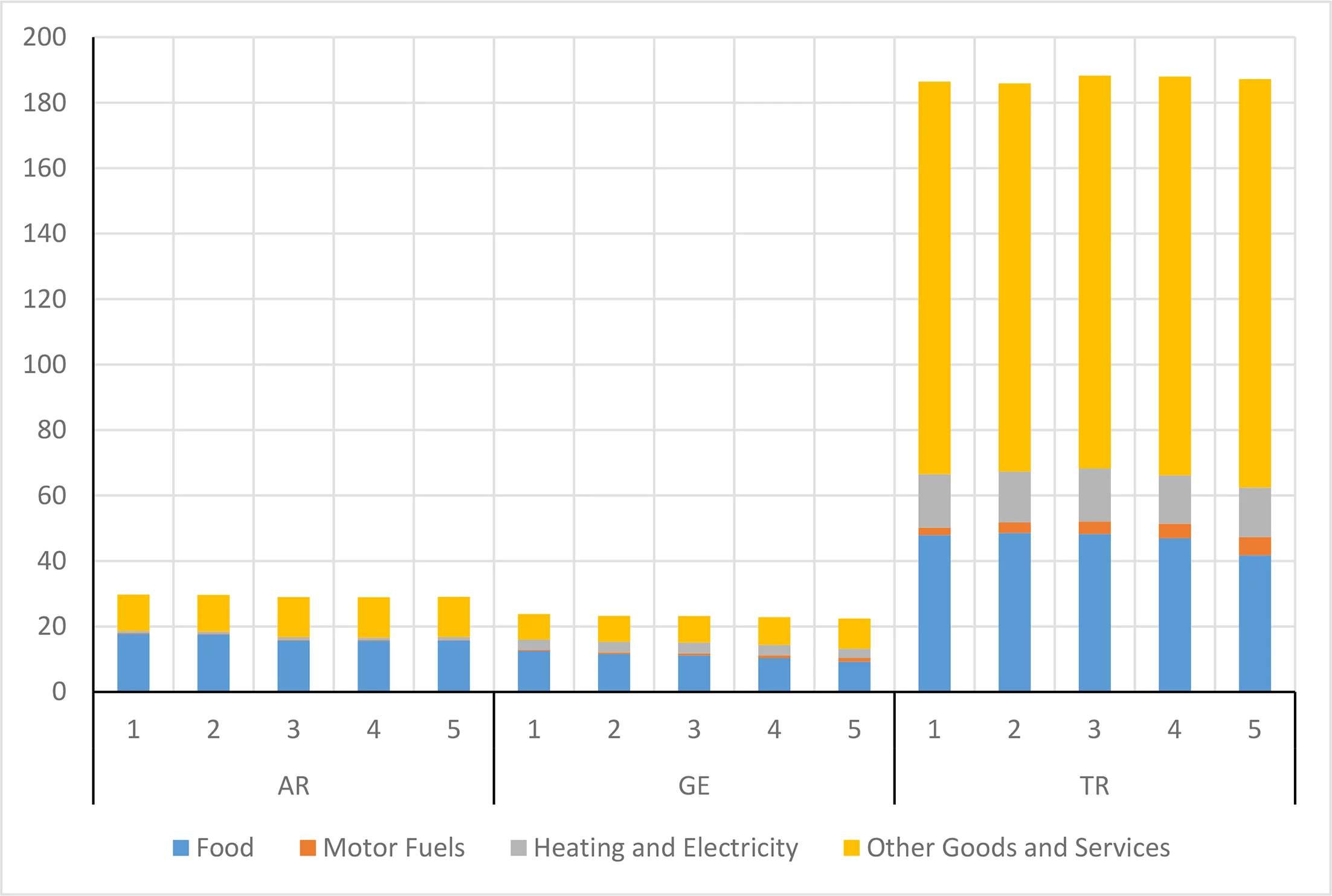
| Denominator | Disposable income | Expenditure | ||||||||
|---|---|---|---|---|---|---|---|---|---|---|
| Quintile | Food | Motor Fuels | Heating and Electricity | Other Goods and Services | Total | Food | Motor Fuels | Heating and Electricity | Other Goods and Services | Total |
| Armenia | ||||||||||
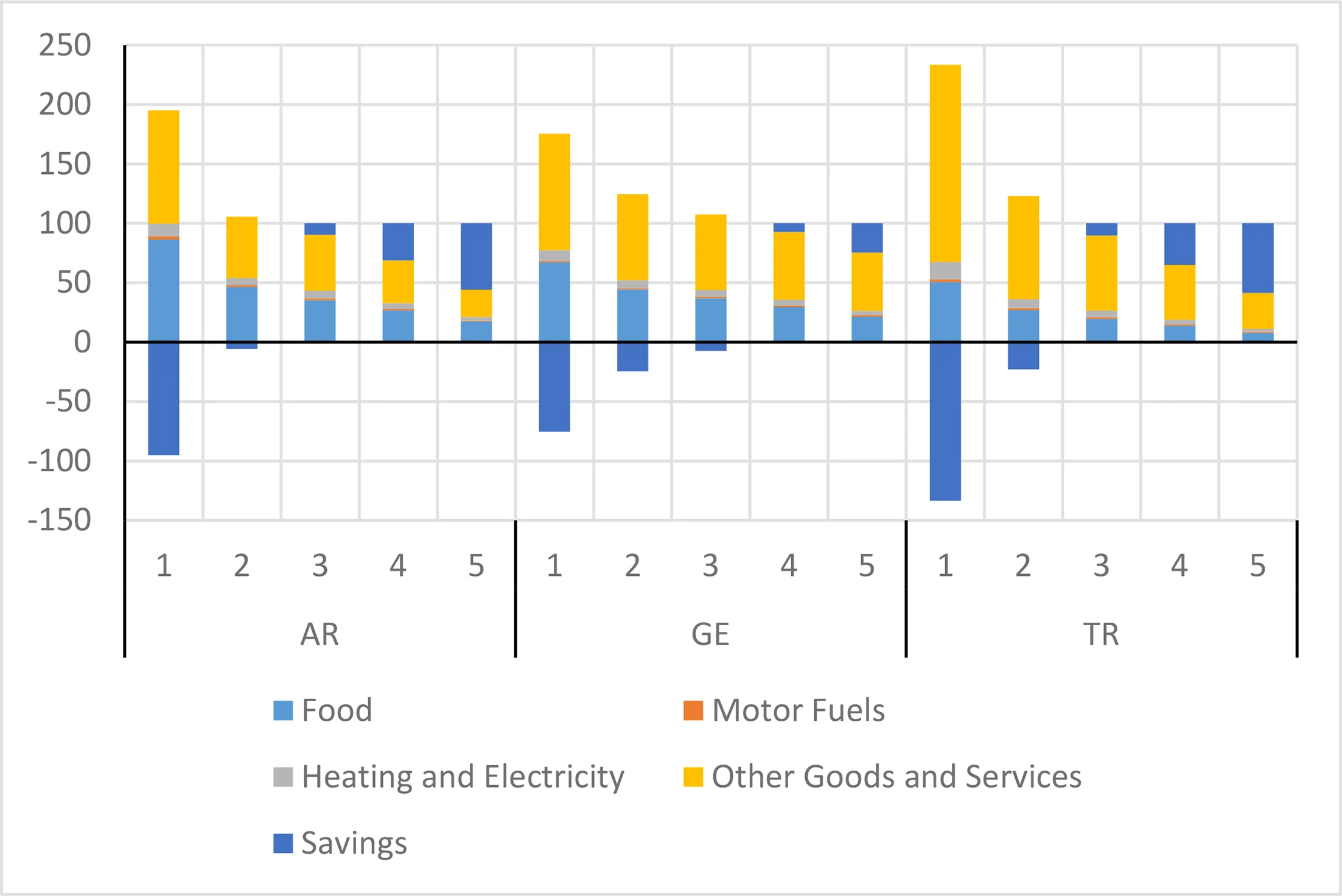
| 1 | 105.4 | 0.8 | 2.9 | 51.5 | 160.5 | 17.8 | 0.2 | 0.7 | 11.1 | 29.8 |
| 2 | 18.5 | 0.2 | 0.7 | 11.3 | 30.7 | 17.6 | 0.2 | 0.7 | 11.1 | 29.6 |
| 3 | 14.1 | 0.2 | 0.8 | 10.6 | 25.6 | 15.7 | 0.2 | 0.9 | 12.2 | 29.0 |
| 4 | 10.8 | 0.1 | 0.6 | 8.2 | 19.7 | 15.6 | 0.2 | 0.9 | 12.3 | 28.9 |
| 5 | 7.8 | 0.1 | 0.4 | 6.0 | 14.3 | 15.8 | 0.2 | 0.9 | 12.2 | 29.0 |
| Georgia | ||||||||||
| 1 | 31.0 | 1.2 | 10.1 | 21.0 | 63.3 | 12.4 | 0.4 | 3.5 | 7.7 | 24.0 |
| 2 | 14.3 | 0.4 | 4.4 | 9.2 | 28.3 | 11.9 | 0.4 | 3.5 | 7.8 | 23.6 |
| 3 | 12.1 | 0.5 | 3.8 | 8.3 | 24.7 | 11.4 | 0.6 | 3.4 | 8.0 | 23.4 |
| 4 | 9.9 | 0.6 | 3.1 | 7.6 | 21.3 | 10.9 | 0.7 | 3.1 | 8.4 | 23.1 |
| 5 | 7.5 | 0.7 | 2.4 | 6.6 | 17.2 | 9.7 | 1.0 | 3.1 | 9.0 | 22.9 |
| Turkey | ||||||||||
| 1 | 293.7 | 17.2 | 109.5 | 690.5 | 1110.8 | 47.9 | 2.3 | 16.3 | 119.9 | 186.4 |
| 2 | 62.5 | 4.4 | 21.7 | 157.7 | 246.4 | 48.6 | 3.2 | 15.5 | 118.6 | 185.9 |
| 3 | 44.4 | 3.8 | 15.7 | 113.5 | 177.4 | 48.2 | 3.8 | 16.2 | 120.0 | 188.3 |
| 4 | 31.2 | 3.2 | 10.2 | 83.5 | 128.0 | 47.0 | 4.4 | 14.8 | 121.8 | 188.0 |
| 5 | 19.3 | 2.6 | 7.2 | 57.4 | 86.5 | 41.7 | 5.6 | 15.1 | 124.8 | 187.2 |
[2] The categorization of countries is based on the World Bank’s classification by per capita income. Hereinafter, the countries with high income are referred as developed countries, while the countries with upper- and lower-middle income are referred as developing countries.