The Distributional Impact of Inflation in Pakistan: A Case Study of a New Price Focused Microsimulation Framework, PRICES
Cathal O’Donoghue, Beenish Amjad, Jules Linden, Nora Lustig, Denisa M Sologon, Yang Wang, Zeynep Gizem Can
University of Galway, Galway, Ireland; CEQ Institute, Tulane University, New Orleans, United States; Luxembourg Institute for Social and Economic Research, Porte des Sciences, Luxembourg
Cite as: C. O’Donoghue, B. Amjad, J. Linden, N. Lustig, D. Sologon, Y. Wang, Z. Gizem Can; 2025; The Distributional Impact of Inflation in Pakistan: A Case Study of a New Price Focused Microsimulation Framework, PRICES; International Journal of Microsimulation; 18(3); 102–131. doi: 10.34196/ijm.00327
Abstract
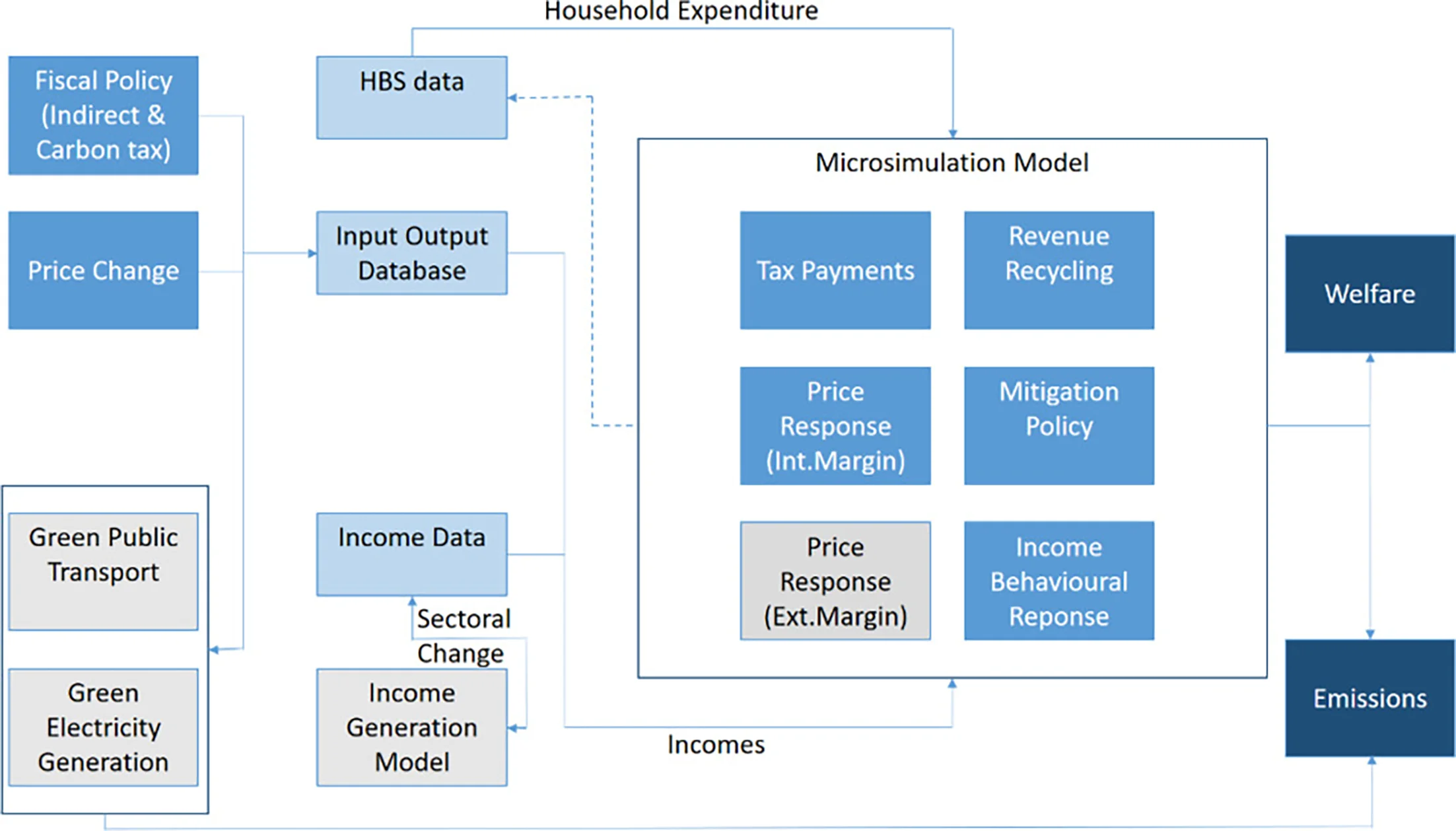
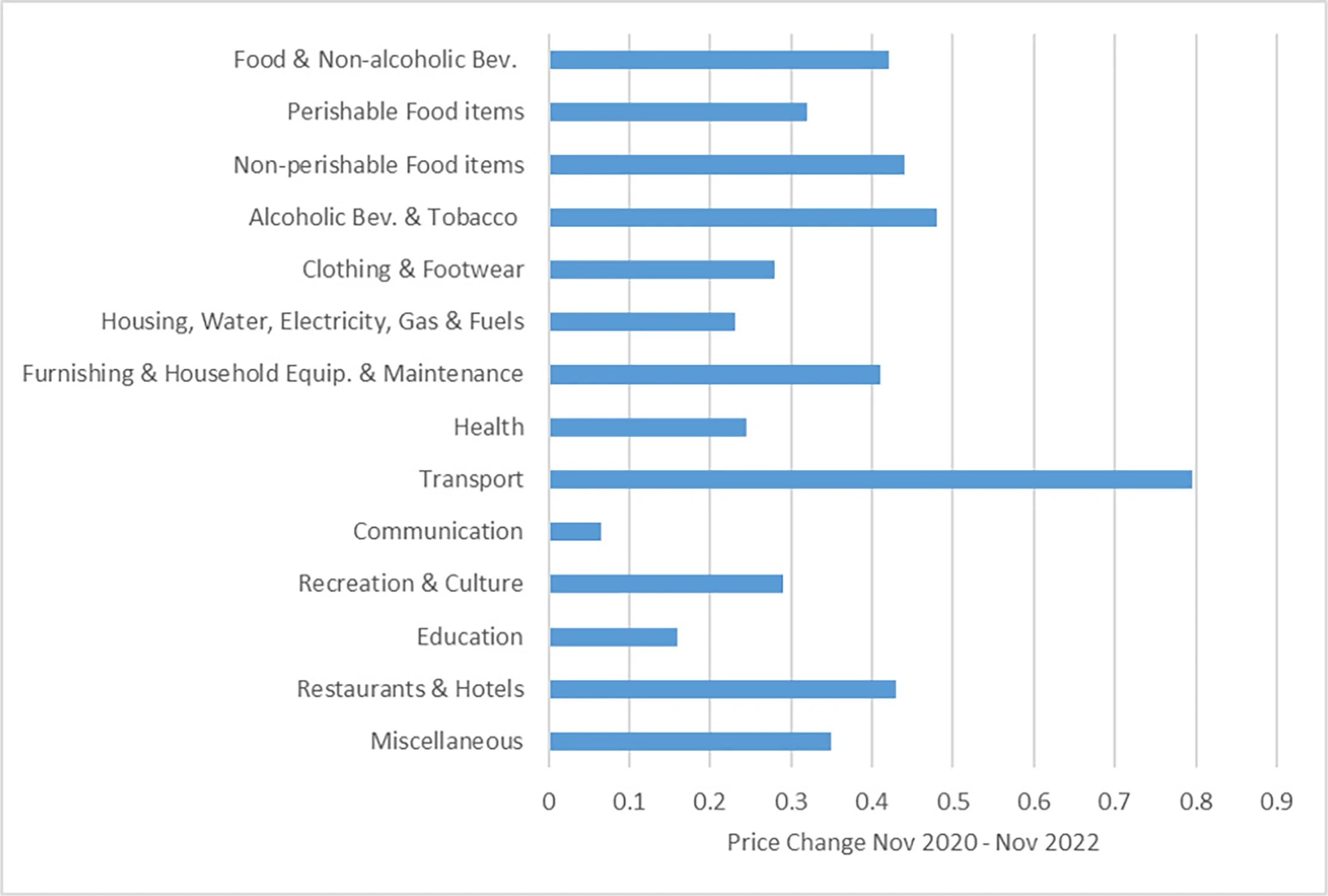
This paper develops a microsimulation model to simulate the distributional impact of price changes using Household Budget Survey data, income survey data, and an Input-Output Model. The primary purpose of this paper is to describe the model components. The secondary purpose is to demonstrate one component of the model by assessing the distributional and welfare impact of recent price changes in Pakistan. Over the period of November 2020 to November 2022, headline inflation in Pakistan was 41.5%, with food and transportation prices increasing most. The analysis shows that despite large increases in energy prices, their importance for the welfare losses is limited because energy budget shares are small. The overall distributional impact of recent price changes is mildly progressive, with significant impacts on household welfare across the expenditure distribution. The biggest driver of welfare losses at the bottom of the expenditure distribution was food price inflation, while inflation in other goods and services was the biggest driver at the top. To compensate households for increased living costs, transfers would need to be on average 40% of pre-inflation expenditure. Behavioural responses to price changes have a negligible impact on the overall welfare cost to households.
This article contains 2 figures and 7 tables.
Figures
Figure 1. Structure of a Price based Microsimulation Model.Figure 2. Expenditure Category specific Price Growth November 2020-November 2022.
Alcoholic beverages and Childcare costs are not included in the Pakistan HBS.
Table 2. Drivers of Inflation by High Level Expenditure Groups.
Budget Share
Average Inflation Rate (in %)
Contribution to total inflation (in %)
Food
0.417
42.89
17.89
Motor Fuels
0.047
79.27
3.74
Domestic Energy and Electricity
0.007
63.65
0.44
Other Goods and Services
0.529
36.61
19.36
Total
1.000
41.43
41.43
Table 3. Budget Shares of expenditure components across equivalised expenditure quintiles (as a share of total expenditure).
Quintile
Food
Motor Fuels
Domestic Energy and Electricity
Other Goods and Services
Relative Expenditure
1
0.511
0.031
0.008
0.450
0.42
2
0.487
0.041
0.007
0.464
0.62
3
0.467
0.043
0.007
0.483
0.82
4
0.444
0.049
0.007
0.500
1.11
5
0.342
0.053
0.006
0.599
2.03
Average
0.450
0.044
0.007
0.499
1.00
Table 4. Budget Shares before and after Inflation without behaviour.
Quintile
Food
Motor Fuels
Domestic Energy and Electricity
Other Goods and Services
Before
After
Before
After
Before
After
Before
After
1
0.511
0.524
0.031
0.027
0.008
0.007
0.45
0.442
2
0.487
0.499
0.041
0.036
0.007
0.006
0.464
0.459
3
0.467
0.476
0.043
0.038
0.007
0.006
0.483
0.481
4
0.444
0.450
0.049
0.043
0.007
0.006
0.5
0.501
5
0.342
0.331
0.053
0.046
0.006
0.005
0.599
0.618
Average
0.45
0.456
0.044
0.038
0.007
0.006
0.499
0.500
Columns show the composition of the inflation (shown in the last column) in terms of the inflation in each expenditure category across equivalised expenditure quintiles
Table 5. Distributional impact of inflation across equivalised expenditure quintiles.
Quintile
Food
Motor Fuels
Domestic Energy and Electricity
Other Goods and Services
Average
1
0.215
0.025
0.005
0.163
0.408
2
0.206
0.033
0.005
0.165
0.409
3
0.198
0.034
0.004
0.170
0.407
4
0.190
0.039
0.004
0.178
0.412
5
0.149
0.042
0.004
0.226
0.422
Average
0.192
0.035
0.005
0.181
0.411
Columns show the composition of the inflation (shown in the last column) in terms of the inflation in each expenditure category across equivalised expenditure quintiles.
Table 6. Welfare losses decomposition into price and behavioural adjustment.
Equivalised Expenditure Quintile
Inflation
Relative CV
Behaviour
1
0.4087
0.4053
-0.0034
2
0.4105
0.4068
-0.0037
3
0.4087
0.4060
-0.0027
4
0.4131
0.4123
-0.0009
5
0.4215
0.4197
-0.0017
Total
0.4125
0.4100
-0.0025
Table A2. Fuel Prices used in Analysis in Local Currency.