
This article contains 5 figures and 7 tables.
Figures
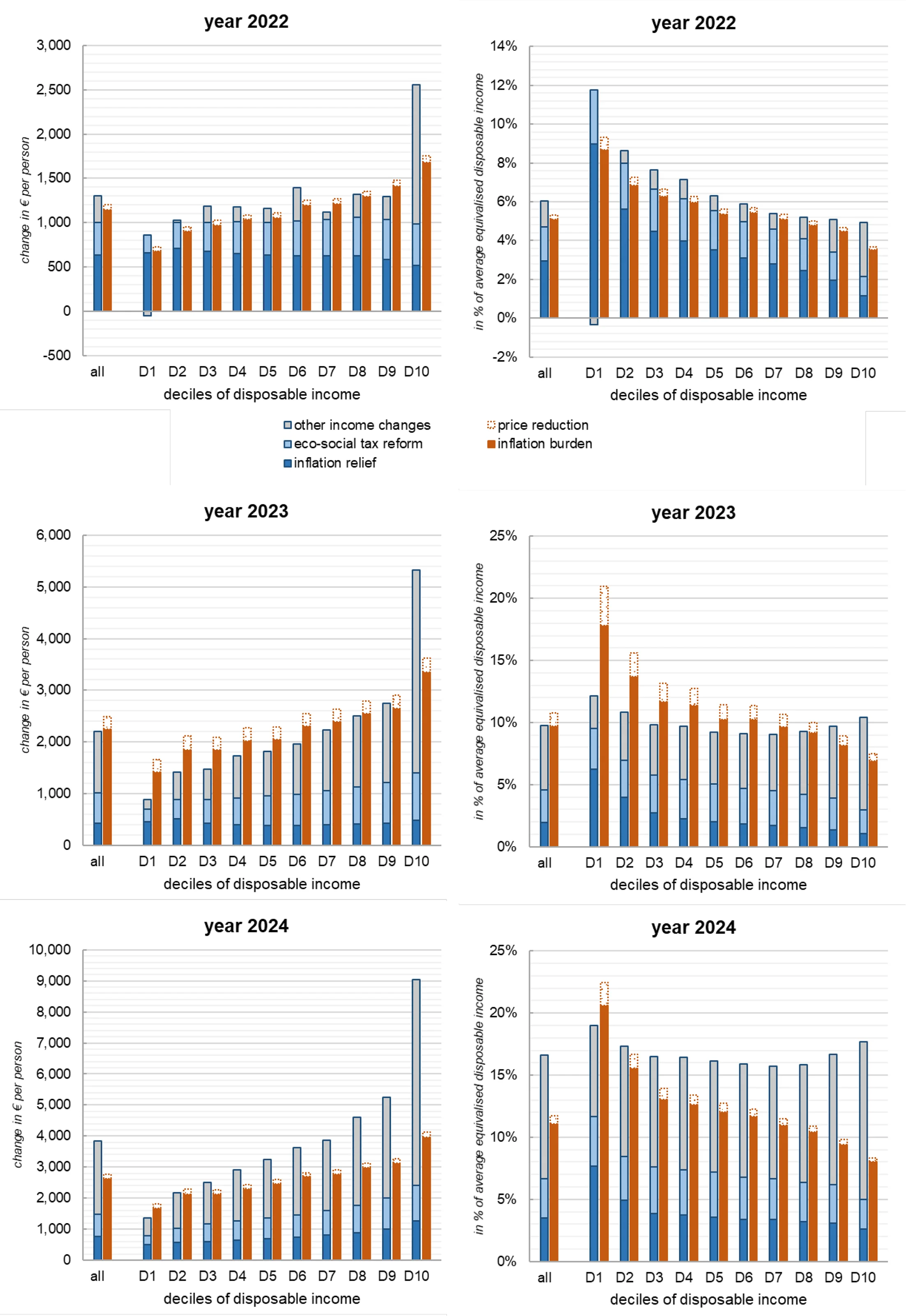
Tables
| Inflation | Share of consumption in deciles of disposable income | |||||||||||||
|---|---|---|---|---|---|---|---|---|---|---|---|---|---|---|
| 2022 | 2023 | 2024 | D1 | D2 | D3 | D4 | D5 | D6 | D7 | D8 | D9 | D10 | total | |
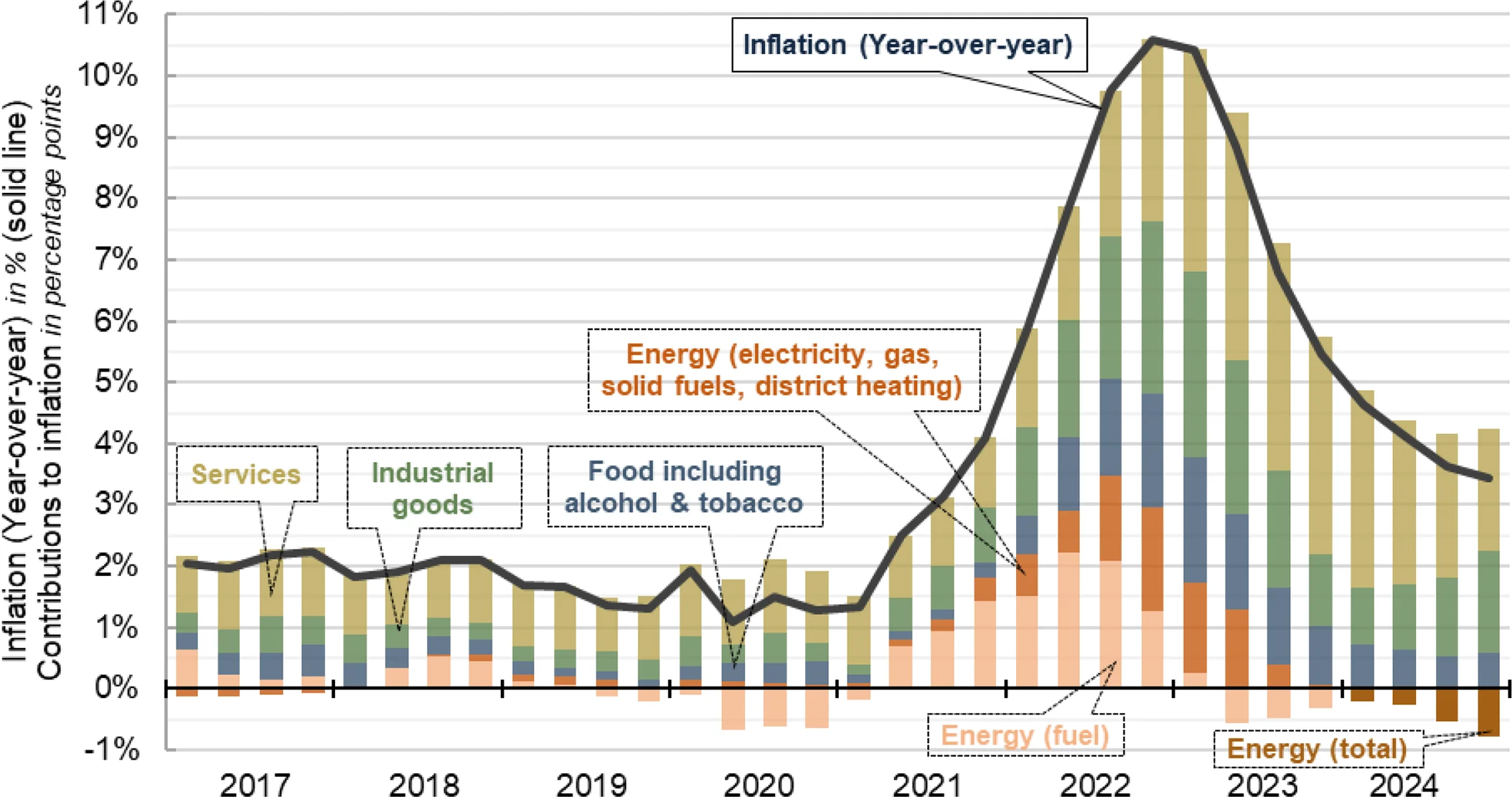
| Services | 4.6% | 7.9% | 5.4% | 47% | 49% | 45% | 46% | 46% | 46% | 44% | 47% | 46% | 47% | 46% |
| Industrial goods | 7.4% | 7.6% | 4.4% | 25% | 27% | 29% | 31% | 33% | 31% | 34% | 33% | 34% | 35% | 32% |
| Food incl. alcohol & tobacco | 9.0% | 10.1% | 4.3% | 19% | 16% | 17% | 15% | 14% | 15% | 14% | 13% | 13% | 12% | 14% |
| Energy (electricity, gas etc.) | 31.0% | 20.5% | -6.6% | 6% | 5% | 5% | 4% | 4% | 4% | 4% | 4% | 3% | 3% | 4% |
| Energy (fuel) | 46.6% | -9.0% | -6.6% | 3% | 3% | 4% | 3% | 3% | 4% | 4% | 4% | 4% | 3% | 4% |
| Total | 8.6% | 7.8% | 4.0% | 100% | 100% | 100% | 100% | 100% | 100% | 100% | 100% | 100% | 100% | 100% |
Source: Statistics Austria, IHS, WIFO macroeconomic forecast December 2023, Household Budget Survey 2020, authors’ calculations.
| 2019 | 2020 | 2021 | 2022 | 2023 | 2024 | 2020 | 2021 | 2022 | 2023 | 2024 | |
|---|---|---|---|---|---|---|---|---|---|---|---|
| index (2019=100) | change (year-over-year in %) | ||||||||||
| real GDP nominal GDP consumer prices indexation of income tax brackets | 100.0 100.0 100.0 100.0 | 93.4 95.9 101.4 100.0 | 97.3 102.0 104.2 100.0 | 102.0 112.6 113.2 100.0 | 101.2 121.4 122.1 105.2 | 102.1 128.0 127.0 115.6 | -6.6 -4.1 +1.4 0.0 | +4.2 +6.4 +2.8 0.0 | +4.8 +10.4 +8.6 0.0 | -0.8 +7.8 +7.9 +5.2 | +0.9 +5.4 +4.0 +9.9 |
| average annual wage indexation of pensions property income | 100.0 100.0 100.0 | 102.2 101.8 51.5 | 104.9 103.3 70.7 | 109.9 105.2 97.7 | 118.9 111.3 106.4 | 128.2 122.1 113.1 | +2.2 +1.8 -48.5 | +2.7 +1.5 +37.2 | +4.7 +1.8 +38.3 | +8.2 +5.8 +8.9 | +7.8 +9.7 +6.3 |
| population employed unemployed pensioners | 100.0 100.0 100.0 100.0 | 100.4 98.0 135.9 103.1 | 100.8 100.4 110.1 104.8 | 101.8 103.3 87.3 106.1 | 102.6 104.5 90.0 107.4 | 103.2 105.2 91.0 109.0 | +0.4 -2.0 +35.9 +3.1 | +0.4 +2.5 -19.0 +1.7 | +1.0 +3.0 -20.7 +1.2 | +0.8 +1.1 +3.0 +1.3 | +0.6 +0.7 +1.1 +1.4 |
Source: Statistics Austria, WIFO macroeconomic forecast December 2023, authors’ calculations.
| Categorisation | Total relief volume in % of GDP | |||||
|---|---|---|---|---|---|---|
| means-tested (yes/no) | type | temporary or permanent | 2022 | 2023 | 2024 | |
| Income support | 1.28 | 0.82 | 1.39 | |||
| One-off payments to all households | 0.70 | 0.00 | 0.00 | |||
| Increase of a lump-sum climate bonus | no | transfer | temporary | 0.62 | 0.00 | 0.00 |
| Transfer for electricity bill | no | transfer | temporary | 0.09 | 0.00 | 0.00 |
| One-off payments to low income households | 0.35 | 0.27 | 0.01 | |||
| One-off payments to vulnerable households | yes (household) | transfer | temporary | 0.05 | 0.01 | 0.00 |
| One-off payments to unemployed persons | yes (person) | transfer | temporary | 0.05 | 0.00 | 0.00 |
| Tax credit for employees and self-employed | yes (person) | tax | temporary | 0.16 | 0.00 | 0.00 |
| One-off payments to pensioners | yes (person) | transfer | temporary | 0.09 | 0.11 | 0.00 |
| Transfer for housing and heating | yes (household) | transfer | temporary | 0.00 | 0.15 | 0.01 |
| Measures for families | 0.15 | 0.04 | 0.07 | |||
| One-off payment per child | no | transfer | temporary | 0.08 | 0.00 | 0.00 |
| One-off payment per child to vulnerable families | yes (household) | transfer | temporary | 0.00 | 0.04 | 0.07 |
| Earlier increase of a child tax credit | no | tax | temporary | 0.06 | 0.00 | 0.00 |
| Increase of a child tax credit for low income earners | yes (household) | tax | permanent | 0.01 | 0.01 | 0.00 |
| Increase of commuter tax allowances and credits | no | tax | temporary | 0.07 | 0.05 | 0.00 |
| Indexation of income tax brackets | no | tax | permanent | 0.00 | 0.38 | 1.12 |
| Indexation of further social transfers | no | transfer | permanent | 0.00 | 0.07 | 0.19 |
| Price reduction | 0.12 | 0.47 | 0.26 | |||
| Energy tax measures | 0.09 | 0.07 | 0.07 | |||
| Reduction of tax rate on electricity and gas | no | tax | temporary | 0.05 | 0.07 | 0.07 |
| Delayed introduction of CO2-price (non-EU-ETS) | no | tax | temporary | 0.04 | 0.00 | 0.00 |
| Electricity price subsidy | 0.03 | 0.40 | 0.18 | |||
| Price cap for basic electricity consumption | no | subsidy | temporary | 0.03 | 0.33 | 0.18 |
| Subsidy of power grid loss cost | no | subsidy | temporary | 0.00 | 0.07 | 0.00 |
| Total in % of GDP | 1.40 | 1.29 | 1.64 | |||
| Total in million € | 6,264 | 6,228 | 8,351 | |||
Source: Authors’ calculations using EU-SILC 2020, Household Budget Survey 2020, and EUROMOD.
| 2022 | 2023 | 2024 | ||||
|---|---|---|---|---|---|---|
| in % of GDP | share in category | in % of GDP | share in category | in % of GDP | share in category | |
| Total | 1.40 | 1.29 | 1.64 | |||
| Type of measure | ||||||
| Transfer measures | 0.97 | 69% | 0.38 | 29% | 0.26 | 16% |
| Tax measures | 0.40 | 29% | 0.51 | 40% | 1.20 | 73% |
| Subsidy measures | 0.03 | 2% | 0.40 | 31% | 0.18 | 11% |
| Means-testing | ||||||
| Means-tested measures | 0.37 | 26% | 0.31 | 24% | 0.08 | 5% |
| Non-means-tested measures | 1.04 | 74% | 0.98 | 76% | 1.56 | 95% |
| Permanent or temporary | ||||||
| Permanent Measures | 0.01 | 1% | 0.46 | 36% | 1.31 | 80% |
| Temporary Measures | 1.39 | 99% | 0.83 | 64% | 0.33 | 20% |
Source: Authors’ calculations using EU-SILC 2020, Household Budget Survey 2020, and EUROMOD.
| Share of relief volume in deciles of disposable income | |||||||||||
|---|---|---|---|---|---|---|---|---|---|---|---|
| Relief volume in million € | Total | D1 | D2 | D3 | D4 | D5 | D6 | D7 | D8 | D9 | D10 |
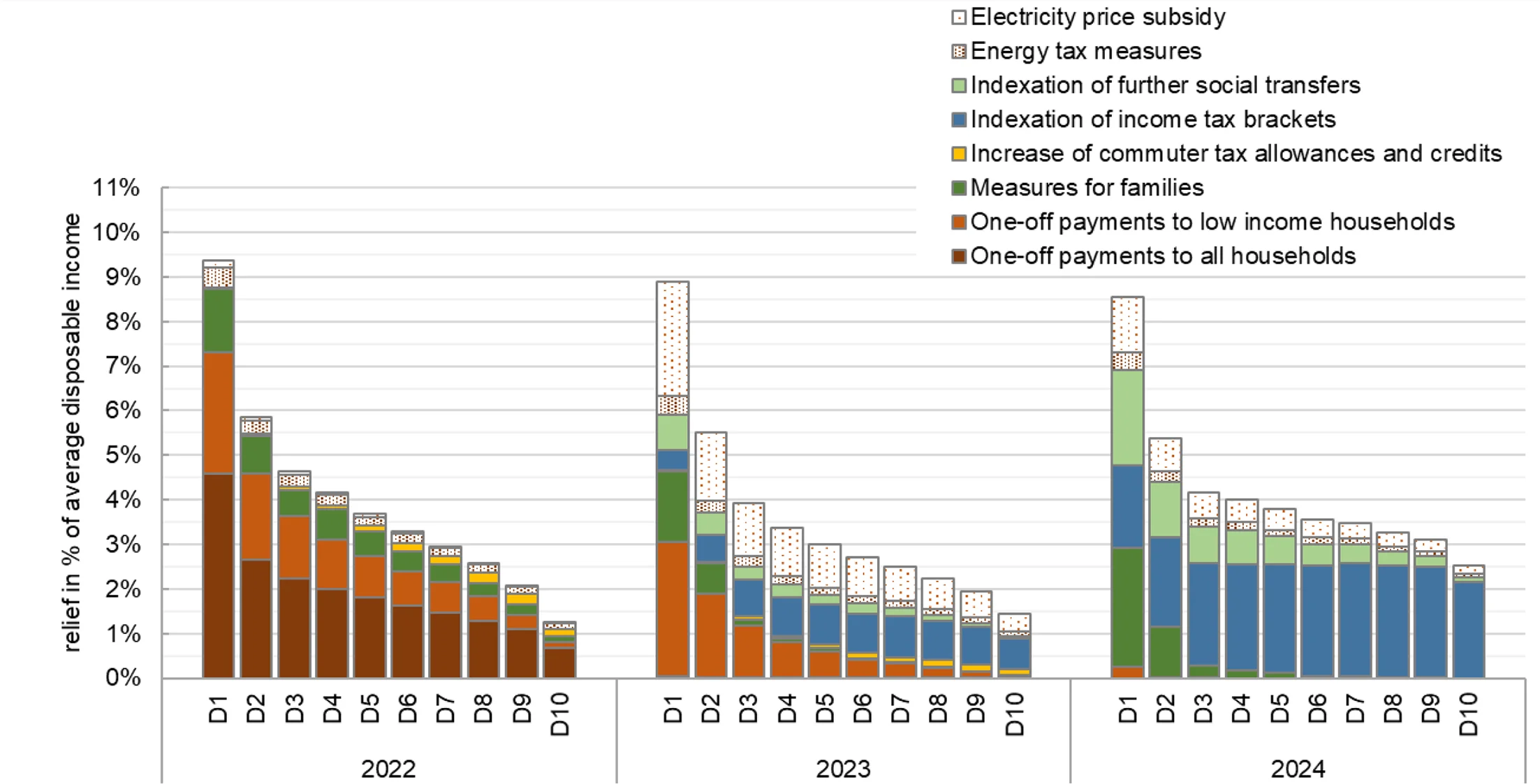
| All measures for private households | 20,840 | 9% | 10% | 9% | 9% | 9% | 10% | 10% | 10% | 11% | 12% |
| Income support | 16,720 | 9% | 10% | 9% | 9% | 9% | 9% | 10% | 10% | 11% | 12% |
| One-off payments to all households | 3,170 | 10% | 10% | 10% | 10% | 10% | 10% | 10% | 10% | 10% | 9% |
| One-off payments to low income households | 2,900 | 17% | 18% | 14% | 11% | 10% | 8% | 8% | 7% | 5% | 3% |
| Measures for families | 1,260 | 26% | 20% | 9% | 10% | 9% | 7% | 7% | 5% | 4% | 3% |
| Increase of commuter tax allowances and credits | 550 | 0% | 2% | 3% | 4% | 6% | 10% | 11% | 18% | 21% | 24% |
| Indexation of income tax brackets | 7,530 | 2% | 5% | 7% | 8% | 9% | 10% | 12% | 13% | 15% | 19% |
| Indexation of further social transfers | 1,300 | 13% | 13% | 11% | 12% | 11% | 10% | 10% | 8% | 7% | 5% |
| Price reduction | 4,130 | 10% | 10% | 10% | 10% | 10% | 10% | 10% | 10% | 10% | 11% |
| Energy tax measures | 1,140 | 8% | 9% | 10% | 9% | 9% | 10% | 10% | 10% | 11% | 14% |
| Electricity price subsidy | 2,980 | 10% | 11% | 10% | 10% | 10% | 10% | 10% | 10% | 10% | 10% |
Source: Authors’ calculations using EU-SILC 2020, Household Budget Survey 2020, and EUROMOD.
| Total population | Deciles of disposable income | ||||||||||||
|---|---|---|---|---|---|---|---|---|---|---|---|---|---|
| D1 | D2 | D3 | D4 | D5 | D6 | D7 | D8 | D9 | D10 | ||||
| Year 2022 | Burden of inflation since 2021 (in excess of 2% p.a.), in % of disposable income | ||||||||||||
| Total burden | 5.1 | 8.7 | 6.9 | 6.3 | 6.0 | 5.4 | 5.4 | 5.1 | 4.8 | 4.5 | 3.5 | ||
| Effect of average inflation | 5.1 | 9.5 | 7.1 | 6.0 | 5.8 | 5.5 | 5.3 | 5.0 | 4.7 | 4.4 | 3.6 | ||
| Effect of idiosyncratic inflation | 0.0 | -0.8 | -0.1 | 0.2 | 0.0 | -0.1 | 0.1 | 0.1 | 0.0 | 0.1 | -0.1 | ||
| Effect of changes in population | 0.0 | 0.1 | -0.1 | 0.0 | 0.1 | 0.0 | 0.0 | 0.0 | 0.0 | 0.0 | 0.0 | ||
| Deviation from total population, in percentage points | mean absolute deviation | standard deviation | |||||||||||
| Total burden | 3.6 | 1.8 | 1.2 | 0.9 | 0.3 | 0.3 | 0.0 | -0.3 | -0.6 | -1.5 | 1.1 | 1.4 | |
| Effect of average inflation | 4.4 | 2.0 | 1.0 | 0.8 | 0.4 | 0.2 | -0.1 | -0.3 | -0.7 | -1.4 | 1.1 | 1.5 | |
| Effect of idiosyncratic inflation | -0.8 | -0.1 | 0.2 | 0.1 | -0.1 | 0.1 | 0.1 | 0.0 | 0.1 | -0.1 | 0.2 | 0.3 | |
| Effect of changes in population | 0.1 | -0.1 | 0.0 | 0.1 | 0.0 | 0.0 | 0.0 | 0.0 | 0.0 | 0.0 | 0.0 | 0.1 | |
| Year 2023 | Burden of inflation since 2021 (in excess of 2% p.a.), in % of disposable income | ||||||||||||
| Total burden | 9.7 | 17.8 | 13.7 | 11.7 | 11.4 | 10.2 | 10.3 | 9.6 | 9.1 | 8.2 | 6.9 | ||
| Effect of average inflation | 9.7 | 18.1 | 13.5 | 11.5 | 11.2 | 10.5 | 10.1 | 9.6 | 9.1 | 8.4 | 7.0 | ||
| Effect of idiosyncratic inflation | 0.0 | -0.3 | 0.3 | 0.1 | -0.1 | 0.0 | 0.1 | 0.1 | 0.0 | -0.1 | -0.1 | ||
| Effect of changes in population | 0.0 | 0.0 | -0.1 | 0.0 | 0.3 | -0.3 | 0.1 | 0.0 | 0.1 | -0.1 | 0.0 | ||
| Deviation from total population, in percentage points | mean absolute deviation | standard deviation | |||||||||||
| Total burden | 8.1 | 4.0 | 2.0 | 1.7 | 0.5 | 0.6 | -0.1 | -0.6 | -1.5 | -2.8 | 2.2 | 2.9 | |
| Effect of average inflation | 8.3 | 3.8 | 1.8 | 1.4 | 0.7 | 0.4 | -0.1 | -0.6 | -1.3 | -2.7 | 2.1 | 2.9 | |
| Effect of idiosyncratic inflation | -0.3 | 0.3 | 0.1 | 0.0 | 0.0 | 0.1 | 0.1 | 0.0 | -0.1 | -0.1 | 0.1 | 0.2 | |
| Effect of changes in population | 0.0 | -0.1 | 0.0 | 0.3 | -0.3 | 0.1 | 0.0 | 0.1 | -0.1 | 0.0 | 0.1 | 0.1 | |
| Year 2024 | Burden of inflation since 2021 (in excess of 2% p.a.), in % of disposable income | ||||||||||||
| Total burden | 11.1 | 20.6 | 15.6 | 13.0 | 12.6 | 12.0 | 11.6 | 11.0 | 10.4 | 9.4 | 8.0 | ||
| Effect of average inflation | 11.1 | 20.7 | 15.4 | 13.2 | 12.8 | 12.0 | 11.5 | 11.0 | 10.4 | 9.6 | 8.0 | ||
| Effect of idiosyncratic inflation | 0.0 | -0.3 | 0.1 | 0.0 | -0.2 | 0.1 | 0.1 | 0.1 | 0.0 | -0.1 | 0.0 | ||
| Effect of changes in population | 0.0 | 0.2 | 0.0 | -0.2 | 0.1 | 0.0 | 0.0 | -0.1 | 0.0 | 0.0 | 0.0 | ||
| Deviation from total population, in percentage points | mean absolute deviation | standard deviation | |||||||||||
| Total burden | 9.5 | 4.5 | 1.9 | 1.5 | 0.9 | 0.5 | -0.1 | -0.7 | -1.7 | -3.1 | 2.5 | 3.4 | |
| Effect of average inflation | 9.5 | 4.3 | 2.1 | 1.7 | 0.9 | 0.4 | -0.1 | -0.7 | -1.5 | -3.1 | 2.4 | 3.4 | |
| Effect of idiosyncratic inflation | -0.3 | 0.1 | 0.0 | -0.2 | 0.1 | 0.1 | 0.1 | 0.0 | -0.1 | 0.0 | 0.1 | 0.1 | |
| Effect of changes in population | 0.3 | 0.0 | -0.2 | 0.1 | 0.0 | 0.0 | -0.1 | 0.0 | 0.0 | 0.0 | 0.1 | 0.1 | |
Source: Authors’ calculations using EU-SILC 2020, Household Budget Survey 2020, and EUROMOD.
| Total population | Deciles of disposable income | ||||||||||
|---|---|---|---|---|---|---|---|---|---|---|---|
| D1 | D2 | D3 | D4 | D5 | D6 | D7 | D8 | D9 | D10 | ||
| Year 2021 | Income components, in % of disposable income | ||||||||||
| Earned income | 66 | 32 | 40 | 52 | 60 | 65 | 63 | 68 | 74 | 73 | 76 |
| Pension income | 21 | 23 | 29 | 29 | 23 | 24 | 26 | 22 | 18 | 18 | 14 |
| Unemployment income | 2 | 14 | 7 | 5 | 4 | 2 | 2 | 1 | 1 | 0 | 0 |
| Other income | 11 | 31 | 24 | 13 | 13 | 9 | 9 | 9 | 7 | 8 | 9 |
| Year 2022 | Income changes without fiscal measures since 2021, in % of disposable income | ||||||||||
| Nominal change in excess of 2% p.a. | 1.3 | -0.3 | 0.7 | 1.0 | 1.0 | 0.7 | 0.9 | 0.8 | 1.1 | 1.7 | 2.8 |
| Contribution of earned income | 2.3 | 3.0 | 1.7 | 1.8 | 2.3 | 0.7 | 2.7 | 1.4 | 2.2 | 2.7 | 3.0 |
| Contribution of pension income | 0.0 | 0.1 | 1.1 | 1.0 | 0.4 | 1.3 | -0.6 | 0.2 | -0.2 | -1.2 | -0.3 |
| Contribution of unemployment income | -0.5 | -3.6 | -1.5 | -1.1 | -1.1 | -0.3 | -0.2 | -0.2 | -0.1 | 0.0 | -0.1 |
| Contribution of other income | -0.4 | 0.2 | -0.6 | -0.7 | -0.7 | -0.9 | -0.9 | -0.6 | -0.8 | 0.2 | 0.1 |
| Year 2023 | Income changes without fiscal measures since 2021, in % of disposable income | ||||||||||
| Nominal change in excess of 2% p.a. | 5.2 | 2.6 | 3.9 | 4.1 | 4.3 | 4.2 | 4.4 | 4.5 | 5.0 | 5.8 | 7.5 |
| Contribution of earned income | 5.3 | 4.6 | 1.6 | 5.0 | 4.3 | 2.3 | 4.8 | 5.0 | 6.0 | 6.7 | 7.4 |
| Contribution of pension income | 0.7 | 1.5 | 4.1 | 0.2 | 2.0 | 3.4 | 0.1 | 0.9 | -0.1 | -1.0 | -0.2 |
| Contribution of unemployment income | -0.4 | -3.1 | -1.1 | -1.0 | -1.0 | -0.3 | 0.0 | -0.2 | -0.1 | 0.0 | -0.1 |
| Contribution of other income | -0.4 | -0.4 | -0.7 | -0.2 | -1.0 | -1.2 | -0.5 | -1.2 | -0.7 | 0.0 | 0.4 |
| Year 2024 | Income changes without fiscal measures since 2021, in % of disposable income | ||||||||||
| Nominal change in excess of 2% p.a. | 10.0 | 7.4 | 8.9 | 8.9 | 9.1 | 9.0 | 9.2 | 9.1 | 9.5 | 10.5 | 12.7 |
| Contribution of earned income | 8.4 | 7.4 | 5.6 | 6.6 | 8.0 | 5.6 | 8.2 | 7.7 | 8.3 | 9.7 | 11.3 |
| Contribution of pension income | 2.1 | 2.4 | 3.4 | 3.4 | 3.4 | 4.6 | 1.4 | 2.3 | 1.9 | 0.5 | 1.2 |
| Contribution of unemployment income | -0.3 | -2.3 | -0.8 | -0.9 | -0.8 | -0.1 | 0.1 | -0.1 | -0.1 | 0.1 | 0.0 |
| Contribution of other income | -0.3 | -0.1 | 0.7 | -0.2 | -1.4 | -1.1 | -0.5 | -0.8 | -0.6 | 0.3 | 0.3 |
Source: Authors’ calculations using EU-SILC 2020, Household Budget Survey 2020, and EUROMOD.