Cite as: M. Hoshen, A. Burton, T. Bowcock; 2007; Simulating disease transmission dynamics at a multi-scale level; International Journal of Microsimulation; 1(1); 26–34. doi: 10.34196/ijm.00004
Abstract
We present a model of the global spread of a generic human infectious disease using a Monte Carlo micro-simulation with large-scale parallel-processing. This prototype has been constructed and tested on a model of the entire population of the British Isles. Typical results are presented. A microsimulation of this order of magnitude of population simulation has not been previously attained. Further, an efficiency assessment of processor usage indicates that extension to the global scale is feasible. We conclude that the flexible approach outlined provides the framework for a virtual laboratory capable of supporting public health policy making at a variety of spatial scales.
This article contains 5 figures and 2 tables.
Figures
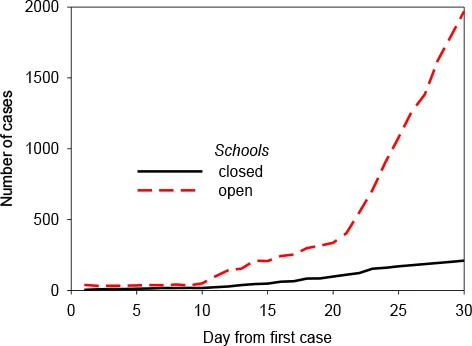
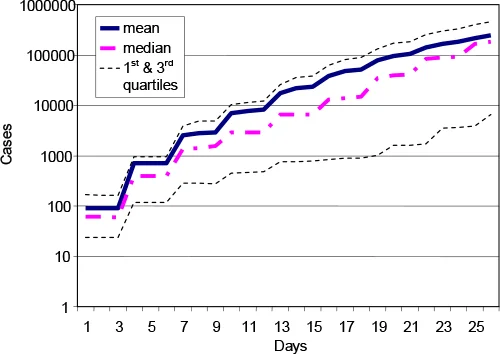
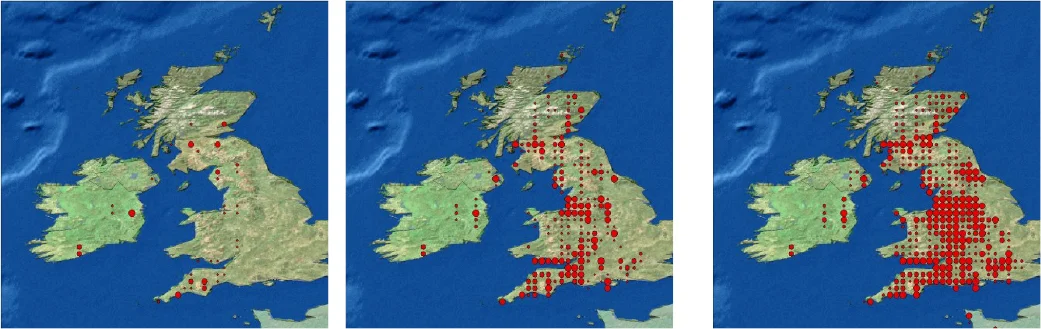
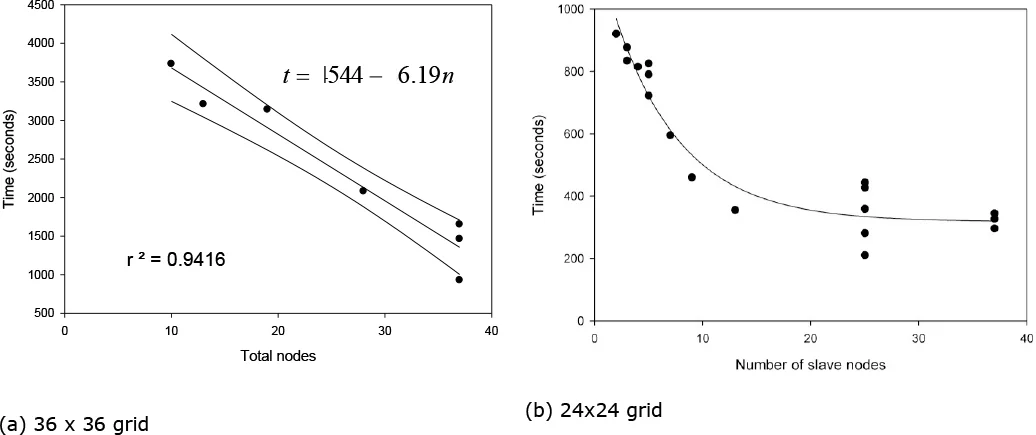
Figure 1. Example of the grid structure of regions, towns and overlaps.Figure 2. A typical time course for disease spread (origin = Midlands).Figure 3. Time course for 20 runs, assuming 1% of adults commute daily and schools are kept open.Figure 4. Spatial distribution of cases after 3, 19 and 25 days for a highly infectious disease, allowing for long distance transmission. The size of the dot represents the number of cases at the grid point.Figure 5. Changes in MPI usage efficiency in response to grid size and processor nodes.