Projecting the impacts of illness on labour force participation: An application of Health&WealthMOD
Deborah Schofield, Rupendra Shrestha, Megan Passey, Susan Fletcher, Simon Kelly, Richard Percival
Department of Rural Health, Northern Rivers University, Australia; The National Centre for Social and Economic Modelling, University of Canberra, Australia
Cite as: D. Schofield, R. Shrestha, M. Passey, S. Fletcher, S. Kelly, R. Percival; 2011; Projecting the impacts of illness on labour force participation: An application of Health&WealthMOD; International Journal of Microsimulation; 4(3); 37–47. doi: 10.34196/ijm.00059
Abstract
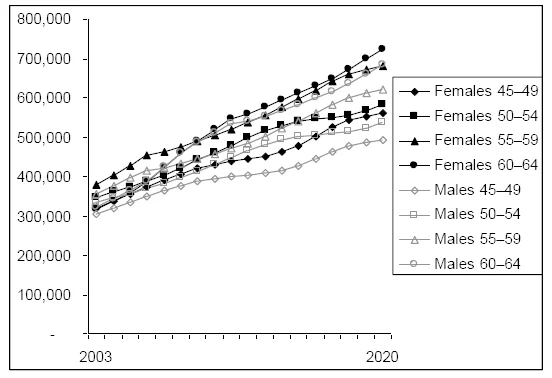
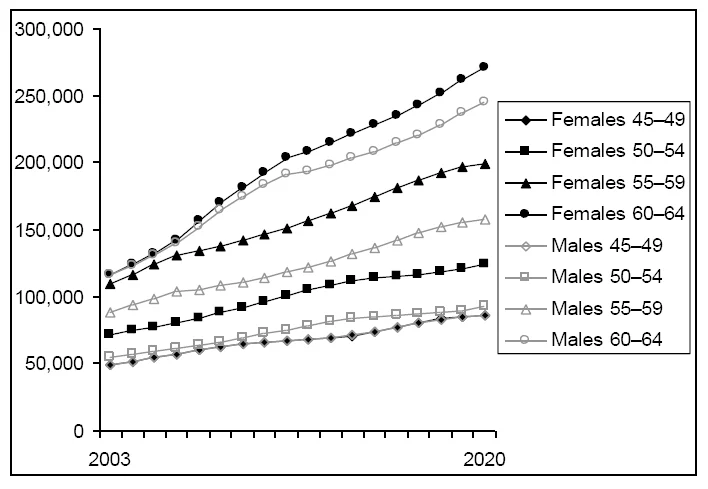
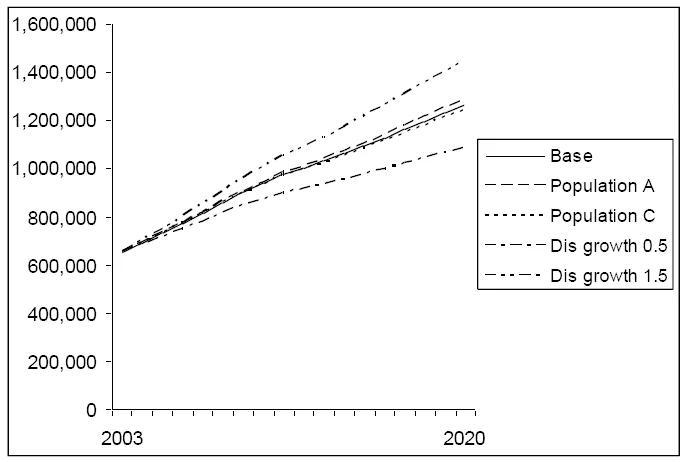
Health&WealthMOD is the first Australian microsimulation model designed to determine the economic impacts of disease on older workers, aged 45 to 65 years. Chronic health conditions are known to be associated with early retirement. This paper describes an application of Health&WealthMOD to estimate the impact of this association on projected labour force participation to 2020 given the ageing population and long-term trend in chronic conditions. Due to ageing and disease trends, the number of people with chronic conditions in the 45–64 years age group was expected to rise to about 4.8 million by 2020, an increase of 82% from the 2003 population of the same age group. About 904,000 persons in the 45–64 age group were projected to be out of the labour force due to ill health in 2020, when only the ageing and population growth were considered. When trends in illness were captured, the figure was increased to about 1.2 million persons. This demonstrates that health is a major driver of labour force participation and retirement and that economic policies alone, with no consideration of health interventions to treat or prevent chronic illness, will only have a limited impact on labour force participation. Thus, it is important that the government focuses on both health policies and economic policies in order to make sure that there will be an adequate supply of labour force in future.
This article contains 3 figures and 6 tables.
Figures
Figure 1. Number of people with chronic health conditions, 2003–2020.Figure 2. Number of people out of the labour force due to chronic health conditions.Figure 3. Number of people aged 45–64 years out of the workforce due to chronic health conditions – base and sensitivity projections, Australia 2003–2020.
Tables
Table 1. Persons aged 45–64 years as percentage of working aged population aged 15–64 years by age group and sex.