Cite as: J. Cumpston; 2012; A more efficient sampling procedure, using loaded probabilities; International Journal of Microsimulation; 5(1); 21–30. doi: 10.34196/ijm.00065
Abstract
All-case simulation, where demographic outcomes are simulated for each person each simulation cycle, has been used in almost every national household microsimulation model. This paper suggests the use of simulation by stratified sampling with loaded probabilities. This suggestion is intended to provide faster simulations, particularly when using simulation cycle times much shorter than a year. The paper derives optimal formulas for draw numbers and loaded probabilities, and uses stochastic simulations to show that sampling with loaded probabilities gives similar results to all-case simulation. Tests with a microsimulation model of 175,000 Australians show that sampling with loaded probabilities can reduce run times with yearly cycles by about 43%, and run times with weekly cycles by about 98%. A 50-year demographic projection took 34 seconds with a yearly cycle, and 54 seconds with a weekly cycle. Event numbers and standard deviations are comparable with those expected from risk profiles. The paper concludes that sampling with loaded probabilities is theoretically valid, can be much quicker than all-case simulation, and does give similar estimates. Potential applications are for large models, or those with short simulation cycles.
This article contains 2 figures and 12 tables.
Figures
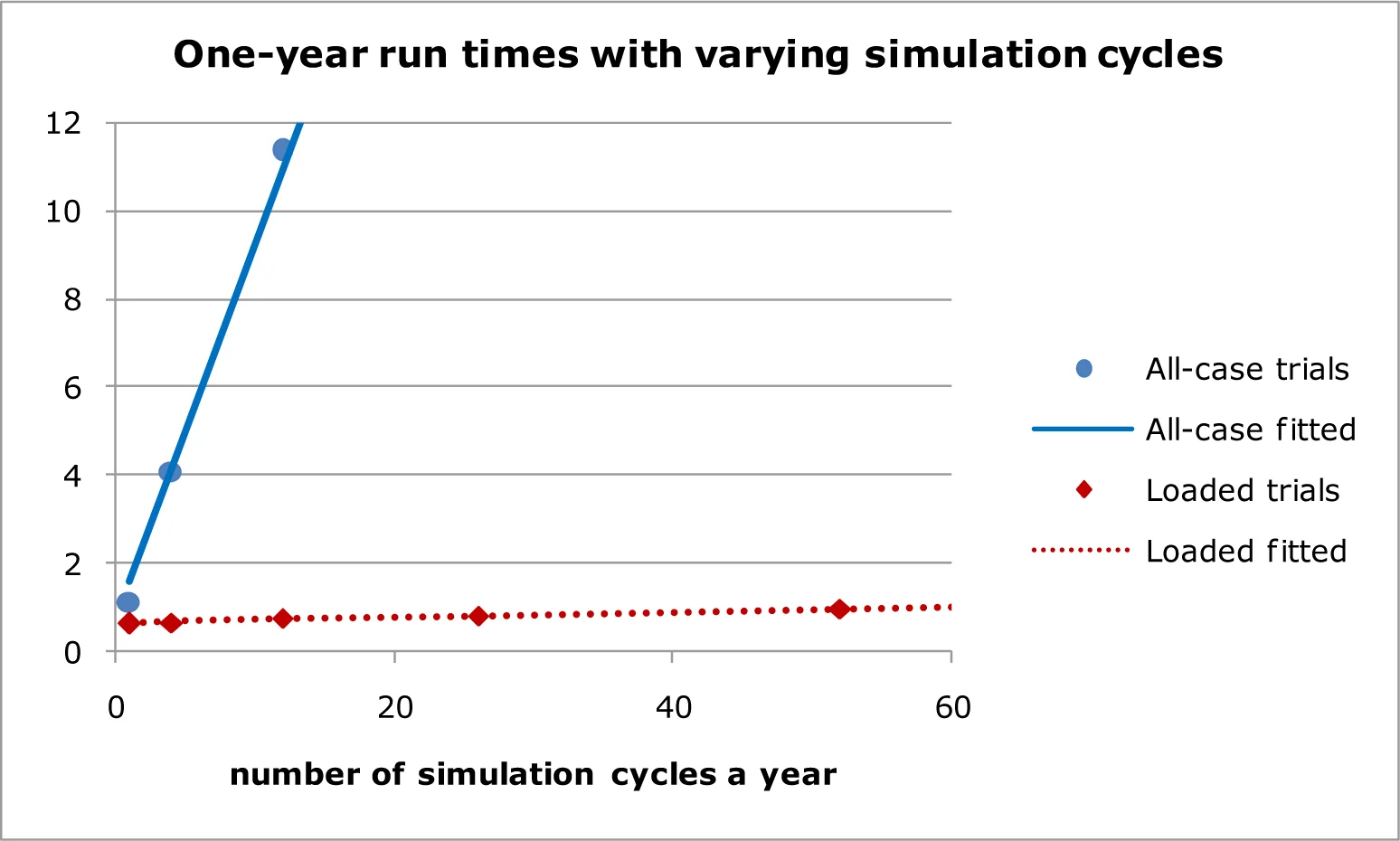
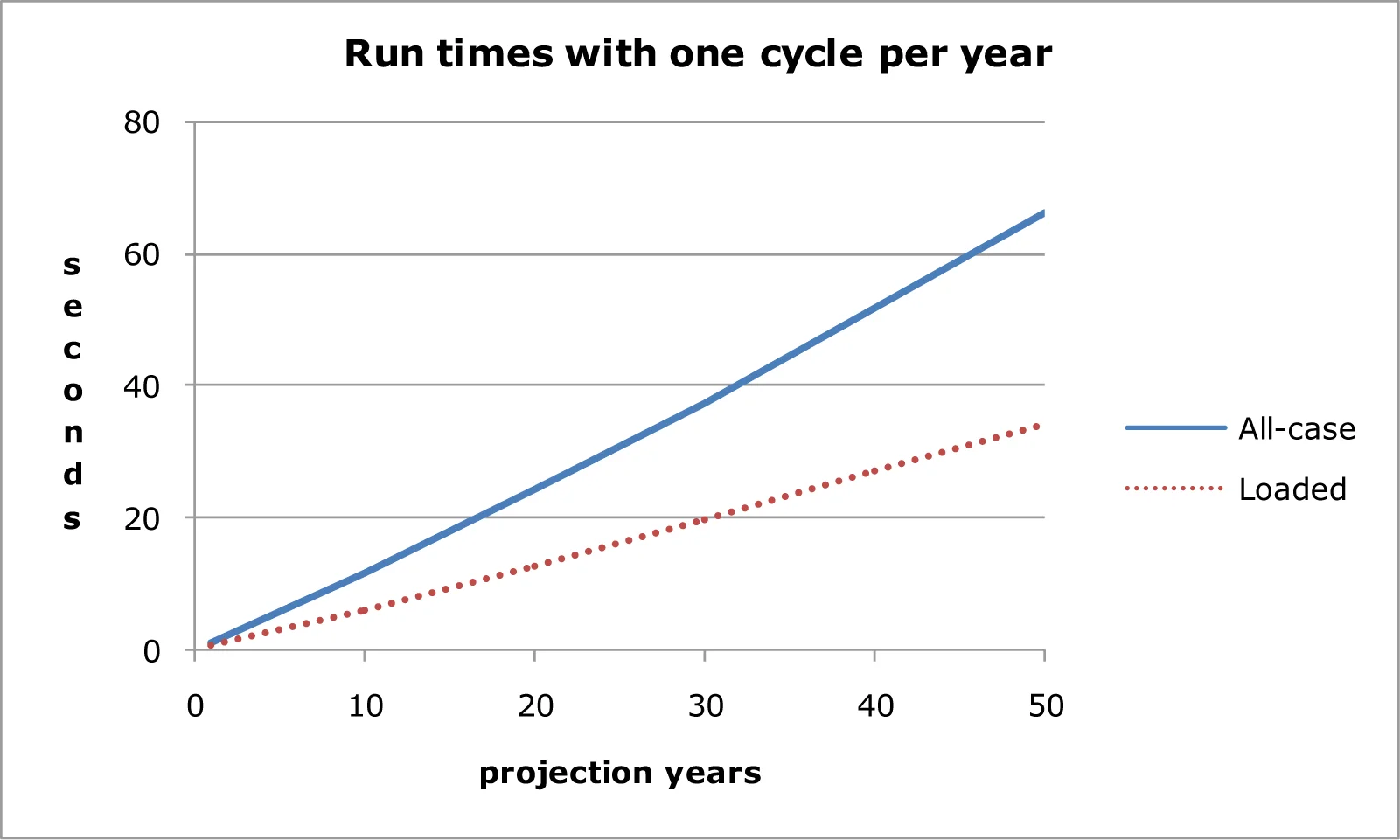
Figure 1. Run times with varying simulation cycles.Figure 2. Run times with one cycle per year.
Tables
Table 1. Number of draws to give maximum loaded probability of 1.
Number in pool
maximum
unloaded
probability
0.01
0.02
0.05
0.1
0.2
0.5
10
1
1
1
2
3
7
100
2
3
6
11
23
69
1,000
11
21
52
106
224
693
10,000
101
203
513
1,054
2,232
6,932
100,000
1,006
2,021
5,130
10,536
22,315
69,315
Table 2. Simulated event numbers with pools chosen to produce 500 events.
Number low risk persons
Low risk rate
Number high risk persons
High risk rate
Expected number of events
Mean number from 10,000 trials
Standard deviation from 10,000 trials
2,500
0.1
500
0.5
500
499.92
.16
1,250
0.2
500
0.5
500
500.12
.14
833
0.3
500
0.5
500
499.88
.12
625
0.4
500
0.5
500
500.03
.10
500
0.5
500
0.5
500
500.00
.09
Table 3. Table Draws needed to simulate the deaths in a year 175,000 Australians.
Age group
Persons in group
Average mortality rate
Expected deaths
Maximum mortality rate
Draws
0-
36,441
0.00040
14.5
0.00453
166
15-
23,593
0.00060
14.1
0.00113
27
25-
25,575
0.00087
22.1
0.00138
36
35-
26,810
0.00123
33.0
0.00192
52
45-
24,156
0.00237
57.2
0.00415
101
55-
16,348
0.00642
104.9
0.01315
217
65-
11,852
0.01826
216.4
0.03697
447
75-
7,706
0.05051
389.3
0.10627
866
85-
2,563
0.18238
467.4
0.48496
1701
Total
175,044
0.00754
1,319.0
3,613
Table 4. Areas, person types and age groups used to form pools.
Area code
Area name
Person type code
Person type
Age code
Age group
1
NSW
1
Partner
1
0–14
2
Victoria
2
Lone parent
2
15–24
3
Queensland
3
Child
3
25–34
4
SA
4
Related person
4
35–44
5
WA
5
Unrelated person
5
45–54
6
Tasmania
6
Lone person
6
55–54
7
NT
7
Group member
7
65–74
8
ACT
8
Non-private resident
8
75–84
9
85-
Table 5. Mean run times in seconds to simulate 175,000 Australians for a year.
Cycles per year
All-case trials seconds
All-case fitted seconds
Loaded trials seconds
Loaded fitted seconds
Loaded trials as % of all-case
1
1.13
1.58
0.64
0.66
57%
4
4.10
4.14
0.67
0.68
16%
12
11.37
10.98
0.75
0.73
7%
26
23.29
22.94
0.83
0.82
4%
52
44.90
45.15
0.98
0.97
2%
365
2.88
2.88
Table 6. Run times in seconds for projections up to 50 years.
Projection years
All-case Yearly
Loaded Yearly
Loaded Weekly
Loaded as% of all case Yearly
1
1.13
0.64
0.98
57%
10
11.59
6.18
9.81
53%
20
24.28
12.82
20.28
53%
30
37.35
19.72
31.2
53%
40
51.93
27.25
42.51
52%
50
66.32
34.16
53.87
52%
Table 7. Event totals from one-year projections, each event simulated separately (50 run averages).
Event
Expected
Observed all-case yearly
Observed loaded yearly
Observed loaded weekly
Births
2,170
2,179
2,183
2,208
Deaths
1,372
1,379
1,330
1,370
Emigrants
2,284
2,280
2,251
2,275
Exits
6,254
6,441
6,203
6,592
Moves
12,468
12,411
12,330
12,364
Table 8. Event totals from one-year projections, all events simulated together.
Event
Expected
Observed all-case yearly
Observed loaded yearly
Observed loaded weekly
Births
2,170
2,175
2,182
2,232
Deaths
1,372
1,375
1,335
1,375
Emigrants
2,284
2,282
2,263
2,304
Exits
6,254
6,333
6,075
6,611
Moves
12,468
13,418
13,210
12,826
Table 9. Table one-year projections, with events in normal & reverse order (50 run averages).
Event
Yearly
Weekly
normal order
reverse order
change in year
normal order
reverse order
change in year
Births
2,182
2,243
61
2,232
2,224
-8
Deaths
1,335
1,331
-4
1,375
1,378
3
Emigrants
2,263
2,308
45
2,304
2,311
7
Exits
6,075
6,540
465
6,611
6,615
4
Moves
13,210
12,323
-887
12,826
12,819
-7
Table 10. 50-year projections with yearly cycles (10 run averages).
Event/persons at end
All-case yearly mean
All-case yearly SD
Loaded yearly mean
Loaded yearly SD
Loaded as % of all-case
Births
102,831
541
101,611
516
98.8%
Deaths
92,205
127
91,924
130
99.7%
Emigrants
123,775
186
123,024
232
99.4%
Exits
355,304
891
347,052
746
97.7%
Moves
797,511
1,716
778,254
937
97.6%
Persons at end
226,755
488
226,566
504
99.9%
Table 11. Standard deviations for one-year projections (based on 50 runs).
Event
All-case Yearly
All-case Yearly
Loaded Yearly
Loaded Yearly
Loaded weekly
Loaded weekly
Expected
Observed
Expected
Observed
Expected
Observed
Births
43.8
38.6
43.6
38.7
43.5
52.8
Deaths
35.4
32.7
28.0
29.9
31.7
32.2
Emigrants
47.3
38.6
26.2
35.6
36.5
42.8
Exits
73.7
67.6
33.2
39.8
54.7
59.6
Moves
98.3
99.7
10.3
18.9
50.0
55.1
Table 12. Observed coefficients of variation for one-year projections (based on 50 runs).