Modelling the impact of declining Australian terms of trade on the spatial distribution of income
Yogi Vidyattama, Maheshwar Rao, Itismita Mohanty, Robert Tanton
National Centre for Social and Economic Modelling (NATSEM), Institute for Governance and Policy Analysis, University of Canberra, Australia; Centre for Research and Action in Public Health, University of Canberra, Australia
Cite as: Y. Vidyattama, M. Rao, I. Mohanty, R. Tanton; 2014; Modelling the impact of declining Australian terms of trade on the spatial distribution of income; International Journal of Microsimulation; 7(1); 100–126. doi: 10.34196/ijm.00095
Abstract
Macroeconomic shocks such as movements in exchange rates or the terms of trade not only affect the overall economy but also affect different areas in a country in different ways, thus creating a spatial distribution of the shock. The effect on some regions is often larger than the national effect as regions differ in terms of resource endowments, economic activities, physical and human capital. The standard national CGE-Microsimulation framework is a useful approach to capture the distributional impacts of macro shocks on households at national and state and territory levels. However, the CGE-Microsimulation framework does not capture the distributional impact of a policy change or an external shock on small geographical areas of interest. To overcome this limitation, this paper extends the framework by linking a spatial microsimulation model to the national CGE-microsimulation framework in a top-down manner to capture the distribution of income in small areas of a macro shock. We simulate a potential decline in Australian terms of trade over 2012–13 to 2017–18 and find significant differences in the spatial distribution of the impacts of the shock.
This article contains 6 figures and 5 tables.
Figures
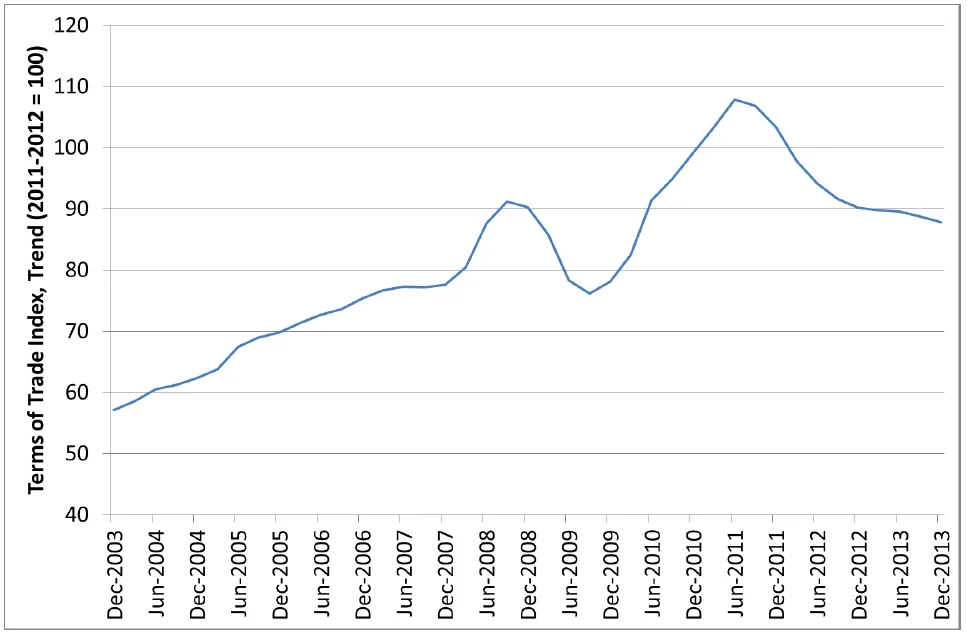
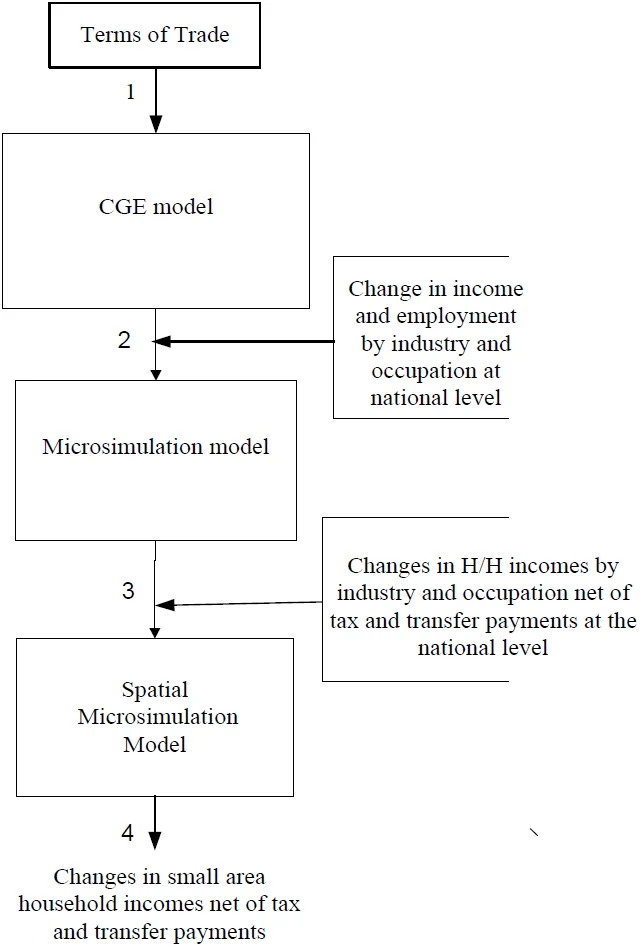
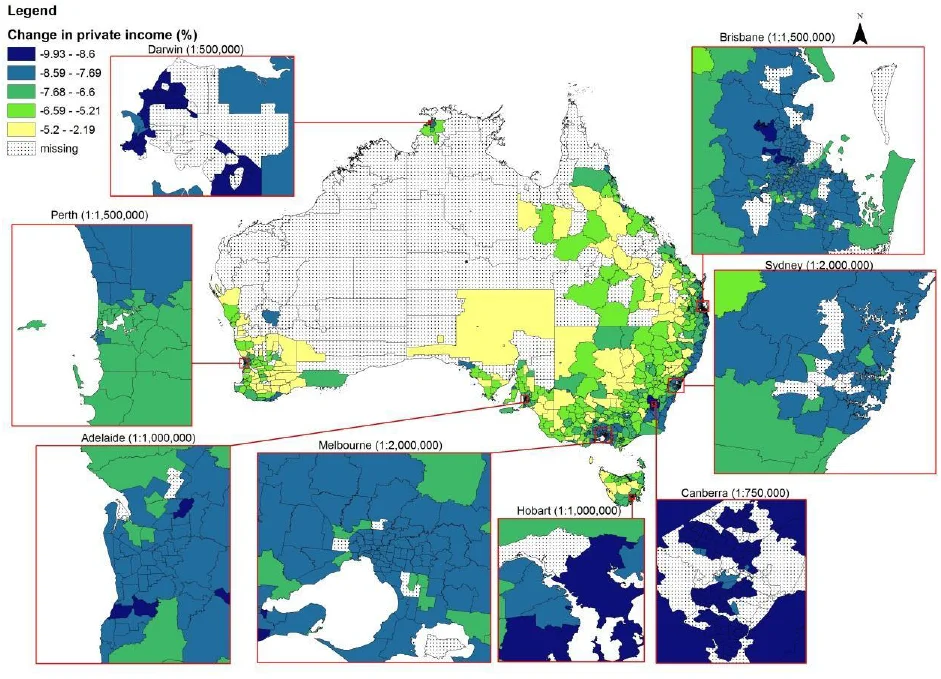
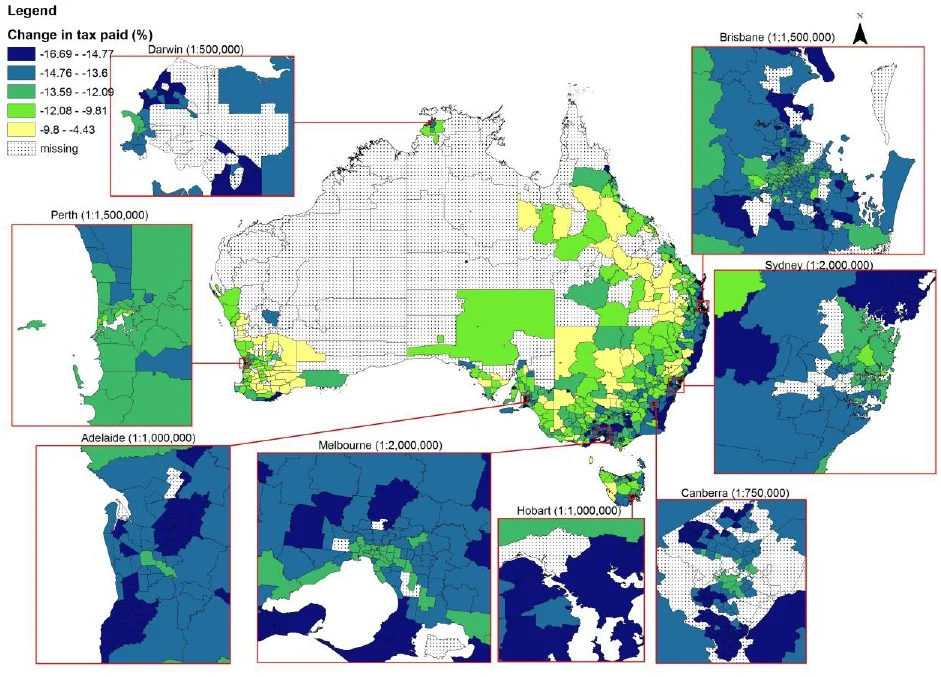
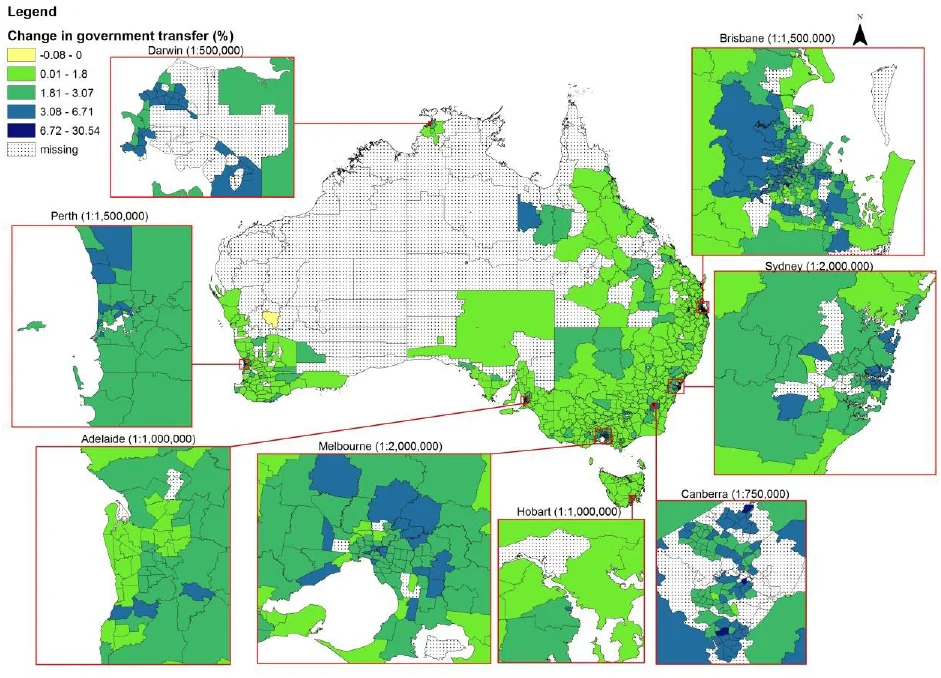
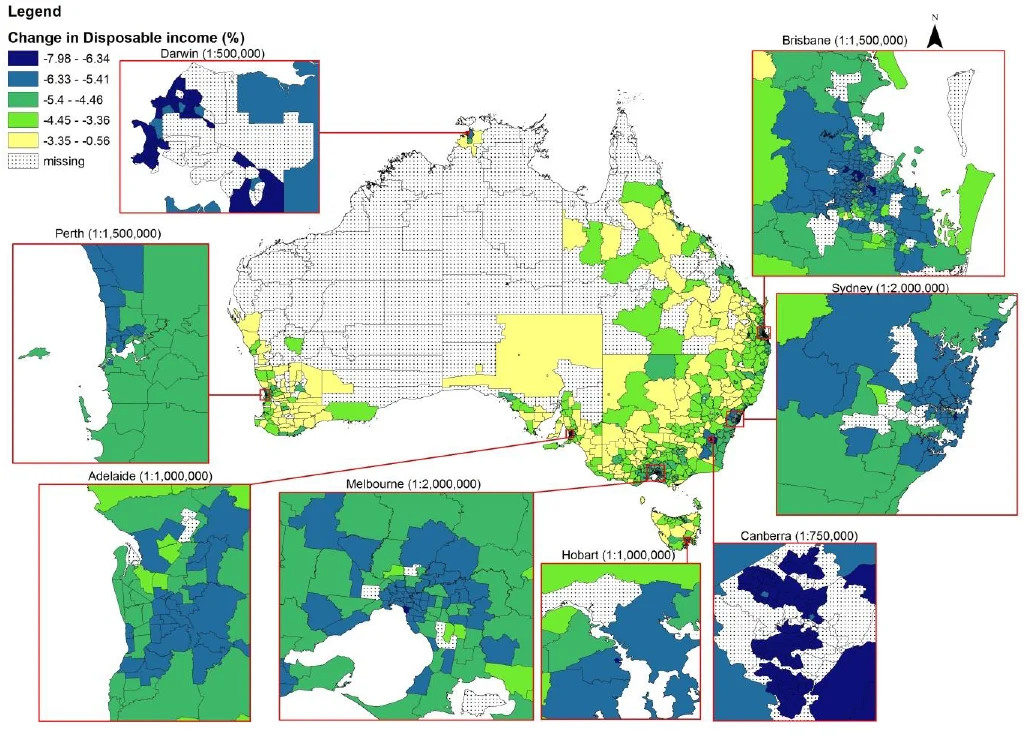
Figure 1. Movements in Australian terms of trade.Figure 2. The modelling framework.Figure 3. Spatial impact on incomes of a change in terms of trade.Figure 4. Spatial reduction in tax paid as a result of a change in terms of trade.Figure 5. Spatial impact on government transfer payments as a result of a change in terms of trade.Figure 6. Spatial impact on disposable income as a result of a change in terms of trade.
Tables
Table 1. Employment simulation benchmark tables.
Number
Benchmark
1
Number of Persons aged 15+
2
Occupation of Reference Person by Industry of employment
3
Occupation of Spouse by Industry of employment
4
Age of Reference person by Age of Spouse by family type
5
Non School Qualification (reference person and Spouse) and Number of Dependents
Source: ABS Census of Population and Housing, 2011.
Table 2. Census benchmark tables to generate dataset for small areas.
Number
Benchmark
1
Age by sex by labour force status
2
Non-school qualification
3
Industry and Occupation
4
Household type
5
Number of persons usually resident in household
6
Tenure type by weekly household income
7
Dwelling structure by household family composition
Source: ABS Census of Population and Housing, 2011.
Table 3. Policy simulation: A terms of trade decline of 22.6 percent (5% pa) over the 5 years from 2011–12 to 2016–17 – the percentage deviations in macro variables from the baseline forecasts.
Macro variables
Deviations from forecast values
1
Real GDP
−0.64
2
Real GNE
−2.38
3
Real GNP
−3.66
4
Total factor productivity
0.00
5
Average Propensity to Consume
0.00
6
Real private consumption
−2.33
7
Real public consumption
−2.33
8
Real investment
−2.56
9
Real exports
2.65
10
Real imports
−8.06
11
Employment (hours weighted)
0.00
12
Employment (wage weighted)
0.07
13
Capital Stocks
−2.29
14
Real wage
−8.93
15
Nominal exchange rate
30.23
16
Real exchange rate
−37.91
17
Terms of trade
−22.60
18
Consumer price index
0.00
19
Price deflator for GDP
−5.52
20
Price deflator for investment
−0.40
21
Price deflator for consumption
−1.37
22
Change in the ratio of balance of trade to GDP
0.03
23
Change in the ratio of net foreign liabilities to GDP
−0.69
Table 4. Movements in sectoral output and employment.
Sector
Input (1)
Employment (2)
Wage rates (3)
1
Agriculture, Fisheries & Forestry
1.88
3.40
−1.32
2
Mining
4.13
7.25
−7.31
3
Manufacturing
2.71
4.47
−5.84
4
Electricity, Gas & Water
−0.30
1.89
−8.59
5
Construction
−2.20
−1.76
−10.75
6
Wholesale Trade
−2.40
−1.86
−8.93
7
Retail Trade
−3.00
−2.35
−11.69
8
Accommodation, Cafes & Restaurants
−0.01
0.78
−9.83
9
Transport & Storage
0.26
0.99
−8.09
10
Communication Services
−1.00
1.01
−8.95
11
Finance & Insurance
−0.28
0.73
−7.46
12
Property & Business Services
−0.59
1.66
−8.50
13
Professional Science & Technical Services
−1.09
−0.83
−8.01
14
Administrative & Support Services
−0.50
0.63
−8.24
15
Public Administration
−2.14
−1.69
−8.72
16
Education
−0.10
0.15
−9.27
17
Health & Social Services
−0.82
−0.68
−11.56
18
Arts & Recreation
−1.22
−0.58
−9.73
19
Other Services
−1.04
−0.35
−9.65
20
Agriculture, Fisheries & Forestry
1.88
3.40
−1.32
21
Mining
4.13
7.25
−7.31
22
Manufacturing
2.71
4.47
−5.84
23
Electricity, Gas & Water
−0.30
1.89
−8.59
Table 5. National effects from the CGE and microsimulation models.