Cite as: J. Loughrey, F. Thorne, T. Hennessy; 2016; A microsimulation model for risk in Irish tillage farming; International Journal of Microsimulation; 9(2); 41–76. doi: 10.34196/ijm.00135
Abstract
Tillage farmers must manage numerous economic risks including uncertain yields and prices. Despite the presence of government payments, these factors can generate a relatively high variability in farm income. The improved management of farm income variability can contribute towards stability in household consumption, support for farm investments, further investment in child education and a reduction in the mental stress associated with variable incomes. In this paper, we develop a new farm-level stochastic microsimulation model to simulate the degree of risk attached to the production of Ireland’s main tillage grain crop i.e. spring barley for animal feed usage. Forward contracting is the main available risk management tool for Irish tillage farmers. Our microsimulation model is extended in order to estimate the impact of forward contracting on farm income risk. Our results show that forward contracting can reduce farm income risk significantly but that other stable sources of income are probably necessary to contain the exposure to the income risk attached to cereal production. The model is capable of addressing the income risk associated with multiple crops although this version of the model is confined to one particular crop. The model can be further extended to accommodate other risk management tools such as crop insurance or a farm management deposit scheme. This will allow policymakers, farmers and other interested parties to assess the impact of alternative risk management policies on the heterogeneous pool of Irish tillage farmers.
This article contains 6 figures and 7 tables.
Figures
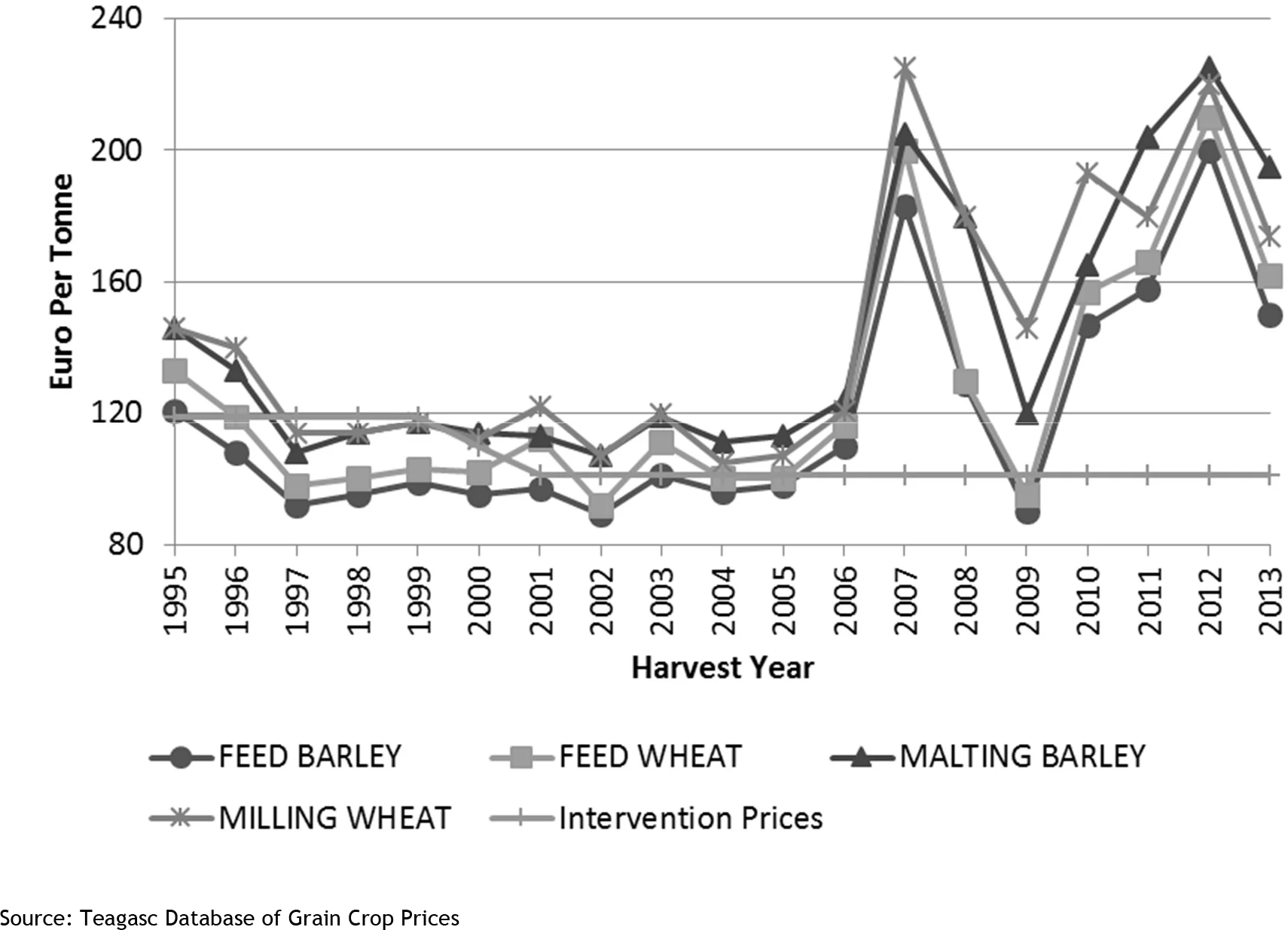
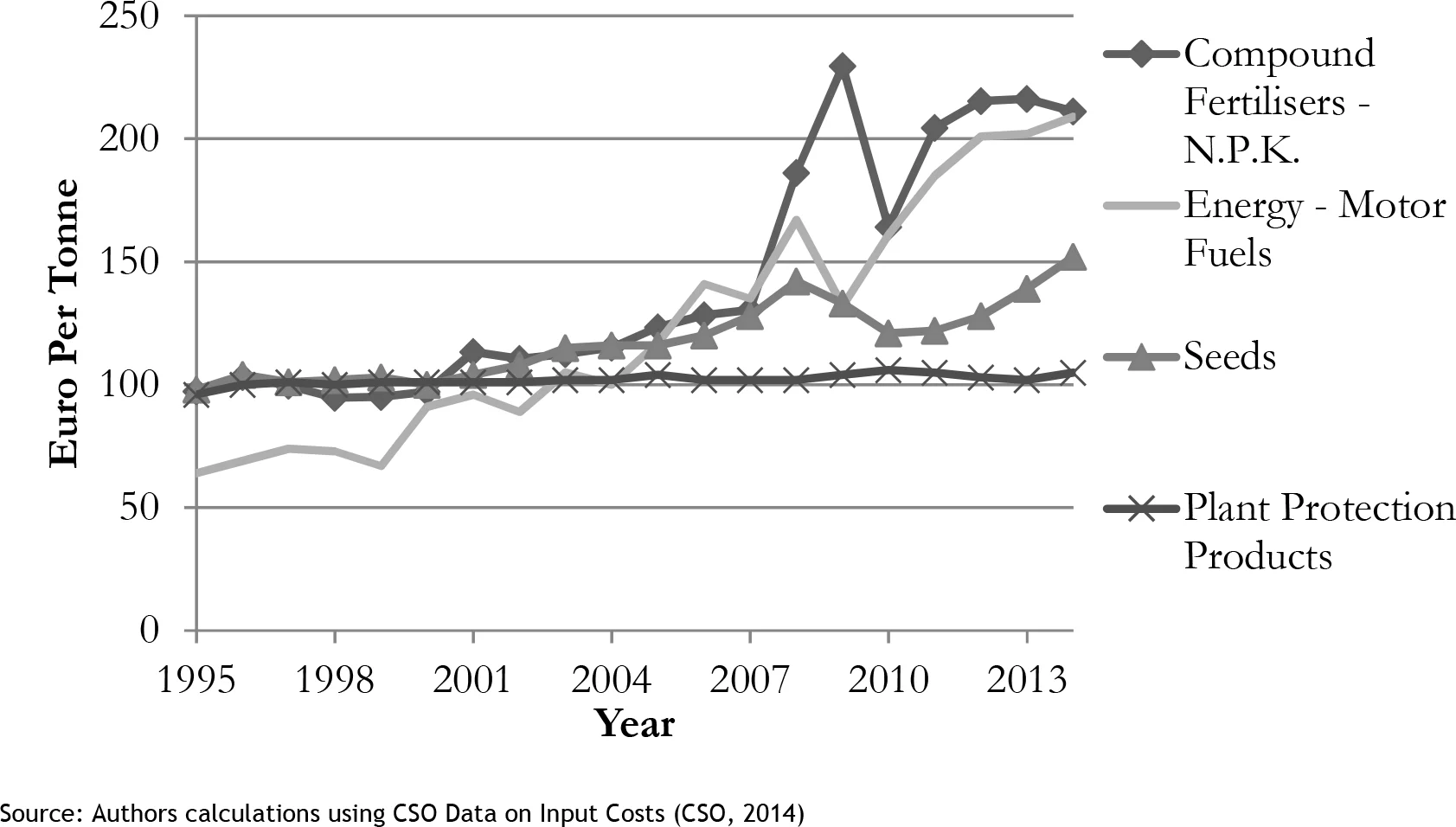
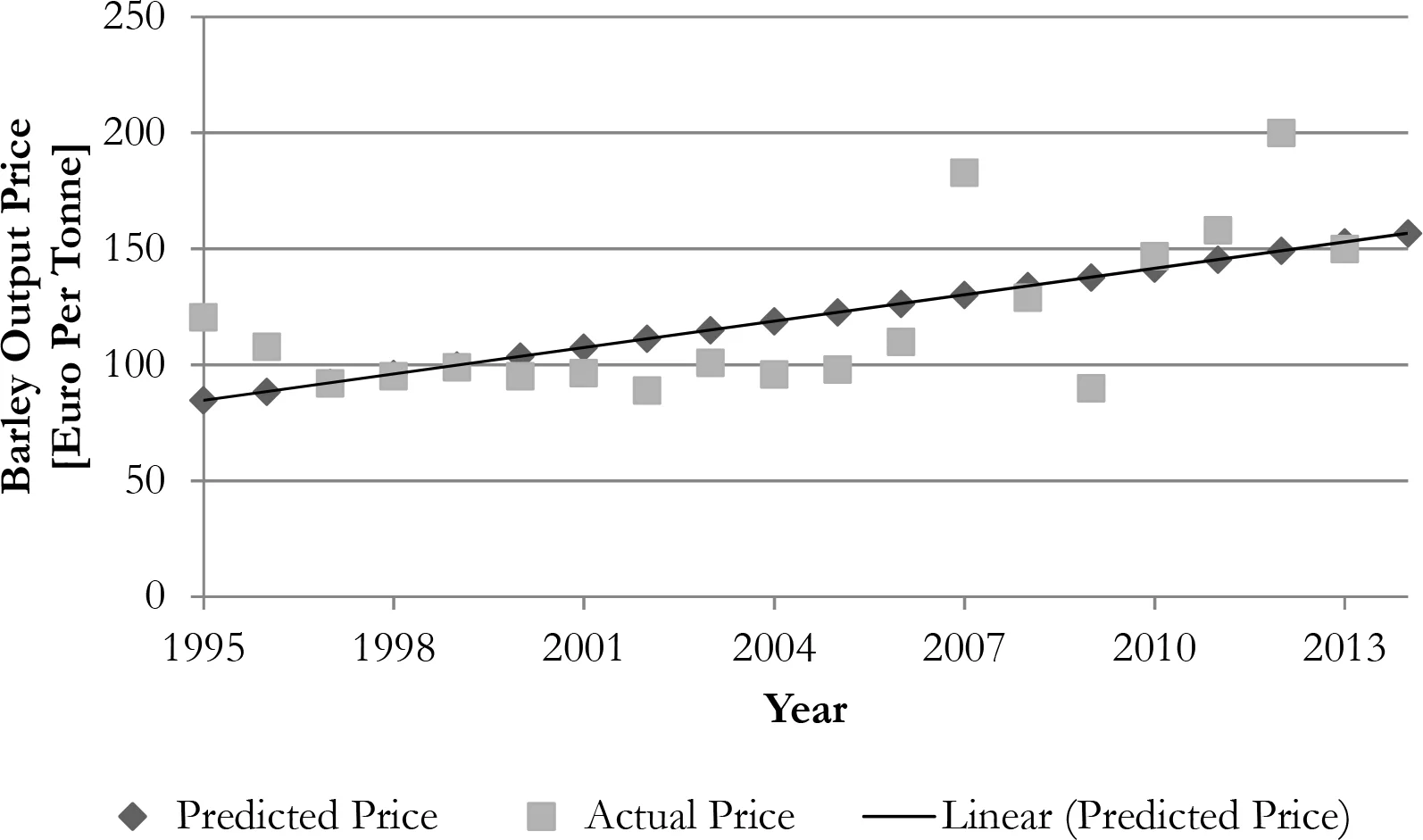
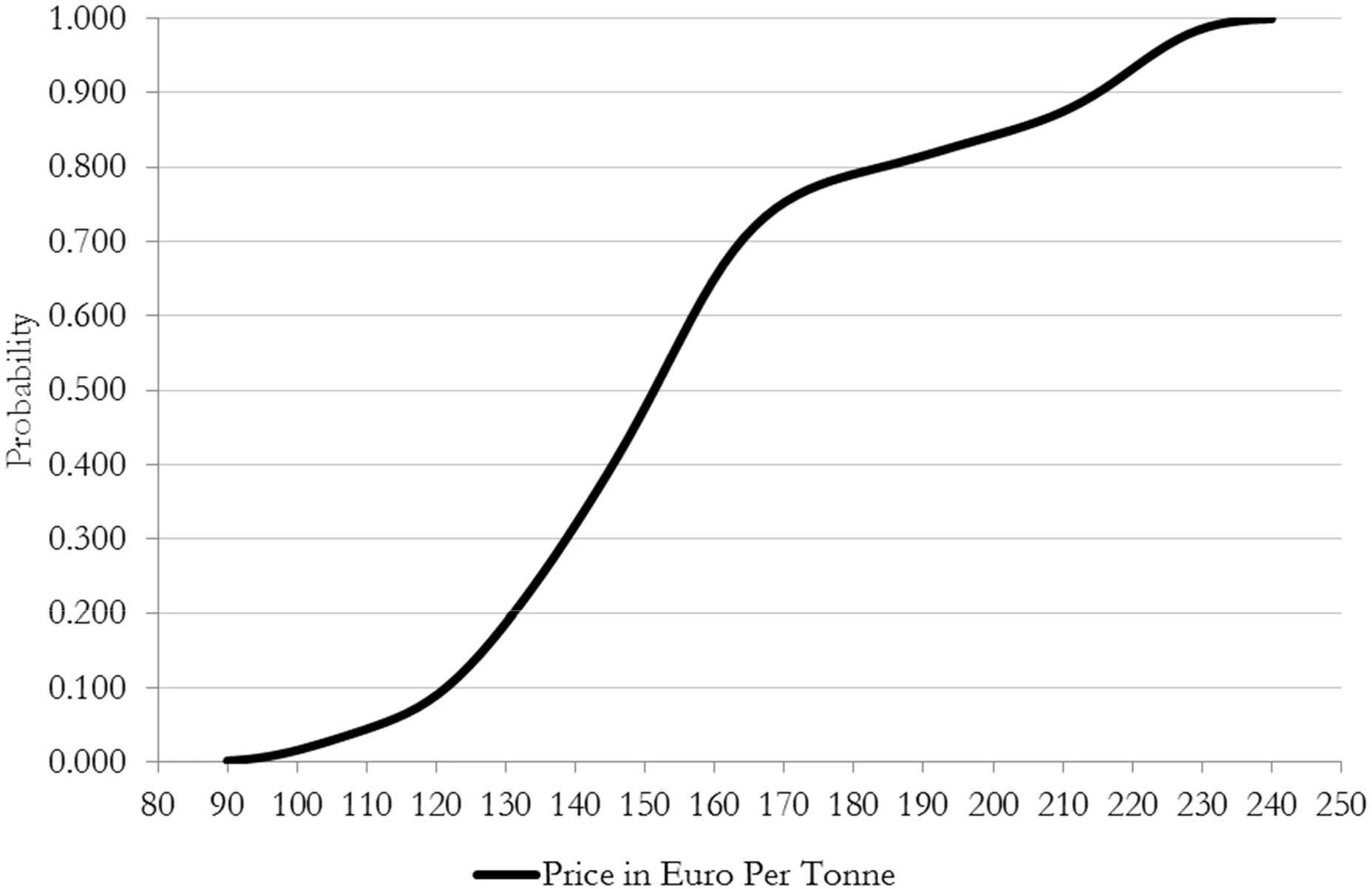
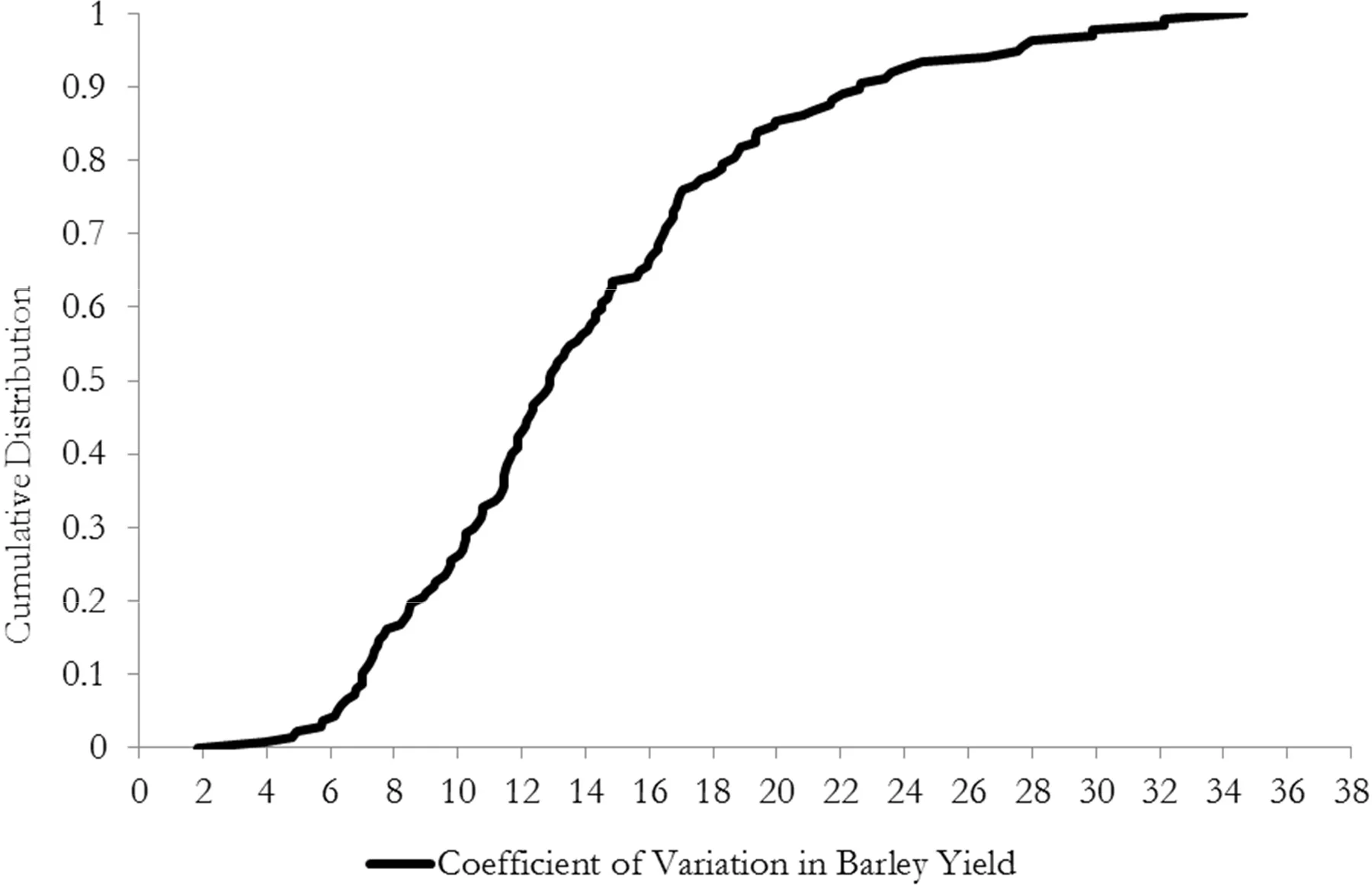
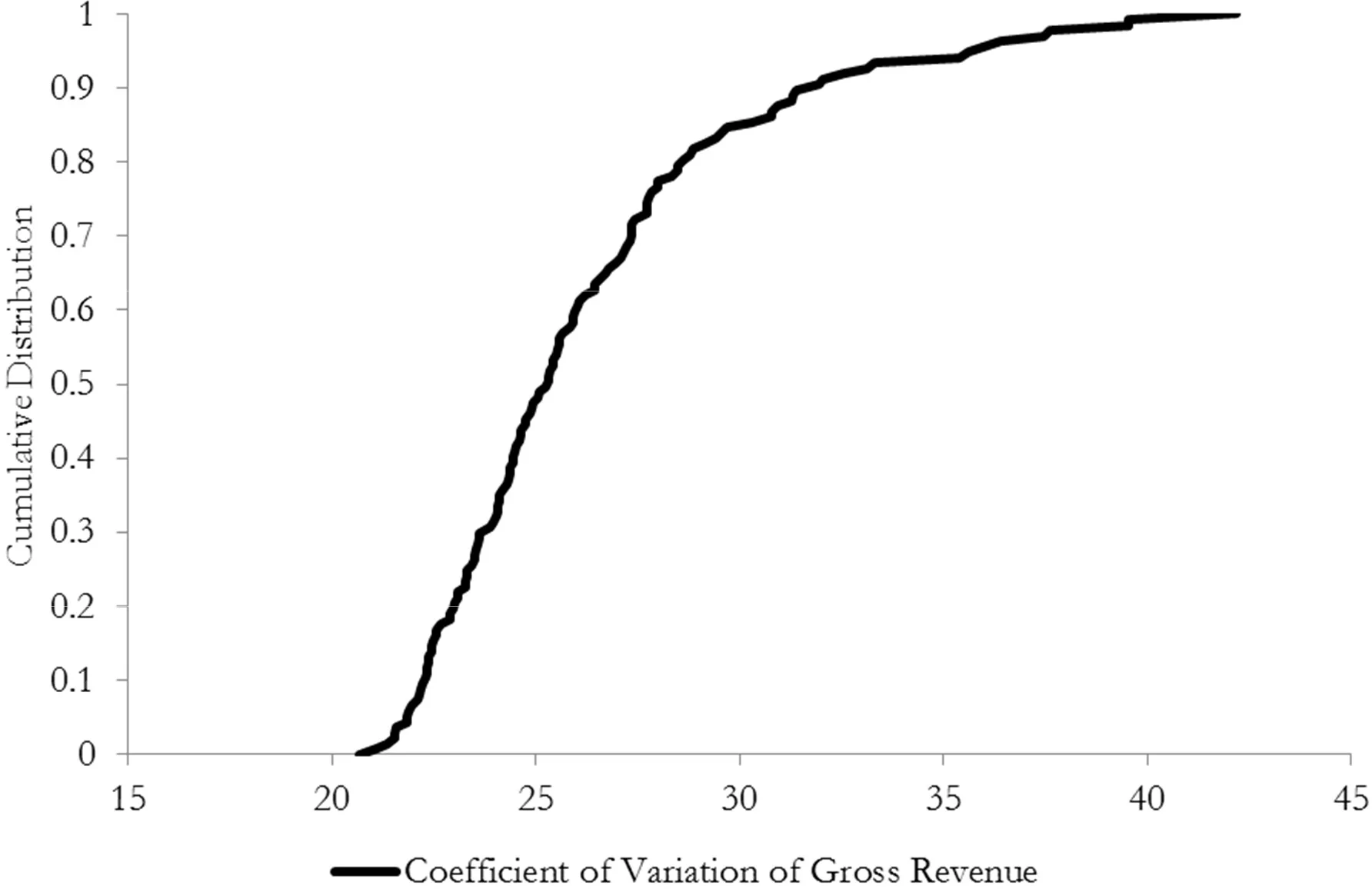
Figure 1. Historical price trends for selected grain crops (€).Figure 2. Cost indices for key inputs at sowing time (Index 2000)1.Figure 3. Actual and linear predicted spring barley price (€) 1995–2013.Figure 4. Cumulative distribution function of the feed barley price in 2014.Figure 5. Cumulative distribution of the variability in barley yield in 2014.Figure 6. Cumulative distribution of the variability in market gross revenue.
Tables
Table 1. Statistics for the selected sample and other tillage producers.
Other Tillage Producers
The selected sample
No Spring Barley
Less than Five Years of Spring Barley
Five Years Plus of Spring Barley
Spring Barley Yield [Animal Feed]
N/A
5.69
6.04
Average Spring Barley [Animal Feed] Hectares
0.00
6.54
10.45
Average Malted Spring Barley Hectares
5.69
1.37
0.34
Farm Size [Number of Hectares
59.23
54.03
69.71
Land Owned
51.97
44.44
59.25
Land Rented In
11.02
14.45
15.01
Total Pasture Hectares
30.43
30.63
38.50
Total Tillage Hectares
24.28
20.36
27.97
Number of Crops in Each Year
1.11
1.38
1.59
Mainly Tillage (0,1)
0.37
0.47
0.51
Specialist Dairy (0,1)
0.20
0.13
0.06
Livestock Units
59.48
56.80
69.73
Livestock Units Per Hectare
1.07
1.01
0.97
Farm Operator Age
50.99
51.90
55.98
Mean Farm Income
38,353
31,140
36,750
Mean Market Farm Income
19,790
15,446
11,780
Mean Single Farm Payment
17,482
14,722
23,991
Off-Farm Employment Operator
0.34
0.38
0.24
Off-Farm Employment Spouse
0.23
0.31
0.28
Sample size
49
240
138
Source: Authors Calculations using Teagasc National Farm Survey Data 2005–2013.
Table 2. Parameters for an empirical distribution of feed barley price in 2014.
Historical Ranking
Deterministic Component
Sorted Fractional Deviates Dct
Cumulative Probability (F(Dc)
Min
156.736
−0.364135974
0
1
156.736
−0.346796166
0.0263
2
156.736
−0.200781935
0.0789
3
156.736
−0.19998511
0.1316
4
156.736
−0.19211783
0.1842
5
156.736
−0.12981906
0.2368
6
156.736
−0.12203359
0.2895
7
156.736
−0.10178267
0.3421
8
156.736
−0.08118956
0.3947
9
156.736
−0.03725432
0.4474
10
156.736
−0.01925512
0.5
11
156.736
−0.00869402
0.5526
12
156.736
−0.00817022
0.6053
13
156.736
−0.002380722
0.6579
14
156.736
0.038333195
0.7105
15
156.736
0.086928907
0.7632
16
156.736
0.219717674
0.8158
17
156.736
0.34089299
0.8684
18
156.736
0.405517738
0.9211
19
156.736
0.424213082
0.9737
Max
156.736
0.445423736
1
Table 3A. The variability of market gross margin across the distribution.
Coefficient of Variation
Standard Deviation
25th Percentile
Median
75th Percentile
25th Percentile
Median
75th Percentile
Market Gross Revenue
23.31
25.25
27.76
1780.08
3420.50
6524.20
Market Gross Margin
54.96
69.77
119.43
1811.45
3531.71
6556.58
Table 3B. Effect of forward contracting on variability of market gross margin.
Coefficient of Variation (%)
Standard Deviation
25th Percentile
Median
75th Percentile
25th Percentile
Median
75th Percentile
Market Gross Margin
54.96
69.77
119.43
1811.45
3531.71
6556.58
Margin with Forward Selling Option A
48.04
62.32
112.57
1639.82
3195.35
5474.91
Margin with Forward Selling Option B
42.11
57.20
97.93
1433.87
2812.42
4703.06
A-20% of expected production @ 150 euro per tonne B-35% of expected production @ 150 euro per tonne.
Table 4. Average coefficient of variation by farm system 2005–20137.