Cite as: I. Saglam; 2018; A new heuristic in mutual sequential mate search; International Journal of Microsimulation; 11(2); 122–145. doi: 10.34196/ijm.00182
Abstract
In this paper, we propose a new heuristic to be used as a mate search strategy in the human mate choice model of Todd and Miller (1999). This heuristic, which we call Take the Weighted Average with the Next Desiring Date, is a plausible search rule in terms of informational assumptions. Our simulations show that this new heuristic is in terms of mating likelihood almost as good as, and in terms of mating speed always better than, the most successful —yet also unrealistic— heuristic of Todd and Miller (1999), namely the Mate Value-5 rule, which assumes that individuals in the mating population completely know their own mate values before interacting with any date. The success of our heuristic stems from its extreme power to lead an average individual in the mating population to always underestimate his/her own mate value during the adolescence (learning) phase of the mating process. While our new heuristic is also found to be successfully egalitarian in pairing up individuals, it does not perform well in terms of marital stability.
This article contains 12 figures and 3 tables.
Figures
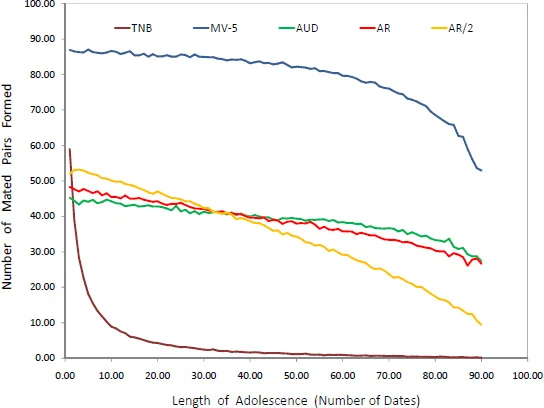
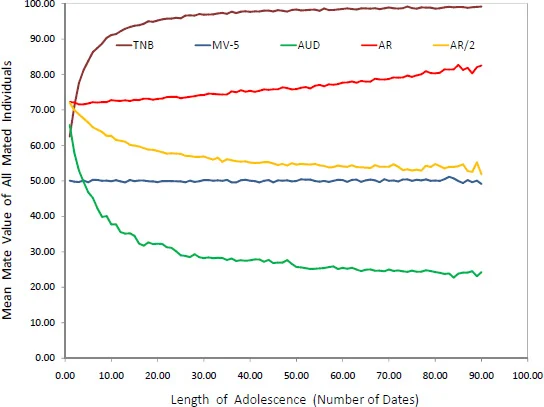
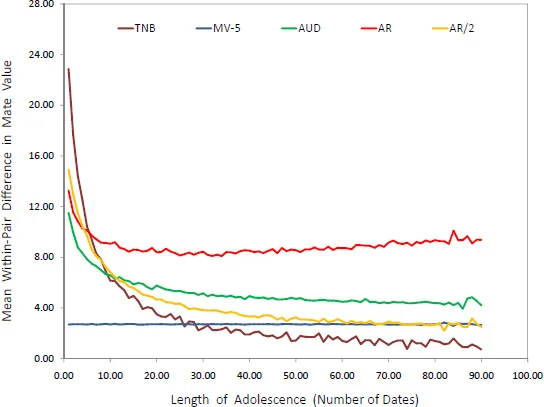
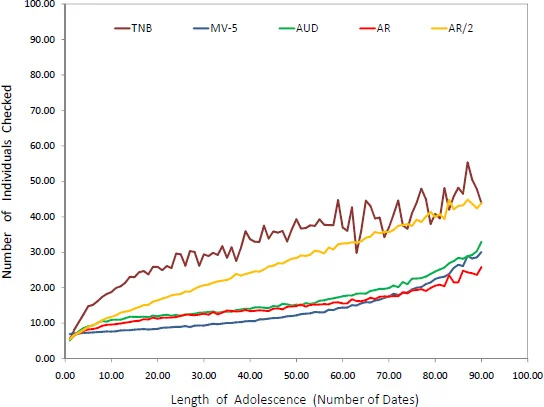
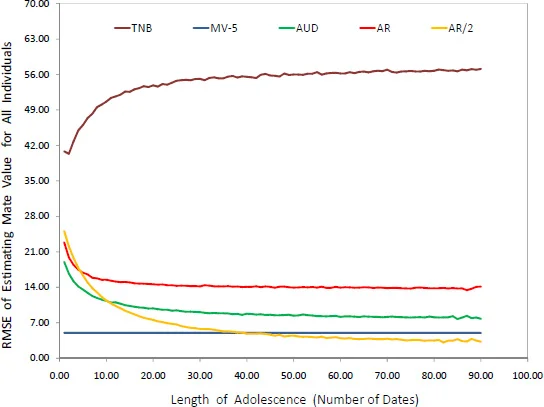
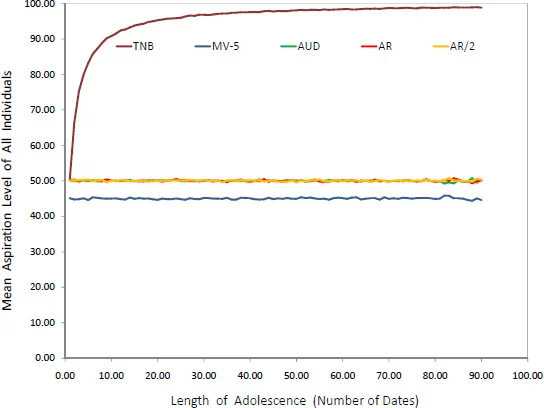
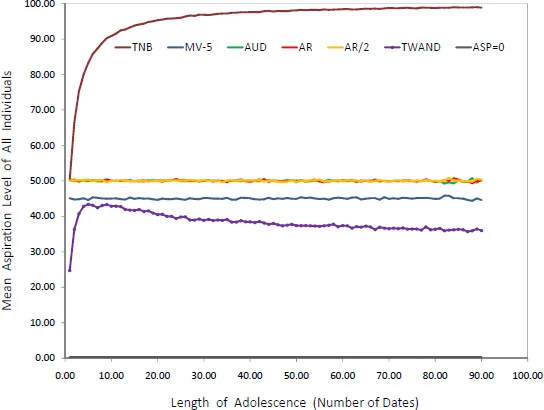
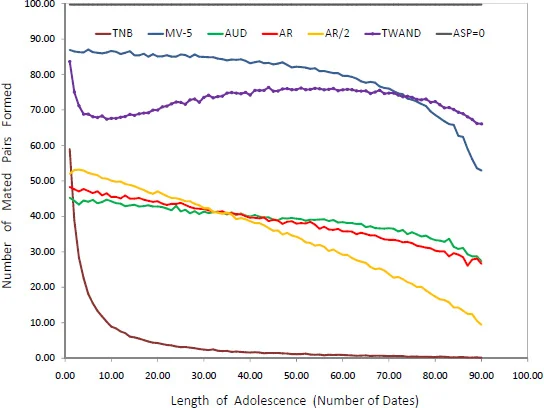
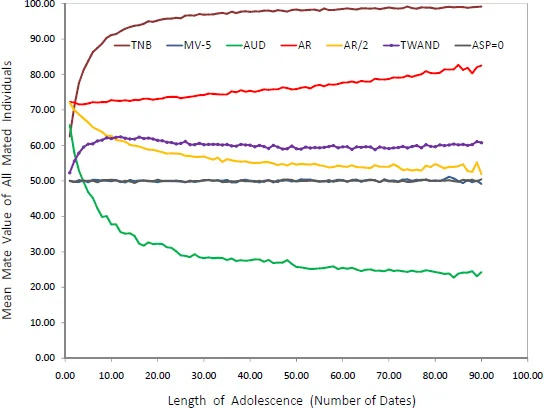
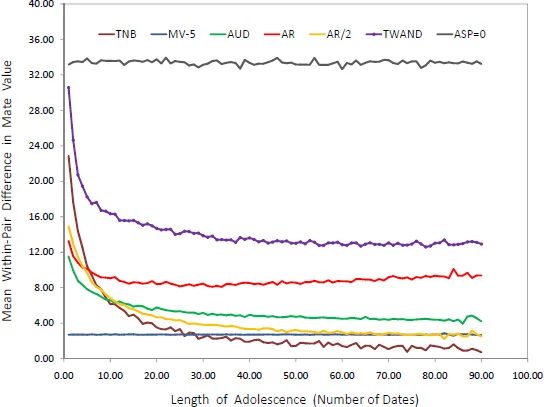
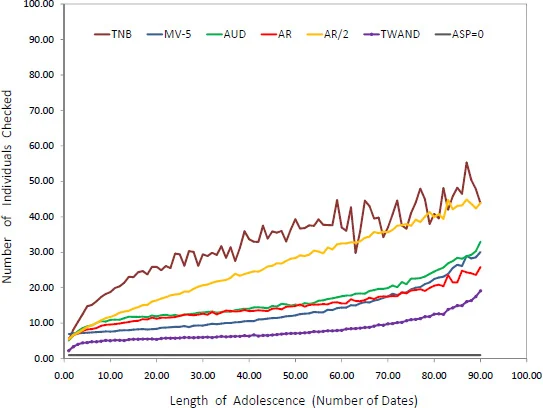
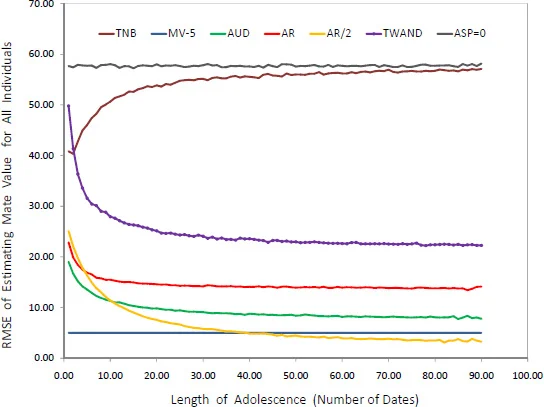
Figure 1. Number of mated pairs formed under the search rules of Todd and Miller (1999).Figure 2. Mean mate value of all mated individuals under the search rules of Todd and Miller (1999).Figure 3. Mean within-pair difference in mate values under the search rules of Todd and Miller (1999).Figure 4. Number of individuals checked under the search rules of Todd and Miller (1999).Figure 5. Root Mean Squared Error (RMSE) generated by the search rules of Todd and Miller (1999).Figure 6. Mean aspiration level of all individuals under the search rules of Todd and Miller (1999).Figure 7. Mean aspiration level of all individuals under all studied search rules.Figure 8. Number of mated pairs formed under all studied search rules.Figure 9. Mean mate value of all mated individuals under all studied search rules.Figure 10. Mean within-pair difference in mate values under all studied search rules.Figure 11. Number of individuals checked under all studied search rules.Figure 12. RMSE generated by all studied search rules.
Tables
Table 1. The mean and standard deviation values for the success of search rules by Todd and Miller (1999).
Success Measure
TNB
MV-5
AUD
AR
AR/2
Number of Mated Pairs Formed
4.172 (8.456)
79.683 (4.110)
39.018 (5.835)
38.523 (12.327)
34.751 (12.327)
Mean Mate Value of All Mated Individuals
95.773 (5.940)
50.029 (0.303)
29.469 (7.762)
76.196 (3.080)
56.664 (4.129)
Mean Within-Pair Difference in Mate Valu
3.186 (3.626)
2.706 (0.029)
5.215 (1.257)
8.904 (0.741)
4.171 (2.345)
Number of Individuals Checked
32.841 (10.141)
13.490 (6.032)
16.317 (5.810)
14.674 (4.372)
26.336 (10.787)
Table 2. The mean and standard deviation values for the success of Mate Values for the success of Mate Value-α.
Success Measure
α = 2
α = 5
α = 8
Number of Mated Pairs Formed
78.018 (0.418)
79.683 (8.045)
89.734 (0.483)
Mean Mate Value of All Mated Individuals
49.966 (0.418)
50.029 (0.303)
50.023 (0.376)
Mean Within-Pair Difference in Mate Valu
1.201 (0.013)
2.706 (0.029)
4.172 (0.029)
Number of Individuals Checked
12.509 (0.159)
13.490 (0.159)
5.008 (0.058)
Table 3. The mean and standard deviation values for success corresponding to all studied search rules.