Cite as: A. Jaccard, L. Retat, M. Brown, L. Webber, Z. Chalabi; 2018; Global sensitivity analysis of a model simulating an individual’s health state through their lifetime; International Journal of Microsimulation; 11(3); 100–121. doi: 10.34196/ijm.00190
Abstract
In public health, model predictions are used by decision-makers to minimise health burdens and monetary costs of non-communicable diseases. Fully understanding the uncertainty underlying those predictions is thus crucial. One-parameter-at-a-time methods are typically used for model uncertainty analysis but are often impractical for large-scale nonlinear models containing a very large number of parameters and cannot be used to examine the uncertainty associated with parameter interaction. An individual-based chronic disease model was developed to model the impact of Body Mass Index (BMI) trends on the rates of non-communicable diseases. The model was simulated for overweight and obese male case studies and used to predict their life expectancy, disease-free life expectancy and quality-adjusted life years. Uncertainty was estimated by carrying out a global sensitivity analysis by assessing the contribution to the overall uncertainty from a selection of parameters individually and from their interactions. Results show that the uncertainty of the BMI input parameter had the greatest impact on the disease-free life expectancy and quality- adjusted life year uncertainty compared to the relative risks of colorectal cancer and stroke. Life expectancy uncertainty was influenced by BMI and colorectal cancer relative risks. Global sensitivity analysis enables the assessment of the parametric uncertainty for individual parameters and their interaction. This allows the communication of the uncertainty of different policy options. A strategy for scaling-up uncertainty analysis from an individual to a population level is discussed.
This article contains 6 figures and 8 tables.
Figures
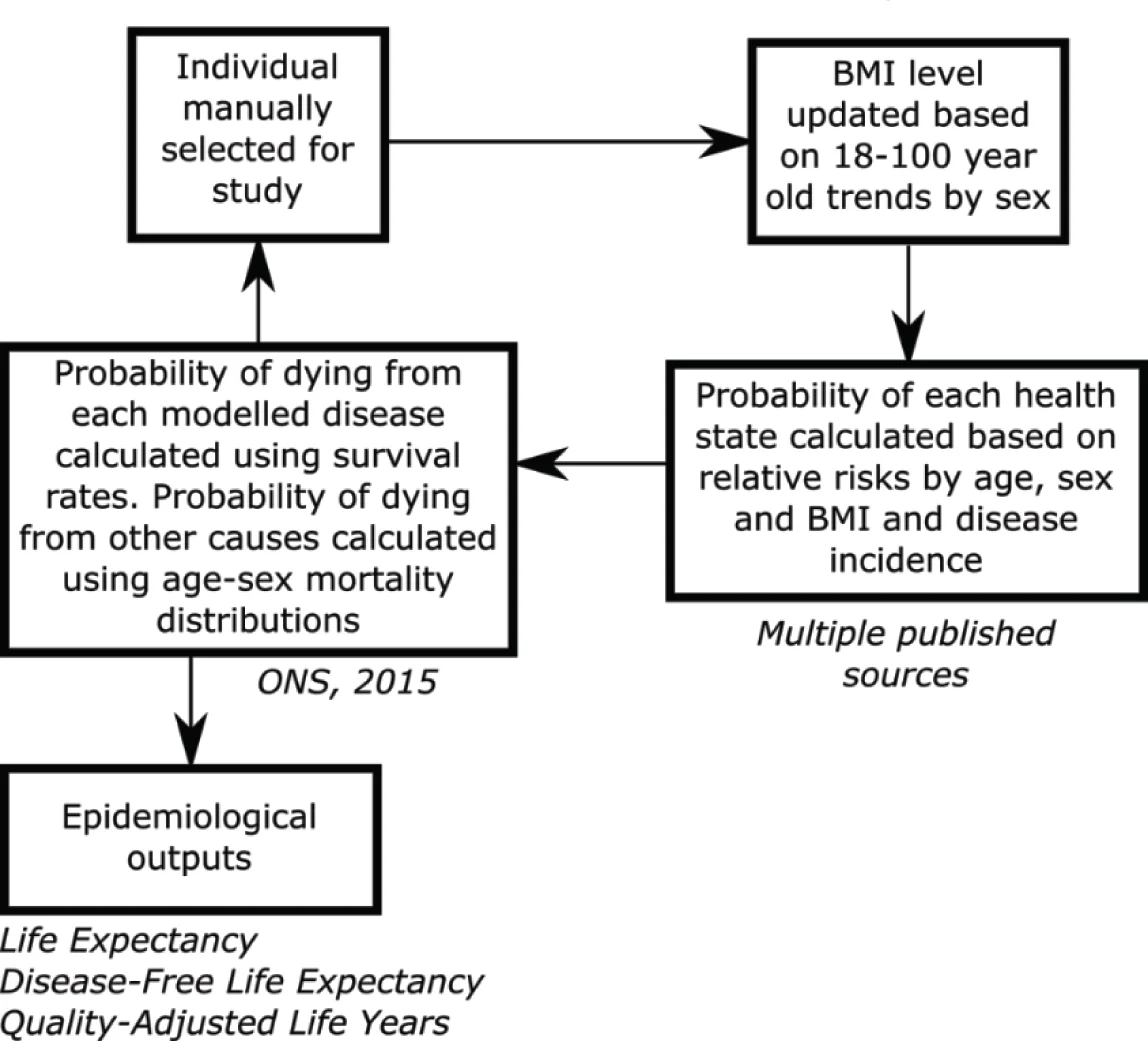
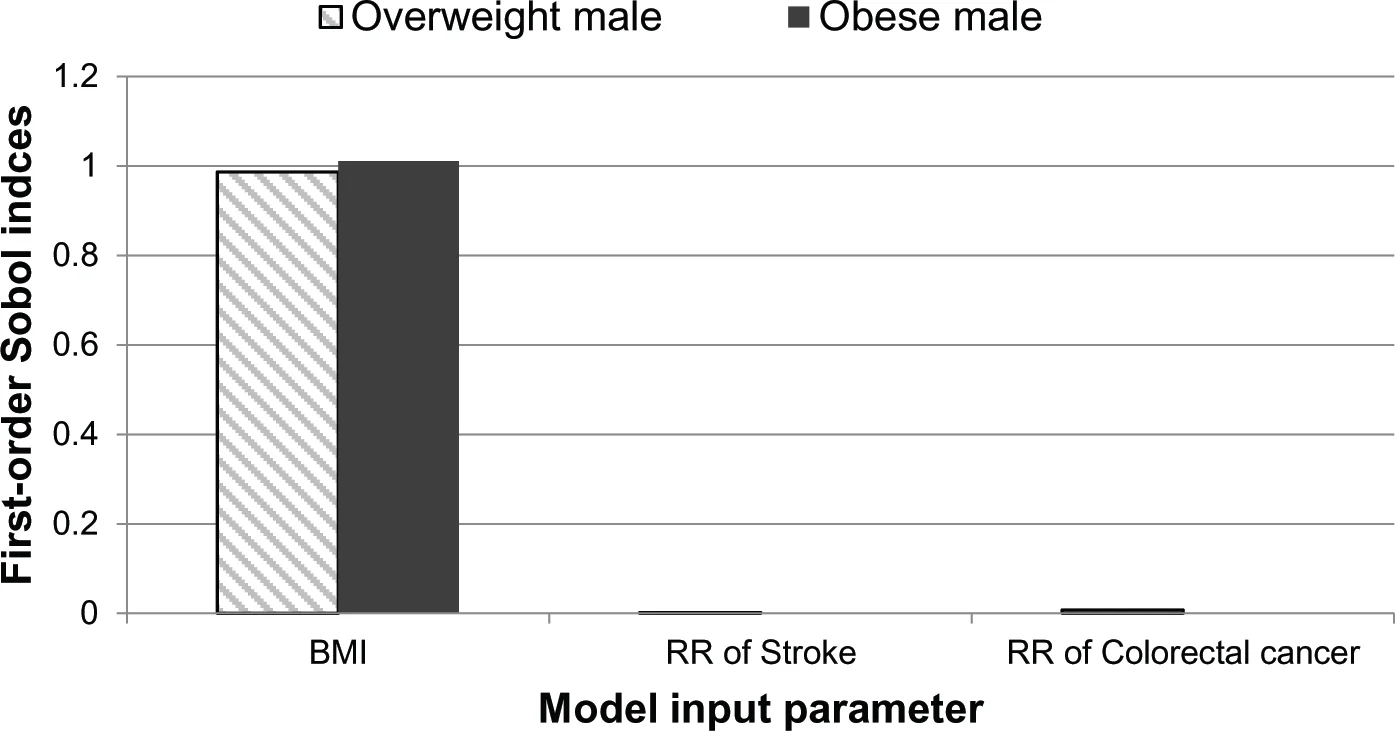
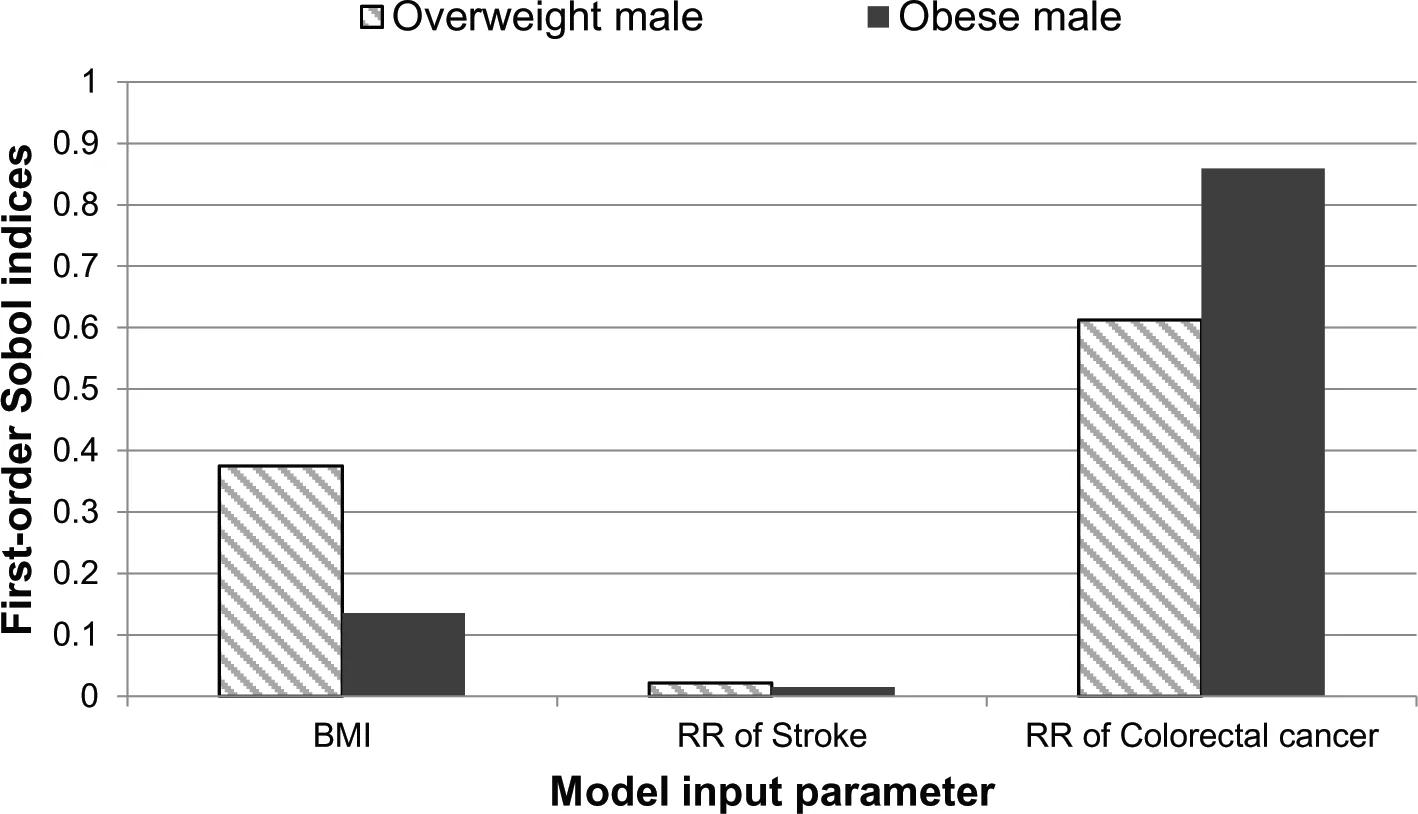
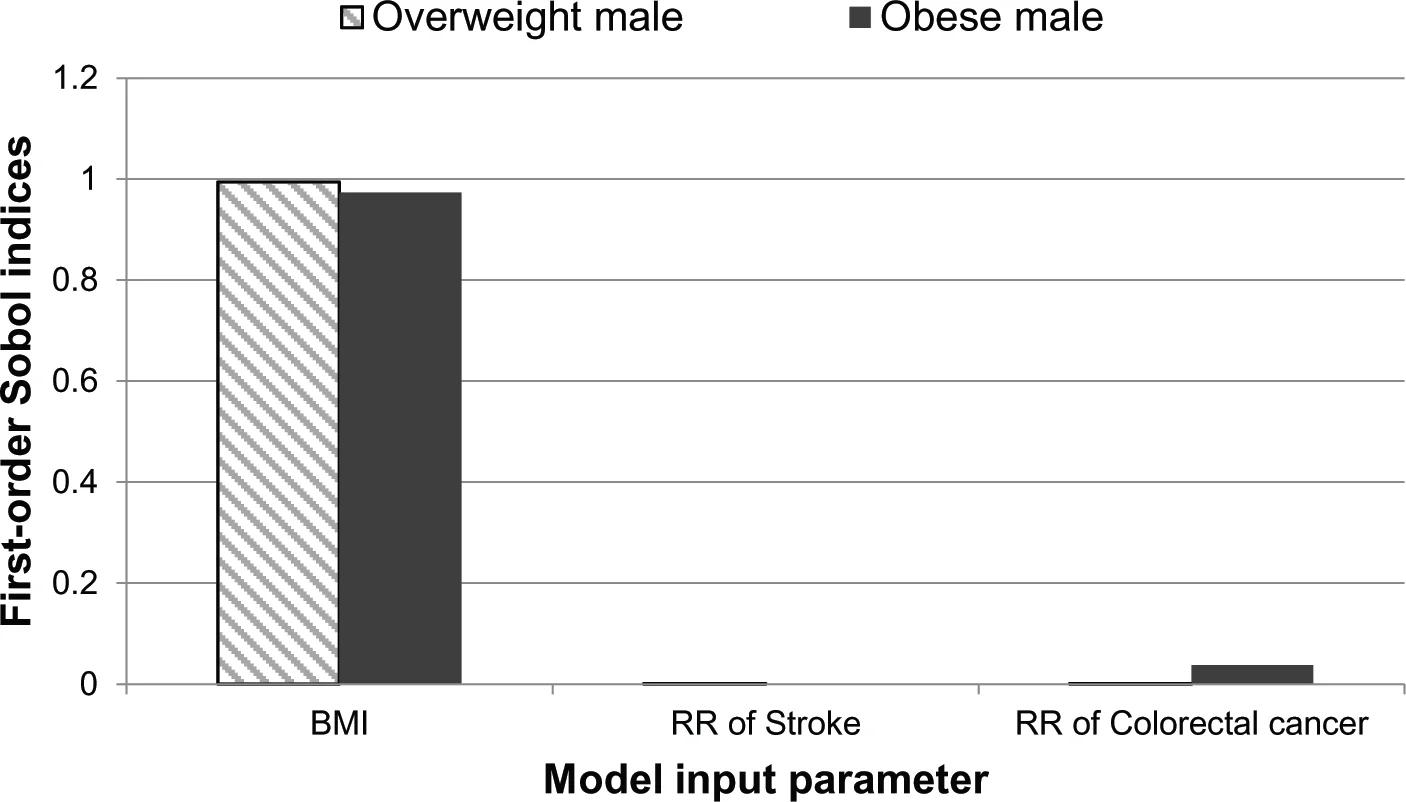
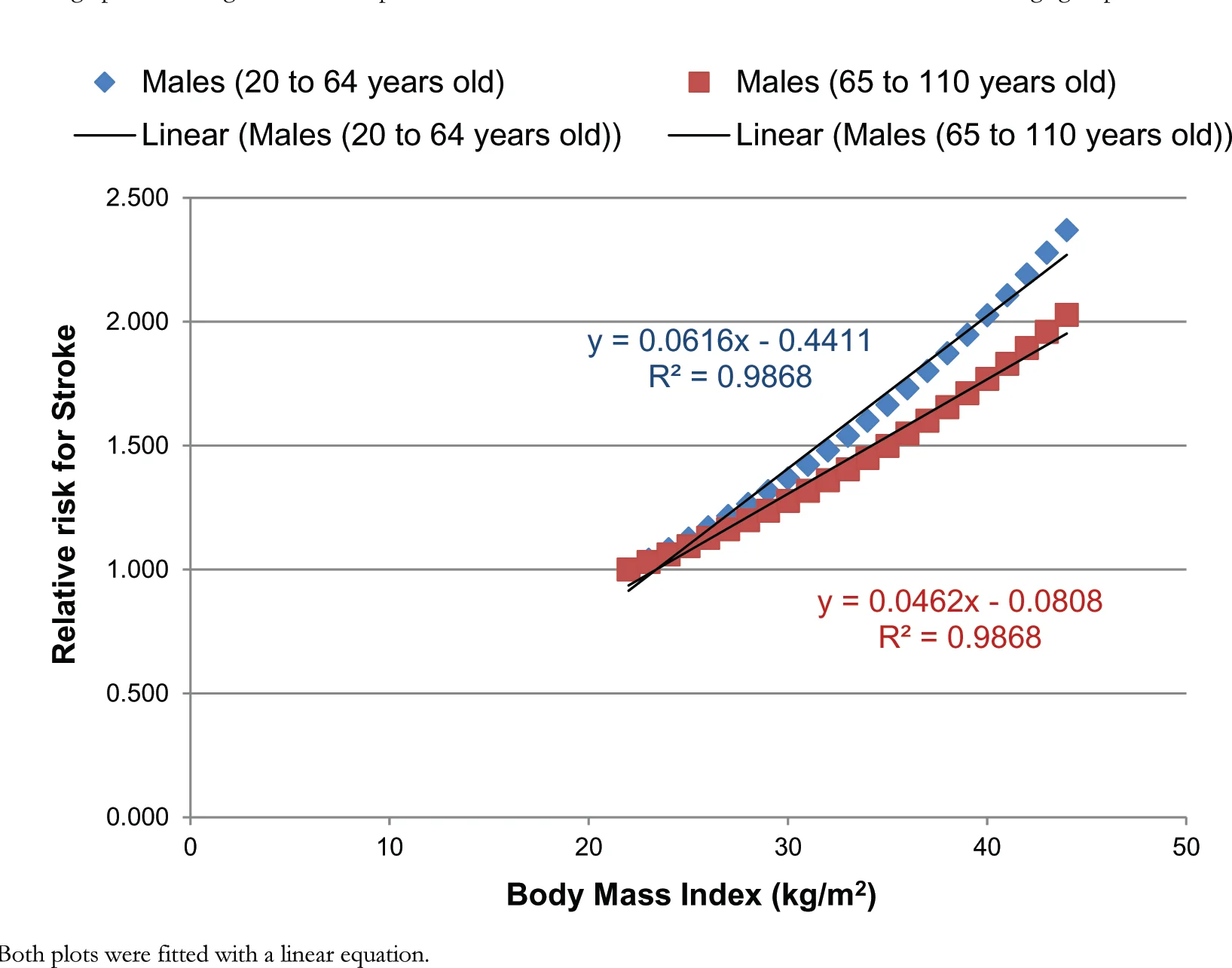
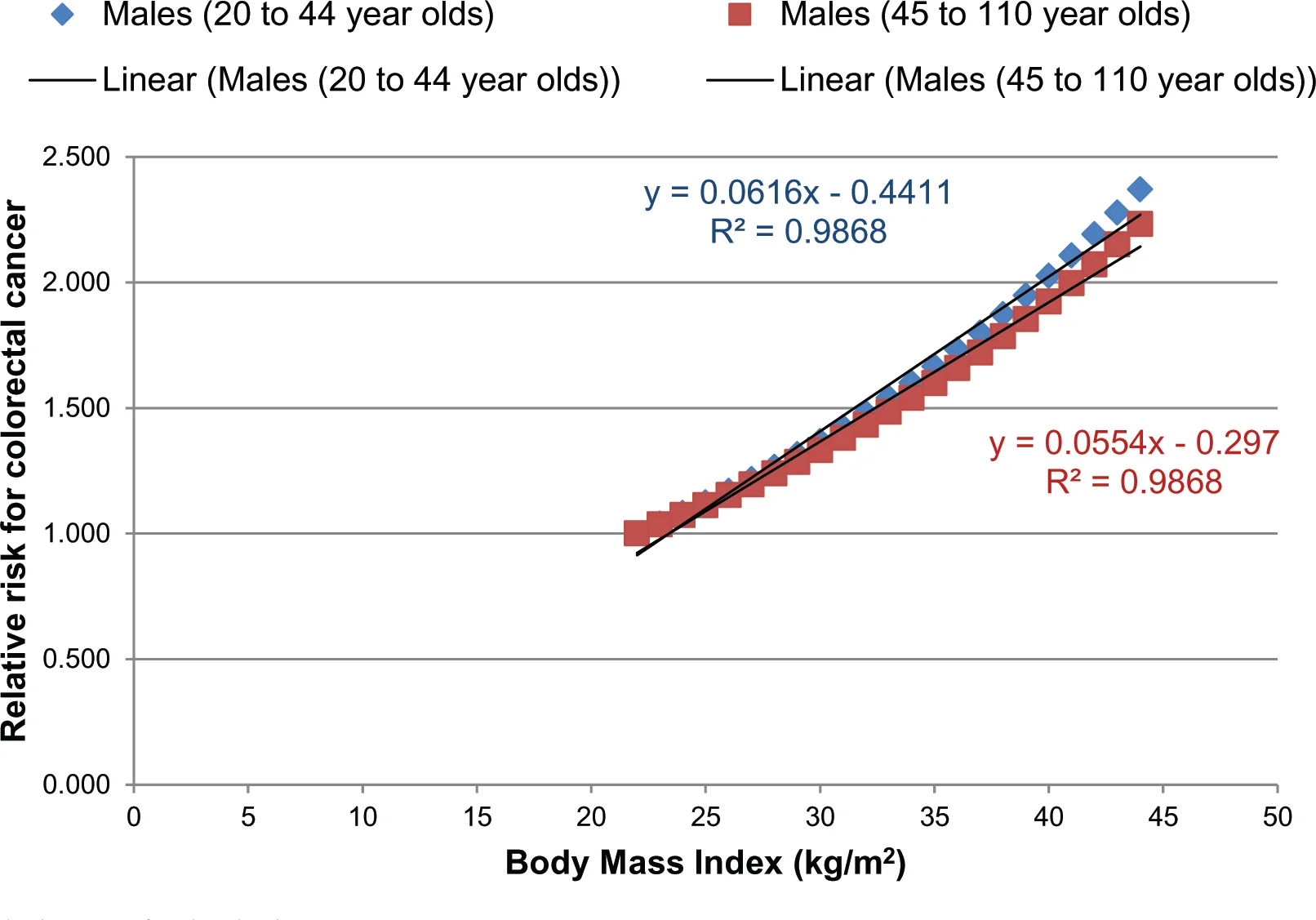
Figure 1. Schematic of the individual-based chronic disease model used to simulate individuals through time.Figure 2. A graphical illustration of the first-order Sobol indices for each model input parameter: BMI, relative risk of stroke and relative risk of colorectal cancer for disease-free life expectancy.Figure 3. A graphical illustration of the first-order Sobol indices for each model input parameter: BMI, relative risk of stroke and relative risk of colorectal cancer for life expectancy.Figure 4. A graphical illustration of the first-order Sobol indices for each model input parameter: BMI, relative risk of stroke and relative risk of colorectal cancer for quality-adjusted life year.Figure B.1. A graph illustrating the relationship between the RR for stroke and BMI for males for two different age groups.Figure B.2. A graph illustrating the relationship between the RR for colorectal cancer and BMI for males for two different age groups.
Tables
Table 1. Summary of the BMI model parameters and their variances used in the sensitivity analysis.
Model parameter
Mean
Standard deviation
Lower bound
Upper bound
Healthy weight BMI probability (BMI < 25 kg/m2)
0.252
0.078
0.117
0.387
Overweight BMI probability (25 ≤ BMI < 30 kg/m2)
0.314
0.083
0.170
0.459
Obese BMI probability (BMI ≥ 30 kg/m2)
0.434
0.107
0.248
0.619
Mean BMI category probability
0.333
0.090
0.177
0.490
Mean BMI1 level
25.192
20.591
27.028
Case study 1 BMI level
27.5
22.899
29.336
Case study 2 BMI level
37.5
35.207
41.644
Table 2. Summary of the relative risk model parameters and their variances used in the sensitivity analysis.
Model parameter
Mean
Standard deviation
Lower bound
Upper bound
Relative risk stroke for overweight
1.213
0.056
1.116
1.310
Relative risk stroke for obese
1.758
0.107
1.573
1.944
Relative risk colorectal cancer overweight for
1.231
0.082
1.089
1.373
Relative risk colorectal cancer obese for
1.823
0.224
1.435
2.211
Table 3. Scalar additives z1, z2 and z3 sampled by PSUADE.
PSUADE parameter
Lower bound for overweight
Upper bound for overweight
Lower bound for obese
Upper bound for obese
z1
22.899
29.336
35.207
41.644
z2
1.116
1.310
1.573
1.944
z3
1.089
1.373
1.435
2.211
Table 4. Summary of the mean, standard deviation and variance for the disease-free life expectancy for the two case studies.
Case study
Mean (years)
Standard deviation (years)
Variance (years2)
Overweight male
63.47
3.41
11.59
Obese male
48.32
3.14
9.87
Table 5. Summary of the mean, standard deviation and variance for the life expectancy for the two case studies.
Case study
Mean (years)
Standard deviation (years)
Variance (years2)
Overweight male
79.76
0.11
0.01
Obese male
79.17
0.31
0.09
Table 6.
Case study
Mean (years)
Standard deviation (years)
Variance (years2)
Overweight male
75.09
1.01
1.02
Obese male
70.06
1.06
1.12
Table C.1. Description of the categories used for the RF BMI.
ONS Cancer Survival in England: adults diagnosed between 2009 and 2013 and followed up to 2014 (Office for National Statistics, 2015) & ONS Cancer Survival in England: 10 year survival rates adults diagnosed between 2010–2011 and followed up to 2012 (Office for National Statistics, 2013)