Methodology, Dynamic microsimulation

Research articles · Aug 31, 2019

Using trajectory analysis to test and illustrate microsimulation outcomes

Janne Salonen, Heikki Tikanmäki, Tapio Nummi

Finnish Centre for Pensions, Helsinki, Finland; University of Tampere, Tampere, Finland

Volume 12(2) Summer 2019

Cite as: J. Salonen, H. Tikanmäki, T. Nummi; 2019; Using trajectory analysis to test and illustrate microsimulation outcomes; International Journal of Microsimulation; 12(2); 3–17. doi: 10.34196/ijm.00198

Abstract

We propose a new data-driven way of testing and visualizing dynamic microsimulation outcome data. The proposed statistical methodology is based on trajectory analysis (Nagin, 1999), which can be used to identify several sub-populations from a population measured longitudinally. We briefly introduce the statistical basis of trajectory analysis and discuss its use in the context of microsimulation. Finally, we report our results from the Finnish microsimulation model ELSI (Tikanmäki et al., 2014; Tikanmäki et al., 2015) to illustrate the possibilities and benefits of this technique. Trajectory analysis is available in many statistical software packages (e.g., SAS, R, Stata and Mplus). We conclude that trajectory analysis is a useful tool for investigating microsimulation outcomes.

This article contains 5 figures and 3 tables.

Figures

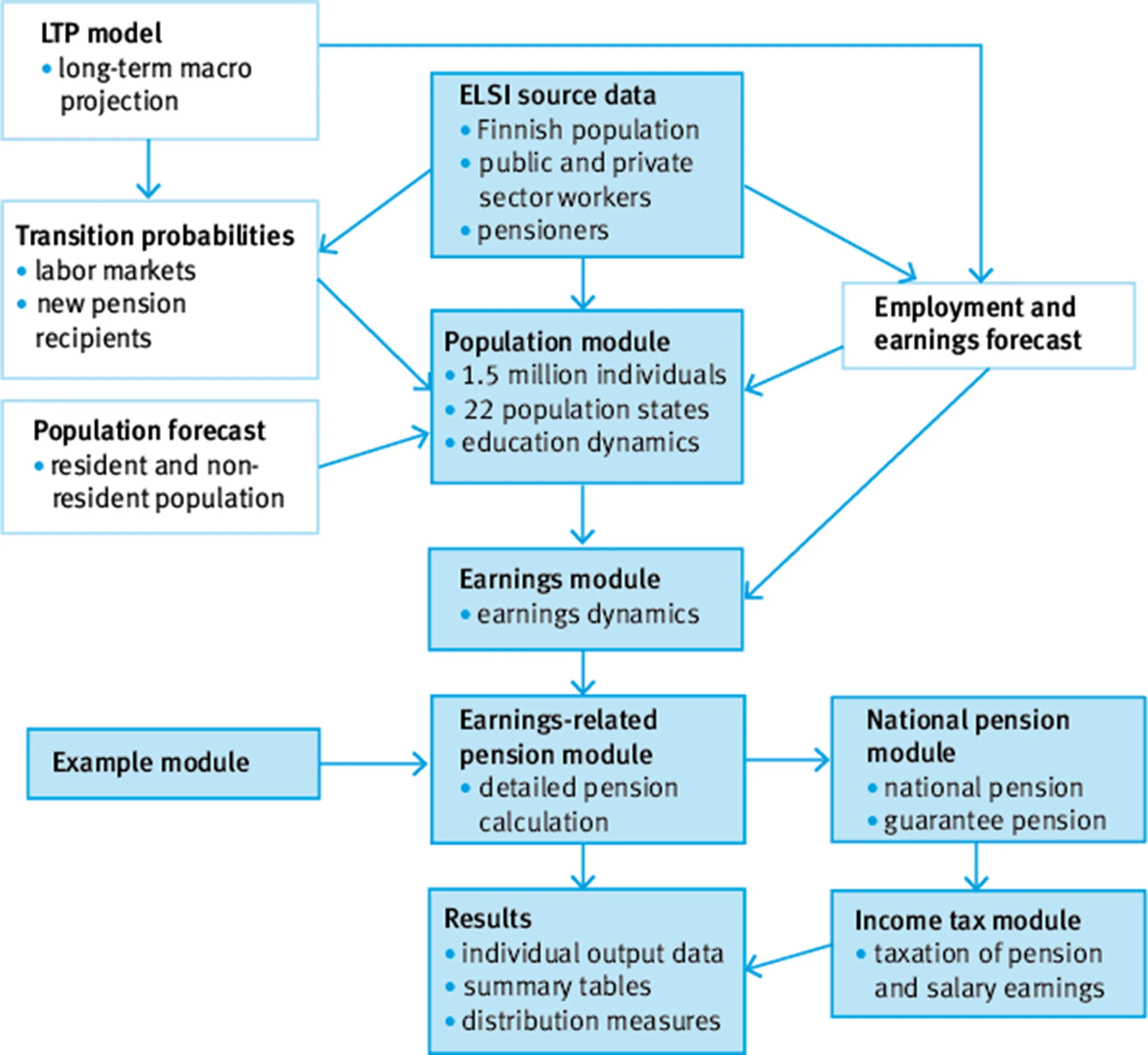
Figure 1. Structure of the ELSI microsimulation model
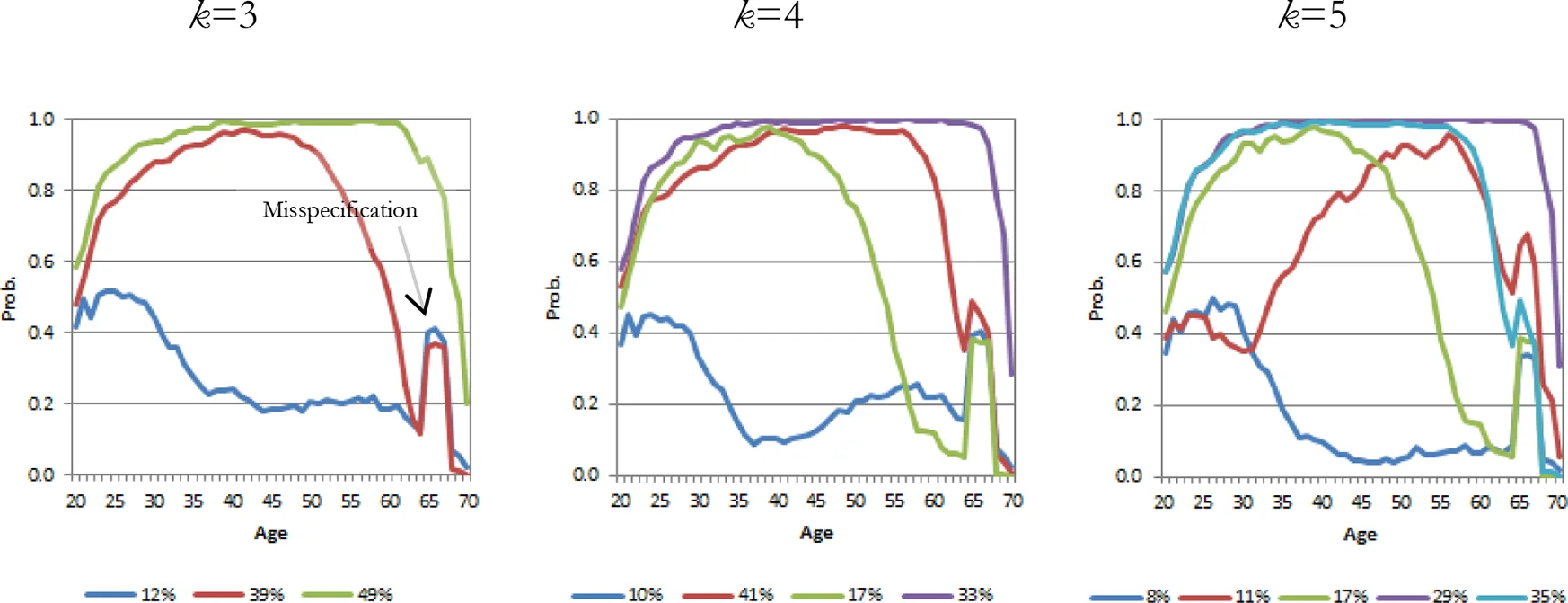
Figure 2. Earnings trajectories
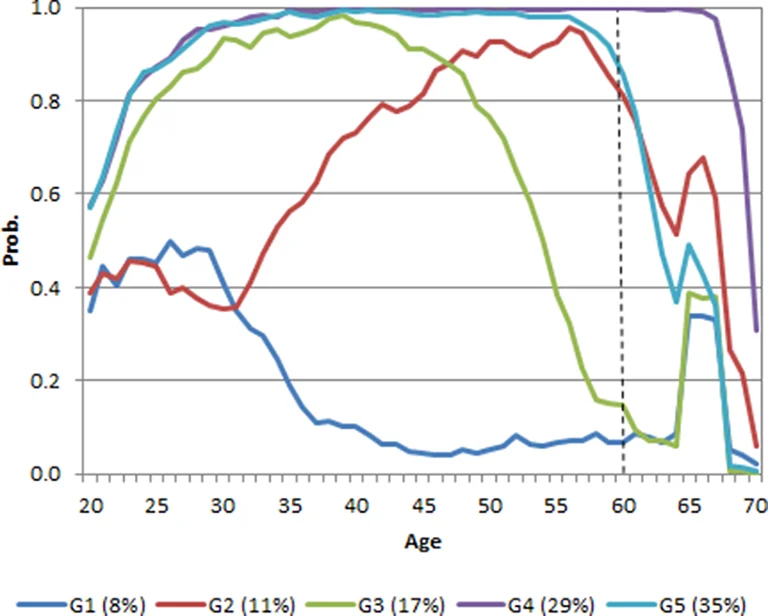
Figure 3. Earnings trajectories, k=5
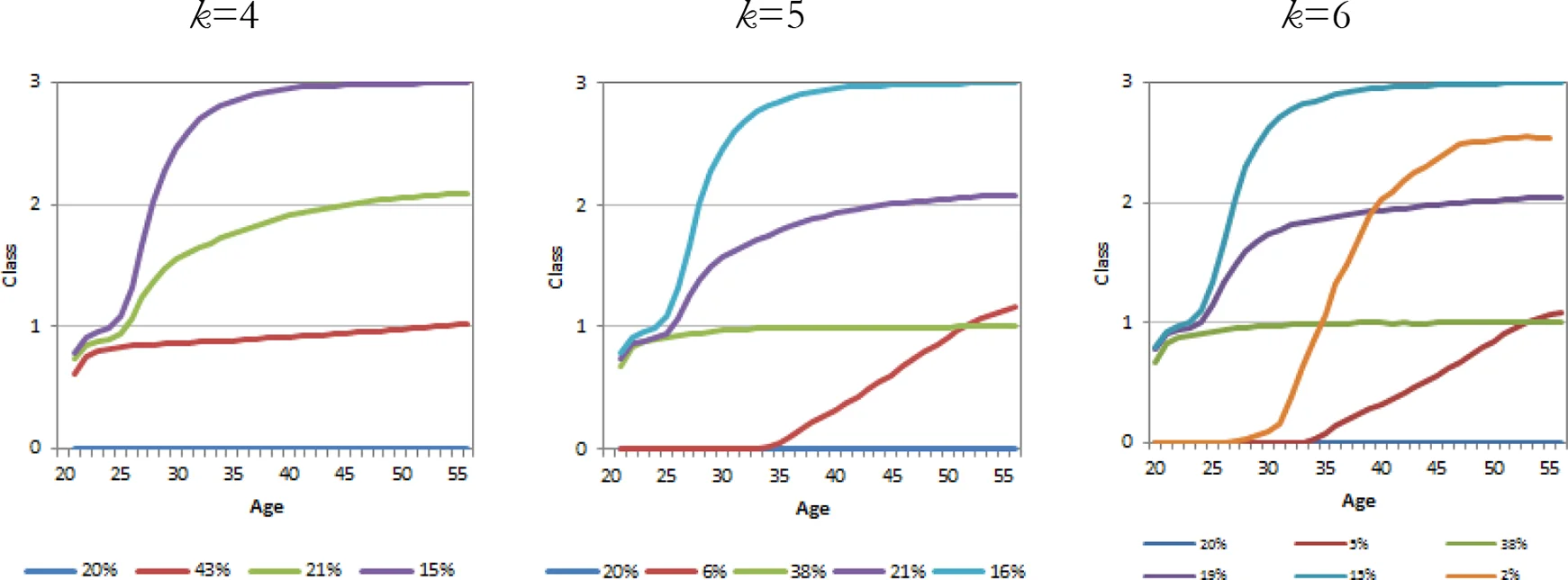
Figure 4. Education trajectories
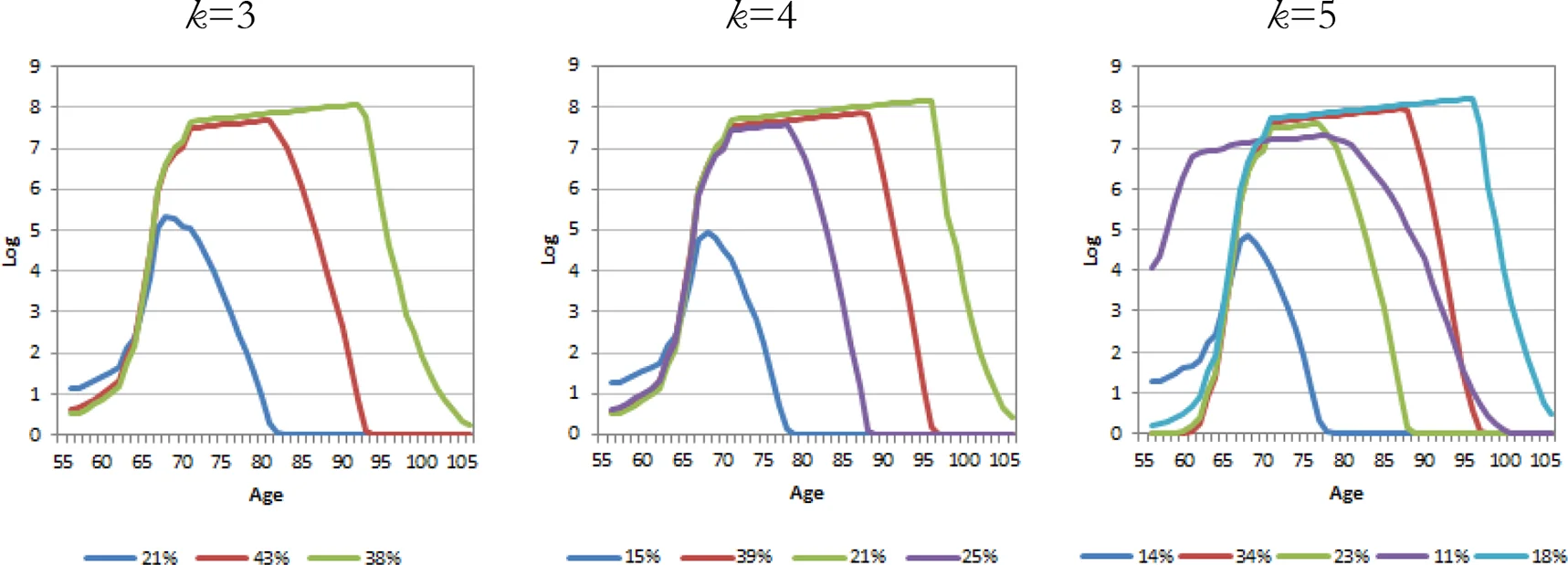
Figure 5. Pension trajectories

Tables

Table 1. BIC scores and number of sub-groups k
Outcome 3 4 5 6
Earnings (N=3,325) −50288.7 −48178.8 −45974.7 −46375.9
Education (N=13,173) −549399.6 −544342.9 −537412.2 −535026.8
Pension (N=10,761) −834881.4 −811092.8 −786210.9 786234.1

Notes: BIC = log(L) −.5 * log(n) k, where L = log likelihood, n = sample size and k = number of parameters.

Table 2. Composition of earnings trajectories at age 60, per cent
G1 (8%) G2 (11%) G3 (17%) G4 (29%) G5 (35%) Total
Active first year 0.8 2.3 2.3 0.5 3.4 2.1
Active second year 0.4 0.6 0.7 0.3 0.9 0.6
Active (working) 2.3 51.1 1.2 89.9 54.2 50.6
Unemployed or in education 1.5 9.7 6.2 1.6 10.4 6.5
Sickness benefits . 1.1 0.4 . 2.5 1.1
Partial disability pension and active . 1.4 0.2 2.3 0.4 1
Partial disability pension and non-active 0.8 1.1 0.9 . 0.7 0.6
Full disability pension 23.4 2.8 26.9 0.5 2.9 7.9
Full disability pension second year 1.1 1.4 3.4 . 2 1.6
Old-age pension . . 0.5 0.1 0.7 0.4
Only national disability pension 15.5 . . . . 1.2
Out of labor markets I 18.9 1.4 17.2 0.3 1.8 5.3
Out of labor markets II 14.3 . 2.5 . 0.8 1.9
Inactive 5.7 18.8 30.8 1.5 15.5 13.8
Deceased 15.5 8.2 6.9 2.8 3.8 5.5
Total 100 100 100 100 100 100
Outcome Groups β^0 SE(β^0) β^1 SE(β^1) β^2 SE(β^2) β^3 SE(β^3)
Earnings 1 −0.60816 0.93616 0.17156 0.07229 −0.00845 0.00173 0.00008 0.00001
Earnings 2 10.77241 0.7512 −1.05243 0.05715 0.03048 0.00135 −0.00026 0.00001
Earnings 4 −24.0041 0.69707 1.88334 0.05421 −0.04084 0.00128 0.00026 0.00001
Earnings 5 2.89272 0.93197 −0.55508 0.08212 0.02763 0.00225 −0.00029 0.00002
Education 1 150.7634 13.69866 −23.324 1.03504 0.60943 0.01352 −0.00442 0.00018
Education 2 −38.2479 1.84202 1.95442 0.10906 −0.03343 0.00214 0.00019 0.00001
Education 3 −1.40435 0.08235 0.09431 0.00638 −0.00206 0.00016 0.00001 0.00000
Education 4 −3.82746 0.09413 0.27969 0.00712 −0.00568 0.00017 0.00004 0.00000
Education 5 −6.14041 0.09384 0.46159 0.00701 −0.00958 0.00017 0.00006 0.00000
Education 6 −34.1529 1.02762 2.02103 0.06446 −0.03841 0.00133 0.00024 0.00001
Pension 1 1352.226 1.29912 −66.1983 0.03537 1.07053 0.0006 −0.00572 0.00001
Pension 2 −220.279 3.93005 5.68868 0.15254 −0.03308 0.00196 −0.00003 0.00001
Pension 3 −464.879 3.77328 14.13735 0.14801 −0.12224 0.00197 0.00024 0.00001
Pension 4 27.60321 4.88433 −1.86771 0.19721 0.03987 0.00262 −0.00025 0.00001
Pension 5 −127.459 2.91581 3.18956 0.10992 −0.01691 0.00136 −0.00002 0.00001