Cite as: J. Salonen, J. Möttönen, H. Tikanmäki, T. Nummi; 2020; Using sequence analysis to visualize and validate model transitions; International Journal of Microsimulation; 13(2); 61–78. doi: 10.34196/ijm.00218
Abstract
We illustrate a novel data-driven way of visualizing paths of labor market transitions. The proposed technique is used in many fields of science when analyzing transitions longitudinally. The statistical method applied in this study is based on sequence analysis (SA) used to identify similar and dissimilar individual transition patterns over longitudinal measurements. We briefly introduce the statistical basis of SA and discuss its use in the dynamic microsimulation context. We also report our results from the Finnish ELSI model to illustrate labor market transitions near retirement. SA is available in many popular statistical software packages such as R and Stata. The programming code for SA and data simulations are also given. Our conclusion is that SA is a useful tool also in a microsimulation context, in visualizing and validating simulated model transitions when statistically more sophisticated mixture modeling are not applicable.
This article contains 5 figures and 5 tables.
Figures
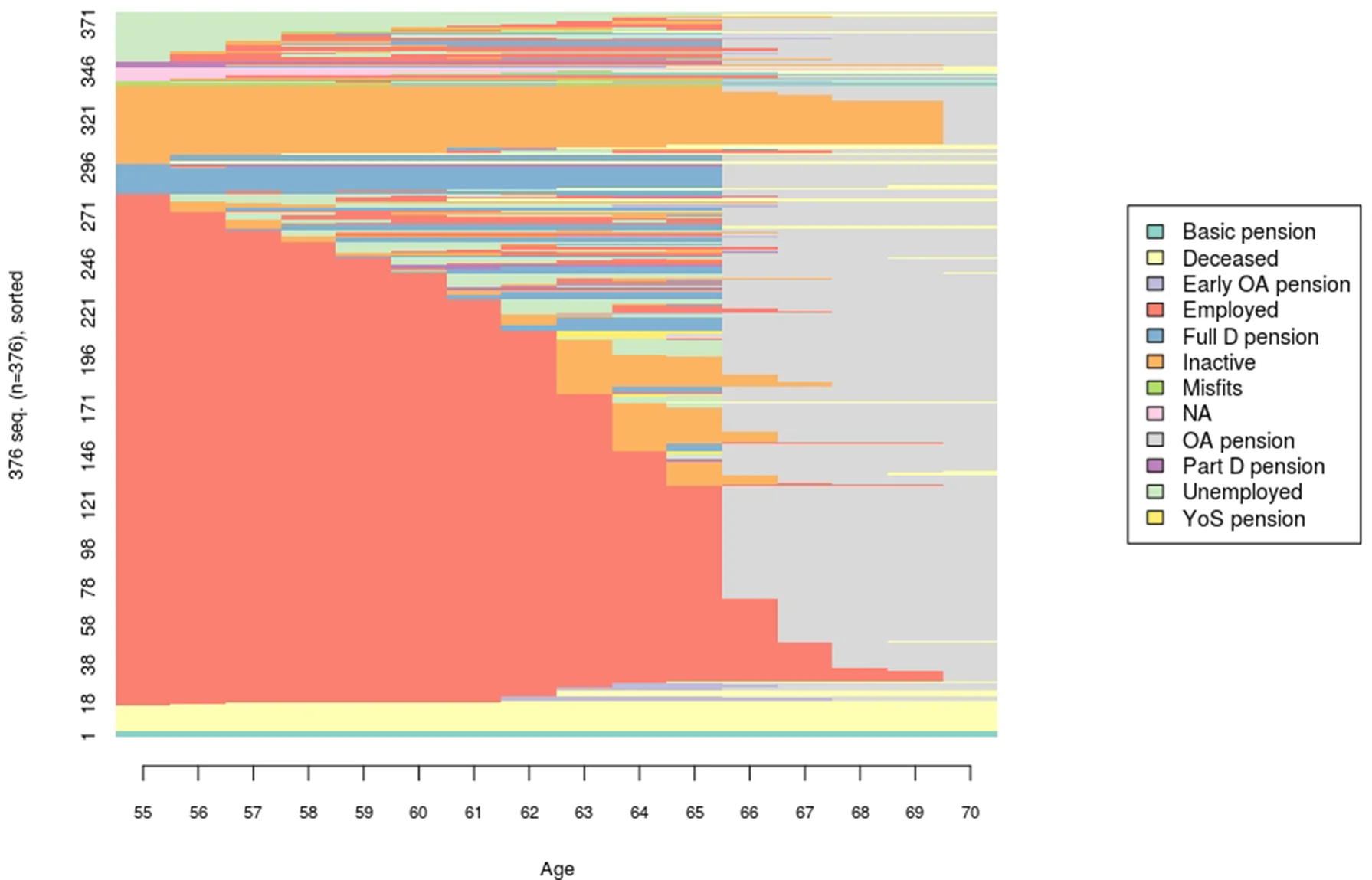
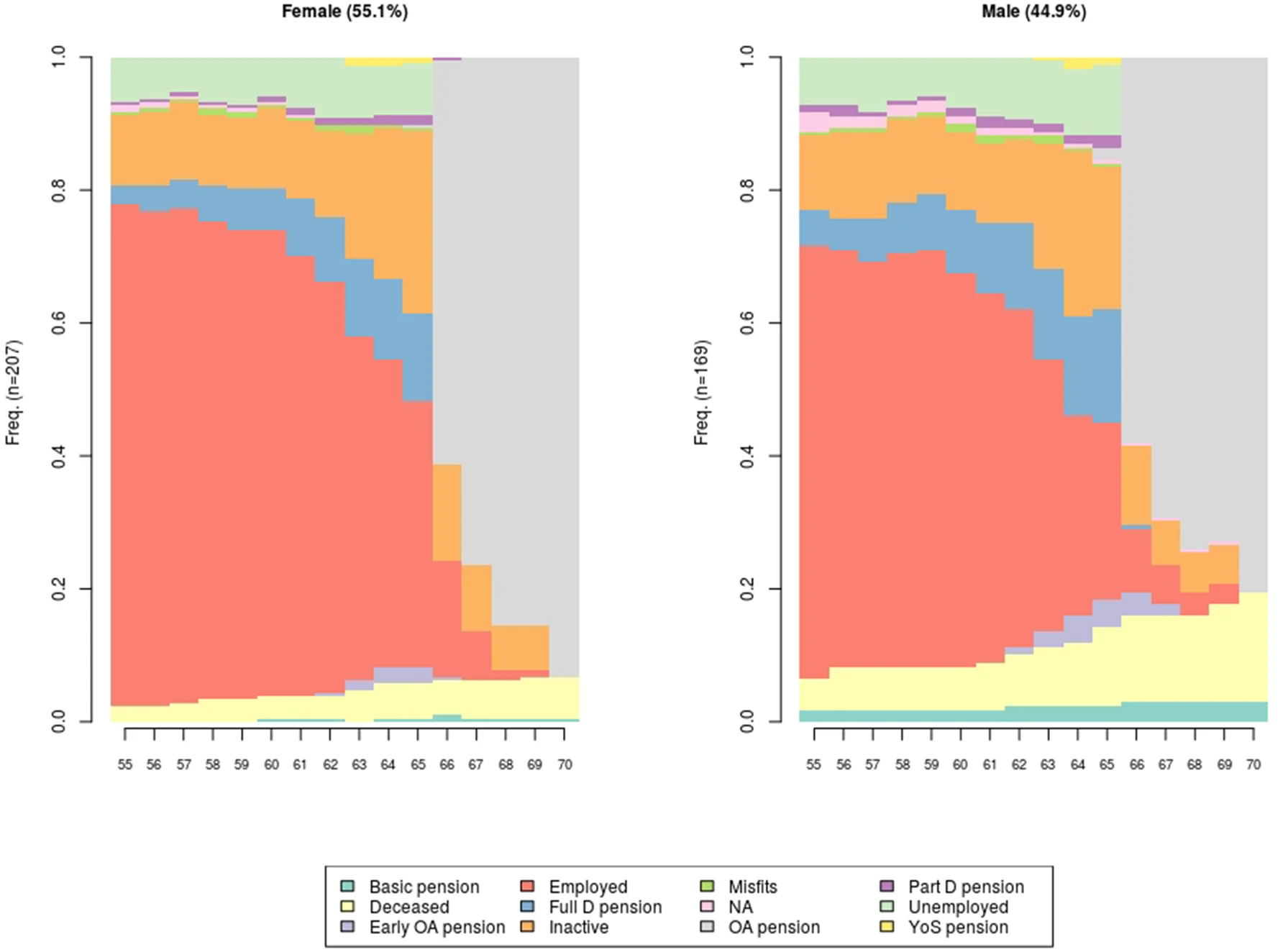
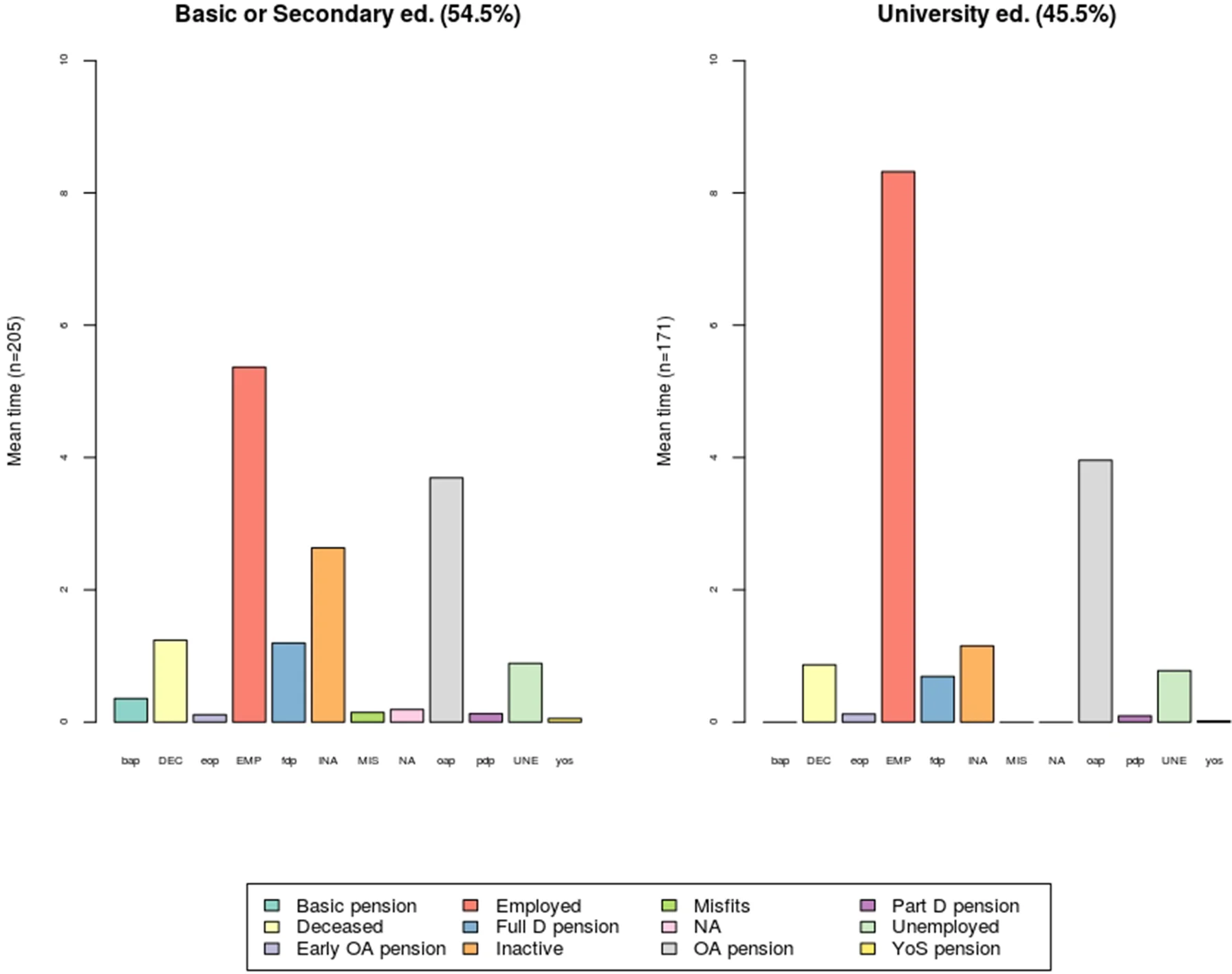
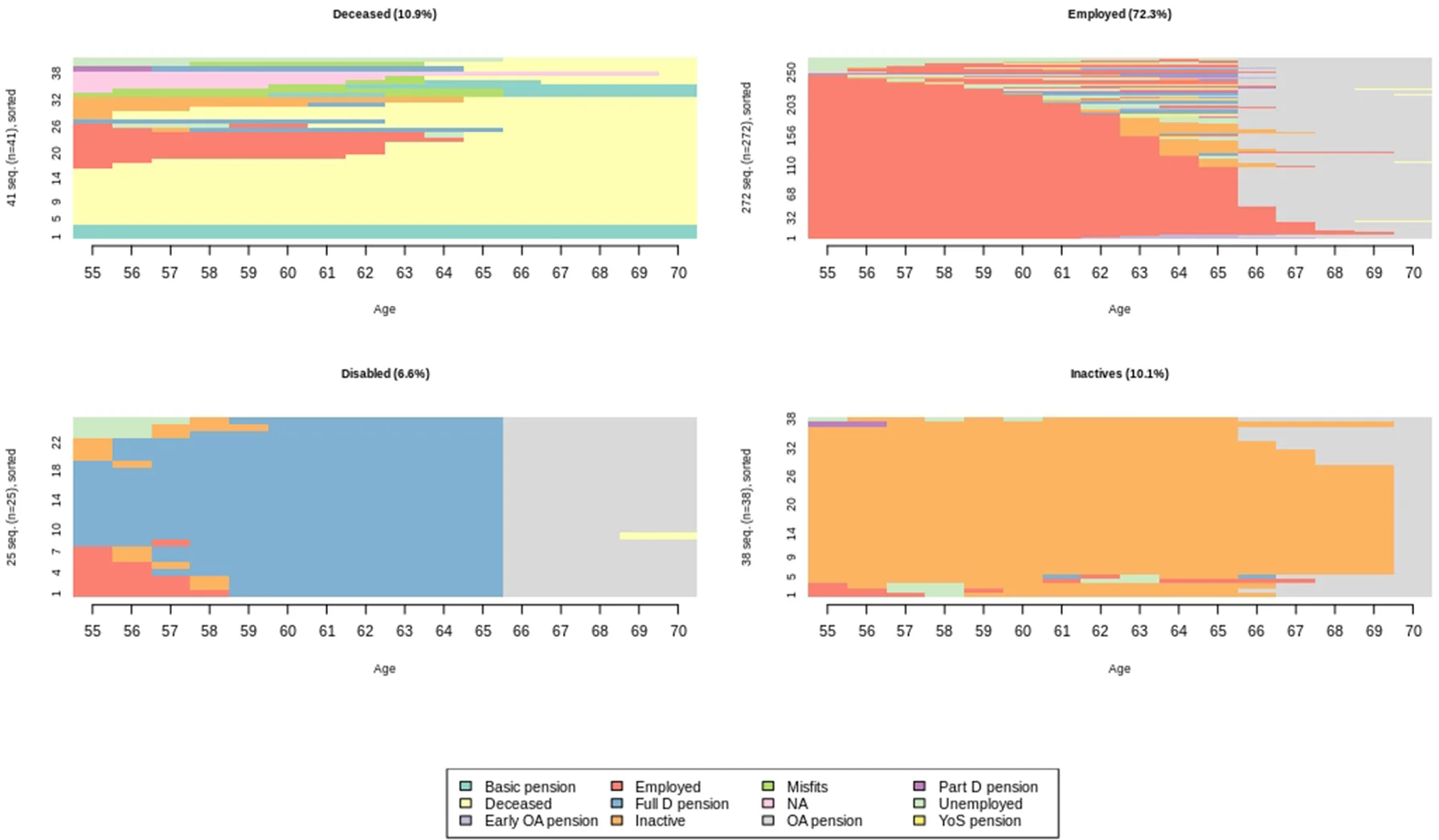
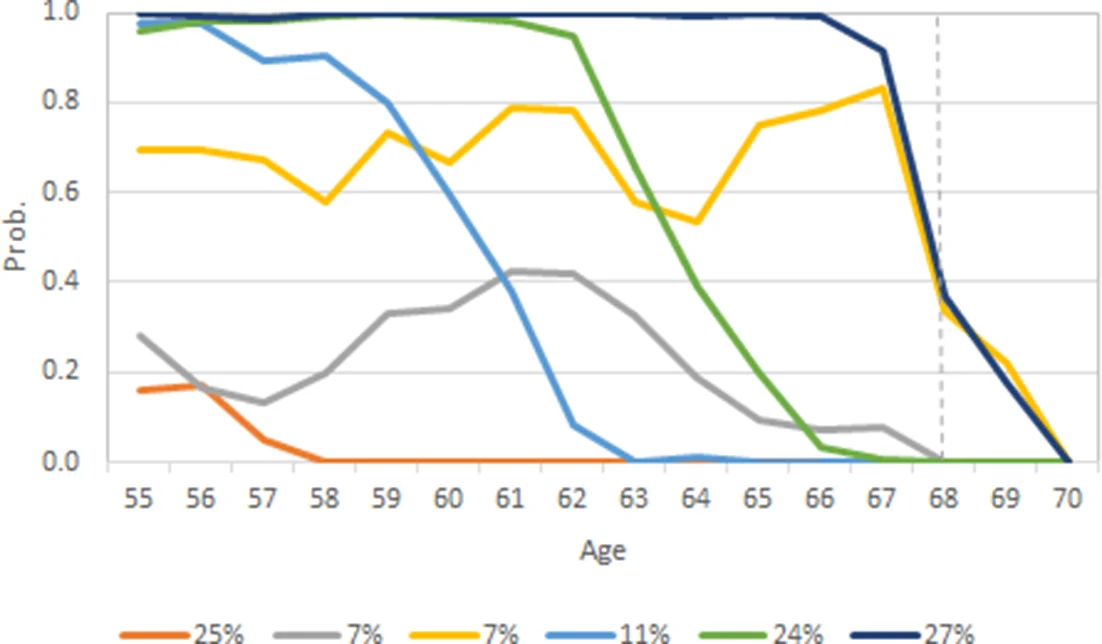
Figure 1. Sequence index plot of cohort born in 1970, individuals.Figure 2. State distribution plot for the 1970 cohort by gender, per cent.Figure 3. Mean time in state for 1970 cohort by education, years.Figure 4. Clustering transition sequences of cohort born 1970.Figure 5. Employment trajectories of cohort born in 2000 (k=6). Dotted line indicates old-age retirement age.
Tables
Table 1. Labor market states and corresponding color codes in figures.
Labor market state
ELSI state(s)
Abb.
Substantial contents
Basic pension
21,22
bap
National pension only
Deceased
12
DEC
Deceased people remain in the model population until the end of the simulation period
Early OA Pension
7
eop
Early old-age pension, retirement age adjusted for life-expectancy
Employed
1,10,11,15,16
EMP
Full or part time employed
Full D Pension
9,5,17
fdp
Full disability pension, leading to old-age pension
Inactive
4,13,19
INA
Outside the labor force
Misfits
20
MIS
Permanently outside the labor force
NA
‘’
NA
Technical state for sequence analysis, not a labor market state in ELSI
OA Pension
8
oap
Old-age pension, retirement age adjusted for life-expectancy
Part D Pension
18
pdp
Partial disability pension
Unemployed
2,3
UNE
Unemployed
YoS Pension
6
yos
Years-of-service pension. Available for individuals aged 63 who have had a long and strenuous working life. No subjective choice.
Notes. The Non-aggregated model states are given in the Appendix A.2.
Table 2. Five most common transition sequences of cohorts born in 1970, 1980, 1990 and 2000, individuals and shares.
Transition sequence
Count
%
1970
EMP/11 - oap/5
58
15.4
INA/15 - oap/1
23
6.1
EMP/12 - oap/4
22
5.9
DEC/16
13
3.5
EMP/13 - oap/3
13
3.5
1980
EMP/12 - oap/4
57
15.4
INA/15 - oap/1
25
6.8
DEC/16
16
4.3
EMP/13 - oap/3
14
3.8
fdp/12 - oap/4
11
3.0
1990
EMP/13 - oap/3
71
15.5
INA/15 - oap/1
35
7.6
EMP/14 - oap/2
28
6.1
EMP/15 - oap/1
14
3.1
fdp/13 - oap/3
13
2.8
2000
EMP/13 - oap/3
54
14.0
INA/15 - oap/1
26
6.7
EMP/14 - oap/2
18
4.7
EMP/15 - oap/1
18
4.7
fdp/13 - oap/3
10
2.6
Table 3. Transition rates of cohort born in 1970, per cent.
To
From
bap
DEC
eop
EMP
fdp
INA
MIS
NA
oap
pdp
UNE
yos
bap
97.0
1.5
0.0
0.0
0.0
0.0
1.5
0.0
0.0
0.0
0.0
0.0
DEC
0.0
100.0
0.0
0.0
0.0
0.0
0.0
0.0
0.0
0.0
0.0
0.0
eop
0.0
0.0
72.7
0.0
0.0
0.0
0.0
0.0
27.3
0.0
0.0
0.0
EMP
0.0
0.3
0.2
87.0
0.4
4.0
0.0
0.0
5.2
0.2
2.4
0.3
fdp
0.0
1.1
0.0
0.8
82.1
0.3
0.0
0.0
15.4
0.3
0.0
0.0
INA
0.0
0.5
0.1
1.2
5.3
77.9
0.0
0.0
11.9
0.1
2.8
0.0
MIS
16.7
6.7
0.0
0.0
0.0
0.0
73.3
0.0
0.0
0.0
3.3
0.0
NA
0.0
2.6
0.0
5.1
0.0
0.0
10.3
82.1
0.0
0.0
0.0
0.0
oap
0.0
0.5
0.0
0.0
0.0
0.0
0.0
0.0
99.5
0.0
0.0
0.0
pdp
0.0
0.0
0.0
0.0
4.8
2.4
0.0
0.0
16.7
76.2
0.0
0.0
UNE
0.0
0.6
1.6
14.9
0.0
6.3
0.3
0.0
10.8
0.0
65.4
0.0
yos
0.0
0.0
0.0
0.0
0.0
0.0
0.0
0.0
50.0
0.0
0.0
50.0
Table A2. ELSI model states.
No.
Contents
15
Full-time employed for the first consecutive year
16
Full-time employed for the second consecutive year
1
Full-time employed for at least the third consecutive year
2
Unemployed (excluding those on an unemployment pathway to retirement)
3
On an unemployment pathway to retirement
4
Sickness benefits preceding full disability pension
5
Part-time pension
11
Partial old-age pension and employed
10
Partial disability pension and employed
6
Years-of-service pension
7
Partial old-age pension and not employed
8
Old-age pension
17
Full disability pension for the first consecutive year
9
Full disability pension for at least the second consecutive year
18
Partial disability pension and not employed
21
National old-age pension only
22
National disability pension only
13
Outside the labor force but has accrued earnings-related pension
19
Permanently outside the labor force but has accrued earnings-related pension
20
Outside the labor force and has not accrued earnings-related pension
12
Deceased
Table A3. Labor market states of the cohort born in 1970 at ages 55 to 70, per cent.