Cite as: A. Klevmarken, P. Olovsson; 2022; Direct and Behavioral Effects of Income Tax Changes. Simulations with the Swedish Model MICROHUS; International Journal of Microsimulation; 15(1); 135–152. doi: 10.34196/ijm.00257
Abstract
A dynamic microsimulation model of the Swedish household sector is used to evaluate the direct and indirect (behavioral) effects on the income distribution of the 1991 Swedish tax reform. The direct effect is a relatively high increase in income inequality while the indirect effects appear to be very small.
This article contains 2 figures and 8 tables.
Figures
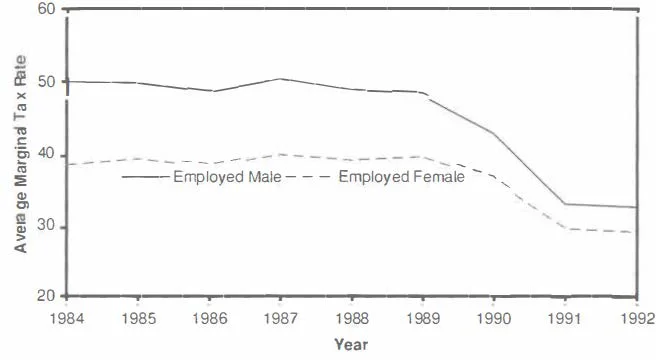
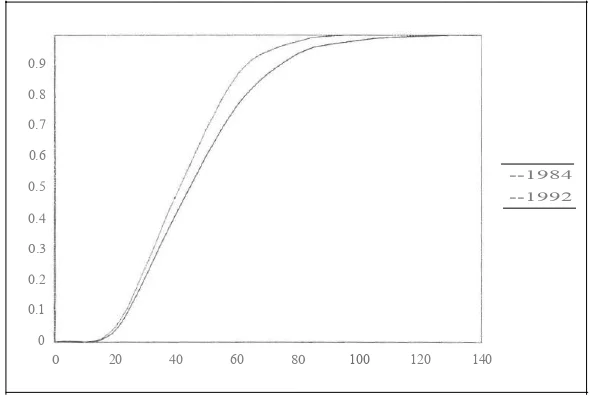
Figure 1. Simulated Swedish Average Marginal Tax Rates by Gender, 1984-1992Figure 2. Simulated Distribution Functions of Disposable Income per Equivalent Adult in 1984 and 1992.
Tables
Table 1. Labor Supply Elasticities for Full-time Working Males and Females by Marital Stah1s
Singles
Couples
Males and Females
Males
Females
Wage rate
0.143
-0.013
-0.006
Income
-0.581
-0.181
-0.149
Compensated
0.601
0.130
0.112
Table 2. Comparison Between Official Statistics and the Simulations of MICROHUS
1984
1985
1986
1987
1988
1989
1990
1991
1992
A. LABOR FORCE PARTICIPATION RATES
Males
Labor force survey
85.6
86.0
85.9
85.7
86.2
86.8
87.0
86.0
84.0
Index 1984=1OD
100
100.5
100.3
100.1
100.7
101.4
101.6
100.5
98.0
Simulation 1
72.3
73.0
73.4
72.2
71.8
69.0
69.1
70.2
68.9
Index 1984=1OD
100
101
102
100
99
95
96
97
95
Females
Labor force survey
78.2
79.2
80.D
81.1
81.8
82.2
82.6
81.7
79.9
Index 1984=100
100
101.3
102.3
103.7
104.6
105.1
105.6
104.4
102.2
Simulation 1
65.4
66.3
66.6
64.0
64.3
63.7
63.8
62.9
63.9
Index 1984=100
100
101
102
98
98
97
98
96
98
B. HOURS OF WORK (EMPLOYED)
Males
Labor force survey
40.6
40.7
40.7
41.4
41.4
41.5
41.5
41.2
41.2
(weekly) Index 1984=100
100
100.2
100.2
102.0
102.0
102.2
102.2
101.5
101.5
Simulation 1
1858
1902
1880
1933
1937
1930
1909
1944
1932
(annual means) Index 1984=100
100
102
101
104
104
104
103
105
104
Females
Labor force survey
31.7
32.1
32.3
32.7
33.2
33.5
33.7
33.6
33.5
(weekly) Index 1984=100
100
101.3
101.9
103.2
104.7
105.7
106.3
106.0
105.7
Simulation 1
1391
1443
1418
1430
1445
1451
1429
1440
1376
(annual means) Index 1984=1OD
100
104
102
103
104
104
103
104
99
C. INEQUALITY IN HOUSEHOLD DISPOSABLE INCOME PER ADULT EQUIVALENT (GINI COEFFICIENT)
Statistics Sweden·
0.220
0.221
0.230
0.221
0.221
0.223
0.231
0.261
0.253
Index 1984=1OD
100
100.4
104.5
100.4
100.4
101.4
105.0
118.6
115.0
Simulation 1
0.171
0.181
0.171
0.180
0.173
0.179
0.188
0.220
0.207
Index 1984=100
100
106
100
105
101
105
110
129
121
Sources: Statistiska Meddelanden Be21SM9501, Income distribution survey in 1993 - Statistics Sweden. Labor force survevs, Statistics Sweden.
The tax reform in 1991 made various benefits taxable which had previously been exempt from taxation. If these benefits had been taxable in 1990 and included in the income concept the Gini coefficient would have increased from 0.231 to 0.246.
Table 3. Direct Effects of Tax Changes 1990-1992 (Simulation 3)
1989
1990
1991
1992
All households
Median disposable income per equivalent adult (1984 SEK)
41577
42852
48680
47760
Index
100
103
117
115
Coefficient of variation
0.325
0.342
0.383
0.364
Index
100
105
118
112
Gini coefficient
0.179
0.188
0.209
0.200
Index
100
105
117
112
Households with children
Median disposable income per equivalent adult (1984 SEK)
36438
37299
41721
41390
Index
100
102
114
114
Coefficient of variation
0.247
0.272
0.325
0.311
Index
100
110
132
126
Gini coefficient
0.131
0.143
0.167
0.160
Index
100
109
127
122
Table 4. Median Disposable Income per Equivalent Adult and Income Inequality in 1991 and 1992 - Comparison of Results for Simulations 1, 2 and 3.
Measure
1991
1992
3
2
1
3
2
1
All households
Median disposable income per equivalent adult (1984 SEK)
48.680
47.084
46,779
47,760
45,700
44.901
Index
100
97
96
100
96
94
Coefficient of variation
0.383
0.419
0.406
0.364
0.408
0.391
Index
100
109
106
100
112
107
Gini coefficient
0.209
0.224
0.220
0.200
0.215
0.207
Index
100
107
105
100
107
104
Households with children
Median disposable income per equivalent adult (1984 SEK)
Table 6. Changes in Hours of Work and Disposable Income 1989-1992 if the 1989 Tax System had Applied in 1990-1992 (Simulation 4)
1989
1990
1991
1992
A. ANNUAL HOURS OF WORK
Employed males
First quartile
100
101
103
101
Median
100
101
102
100
Third quartile
100
102
103
102
Mean
100
102
103
101
Employed females
First quartile
100
102
104
100
Median
100
100
104
100
Third quartile
100
102
104
104
Mean
100
102
104
101
B. HOURLY WAGE RATES
Employed males
First quartile
100
88
105
95
Median
100
97
112
103
Third quartile
100
101
116
111
Mean
100
101
116
107
Coefficent of variation
100
113
115
116
Gini
100
111
115
118
Employed females
First quartile
100
94
114
100
Median
100
96
115
104
Third quartile
100
100
118
114
Mean
100
100
115
108
Coetficent of variation
100
143
112
132
Gini
100
114
112
120
C. DISPOSABLE INCOME
All households
First quartile
100
95
98
96
Median
100
95
99
97
Third quartile
100
96
103
97
Mean
100
96
101
98
Coefficent of variation
100
107
108
104
Gini
100
103
107
102
Households with children
First quartile
100
96
97
97
Third quartile
100
97
102
98
Mean
100
97
100
97
Coefficent of variation
100
130
111
101
Gini
100
104
111
102
Table 7. An Alternative Assessment of the Total Effects of the 1990-1992 Income Tax Changes - Current Tax System (Simulation 1) Compared to the 1989 Tax System (Simulation 4)
C. Labor force participation (%); 18 years and older
1984
1985
1986
1987
1988
1989
1990
1991
1992
Male adults
Unemployed (≥12 months)
1.1
0.7
0.5
0.2
0.3
0.3
0.5
0.7
0.8
Employed
71.2
72.2
72.9
720
71.5
68.7
68.8
69.5
68.1
Student
5.3
5.3
5.3
7.2
8.0
9.0
8.8
8.3
8.4
Retired
18.5
17.8
17.9
17.4
17.1
19.0
19.0
18.6
20.0
Other not in L.F.
3.9
3.8
3.4
3.2
3.1
3.0
2.9
2.9
2.6
Female adults
Unemployed (≥12 months)
1.3
1.8
1.2
0.5
0.2
0.4
0.5
0.8
0.9
Employed
64.1
64.5
65.4
63.6
64.1
63.3
63.3
62.1
63.0
Student
5.5
5.5
5.4
7.6
8.3
8.3
8.2
8.9
8.6
Retired
18.9
18.1
18.3
19.3
18.9
19.7
20.1
20.7
20.3
Other not in L.F.
10.2
10.1
9.7
9.1
8.5
8.2
7.9
7.5
7.3
D. Annual hours of market work; employed
1984
1985
1986
1987
1988
1989
1990
1991
1992
Males
First quartile
1750
1800
1764
1820
1820
1800
1768
1800
1813
Median
1924
1950
1924
1976
1976
1976
1932
1960
1976
Third quartile
2080
2080
2040
2132
2132
2091
2080
2132
2184
Females
First quartile
1260
1300
1274
1300
1288
1300
1248
1200
1092
Median
1404
1440
1404
1428
1421
1456
1404
1428
1377
Third quartile
1551
1598
1560
1581
1600
1612
1612
1666
1700
E. Hourly wage rates (current SEK); employed
1984
1985
1986
1987
1988
1989
1990
1991
1992
Males
First quartile
38
42
39
41
37
42
37
44
40
Median
45
52
50
54
51
58
56
65
60
Third quartile
55
61
62
68
67
75
76
87
83
Mean
49
55
54
58
56
61
62
71
65
Coefficent of variation
0.439
0.443
0.508
0.510
0.585
0.548
0.619
0.629
0.634
Females
First quartile
32
37
32
35
33
36
34
41
36
Median
38
44
41
46
42
48
46
55
50
Third quartile
46
53
50
57
54
62
62
73
69
Mean
40
46
43
48
46
52
52
60
56
Coefficent of variation
0.434
0.455
0.523
0.460
0.602
0.494
0.706
0.554
0.652
F. Household disposable income per equivalent adult (constant 1984 SEK)
1984
1985
1986
1987
1988
1989
1990
1991
1992
All households
First quartile
33792
35195
33645
33840
33135
33954
32602
35862
34936
Median
41691
44464
40475
42389
39870
41577
39826
46779
44901
Third quartile
51321
55475
50155
52983
50272
52325
50283
62945
58588
Mean
43682
46681
42817
44772
42645
44225
42925
51649
48721
Coefficent of variation
0.311
0.326
0.311
0.325
0.319
0.325
0.362
0.406
0.391
Households with children
First quartile
32378
33803
32108
32474
31676
32040
30788
32545
31714
Median
37903
39860
36591
38173
35465
36438
35139
39436
36911
Third quartile
43991
47530
42879
45237
42123
42909
41525
49232
46780
Mean
39355
41653
38308
39693
37872
38190
37334
42569
40448
Coefficent of variation
0.263
0.277
0.264
0.262
0.288
0.247
0.354
0.344
0.310
When a household head reaches the age of 75 the whole household is excluded from the sample. Only household members 75 years and older who live in a household with a head younger than 75 remain in the sample.