
This article contains 2 figures and 10 tables.
Figures
Tables
| Total number of postcodes | Number of postcodes with less than 1000 households | |
|---|---|---|
| New South Wales | 589 | 181 |
| Victoria | 625 | 305 |
| Queensland | 392 | 154 |
| South Australia | 321 | 178 |
| Western Australia | 289 | 171 |
| Tasmania | 108 | 62 |
Source: 1998-99 HES and Marketinfo/2001 weights.
| Highest poverty rate | Lowest poverty rate | NSW average | Australian average | |
|---|---|---|---|---|
| Postcode number | 2834 | 2088 | ||
| Postcode name | Lightning Ridge | Spit Junction | ||
| Poverty rates | % | % | % | % |
| People | 25.9 | 0.7 | 9.8 | 10.3 |
| Adults | 22.4 | 0.9 | 8.8 | 9.3 |
| Children | 39.6 | 0.2 | 12.5 | 12.9 |
Note: Poverty rates are measured at the household level, which means they are not directly comparable to most other poverty studies. Only includes postcodes with over 1000 households.
Source: 1998-99 HES and Marketinfo/2001 weights.
Using the Henderson half average poverty line
| Highest poverty rate | Lowest poverty rate | Victorian average | Australian average | |
|---|---|---|---|---|
| Postcode number | 3053 | 3186 | ||
| Postcode name | Carlton South | Brighton | ||
| Poverty rates | % | % | % | % |
| People | 25.2 | 1.4 | 10.1 | 10.3 |
| Adults | 22.4 | 1.3 | 9.2 | 9.3 |
| Children | 38.5 | 1.8 | 12.8 | 12.9 |
Note: Poverty rates are measured at the household level, which means they are not directly comparable to most other poverty studies.
Source: 1998-99 HES and Marketinfo/2001 weights.
Using the Henderson half average poverty line.
| Highest poverty rate | Lowest poverty rate | Queensland average | Australian average | |
|---|---|---|---|---|
| Postcode number | 4671 | 4069 | ||
| Postcode name | Gin Gin | Kenmore | ||
| Poverty rates | % | % | % | % |
| People | 21.6 | 3.4 | 10.6 | 10.3 |
| Adults | 20.0 | 2.9 | 9.6 | 9.3 |
| Children | 25.9 | 4.6 | 13.3 | 12.9 |
Note: Poverty rates are measured at the household level, which means they are not directly comparable to most other poverty studies.
Source: 1998-99 HES and Marketinfo/2001 weights.
Using the Henderson half average poverty line.
| Highest poverty rate | Lowest poverty rate | South Australian average | Australian average | |
|---|---|---|---|---|
| Postcode number | 5010 | 5725 | ||
| Postcode name | Ferryden Park | Roxby Downs | ||
| Poverty rates | % | % | % | % |
| People | 29.8 | 1.4 | 12.1 | 10.3 |
| Adults | 27.2 | 0.9 | 11.2 | 9.3 |
| Children | 36.9 | 2.6 | 14.6 | 12.9 |
Note: Poverty rates are measured at the household level, which means they are not directly comparable to most other poverty studies.
Source: 1998-99 HES and Marketinfo/2001 weights.
Using the Henderson half average poverty line.
| Highest poverty rate | Lowest poverty rate | West Australian average | Australian average | |
|---|---|---|---|---|
| Postcode number | 6000 | 6015 | ||
| Postcode name | Perth City | City Beach | ||
| Poverty rates | % | % | % | % |
| People | 19.0 | 2.8 | 10.3 | 10.3 |
| Adults | 18.5 | 2.5 | 9.4 | 9.3 |
| Children | 23.3 | 3.5 | 12.7 | 12.9 |
Note: Poverty rates are measured at the household level, which means they are not directly comparable to most other poverty studies.
Source: 1998-99 HES and Marketinfo/2001 weights.
Using the Henderson half average poverty line.
| Highest poverty rate | Lowest poverty rate | Tasmanian average | Australian average | |
|---|---|---|---|---|
| Postcode number | 7215 | 7053 | ||
| Postcode name | St. Mary’s | Taroona | ||
| Poverty rates | % | % | % | % |
| People | 20.5 | 6.4 | 13.0 | 10.3 |
| Adults | 18.5 | 6.2 | 12.3 | 9.3 |
| Children | 26.4 | 7.0 | 14.9 | 12.9 |
Note: Poverty rates are measured at the household level, which means they are not directly comparable to most other poverty studies.
Source: 1998-99 HES and Marketinfo/2001 weights.
Using the Henderson half average poverty line.
| Postcode | 2834 | 3053 | 4671 | 5010 | 6000 | 7215 | Australia |
|---|---|---|---|---|---|---|---|
| % of total in poverty | |||||||
| Age of the household reference person | |||||||
| Less than 25 years | 2.1 | 10.3 | 0.8 | 9.5 | 23.2 | 4.8 | 4.6 |
| 25-34 years | 35.2 | 24.7 | 21.6 | 31.6 | 28.4 | 22.9 | 25.9 |
| 35-44 years | 22.6 | 32.5 | 35.8 | 22.9 | 26 | 32.5 | 30.7 |
| 45-54 years | 19.9 | 22.1 | 17.9 | 19.8 | 14 | 18.6 | 17.1 |
| 55-64 years | 13.7 | 3.4 | 15.4 | 3.9 | 4.6 | 13.8 | 10.7 |
| 65 years or more | 6.6 | 7 | 8.6 | 12.3 | 3.9 | 7.3 | 11.1 |
| 100 | 100 | 100 | 100 | 100 | 100 | 100 | |
| Sex of the reference person | |||||||
| Male | 43.3 | 52.6 | 43 | 42.1 | 51.4 | 36.9 | 37.6 |
| Female | 56.7 | 47.4 | 57 | 57.9 | 48.6 | 63.1 | 62.4 |
| 100 | 100 | 100 | 100 | 100 | 100 | 100 | |
| Labour force status of the reference person | |||||||
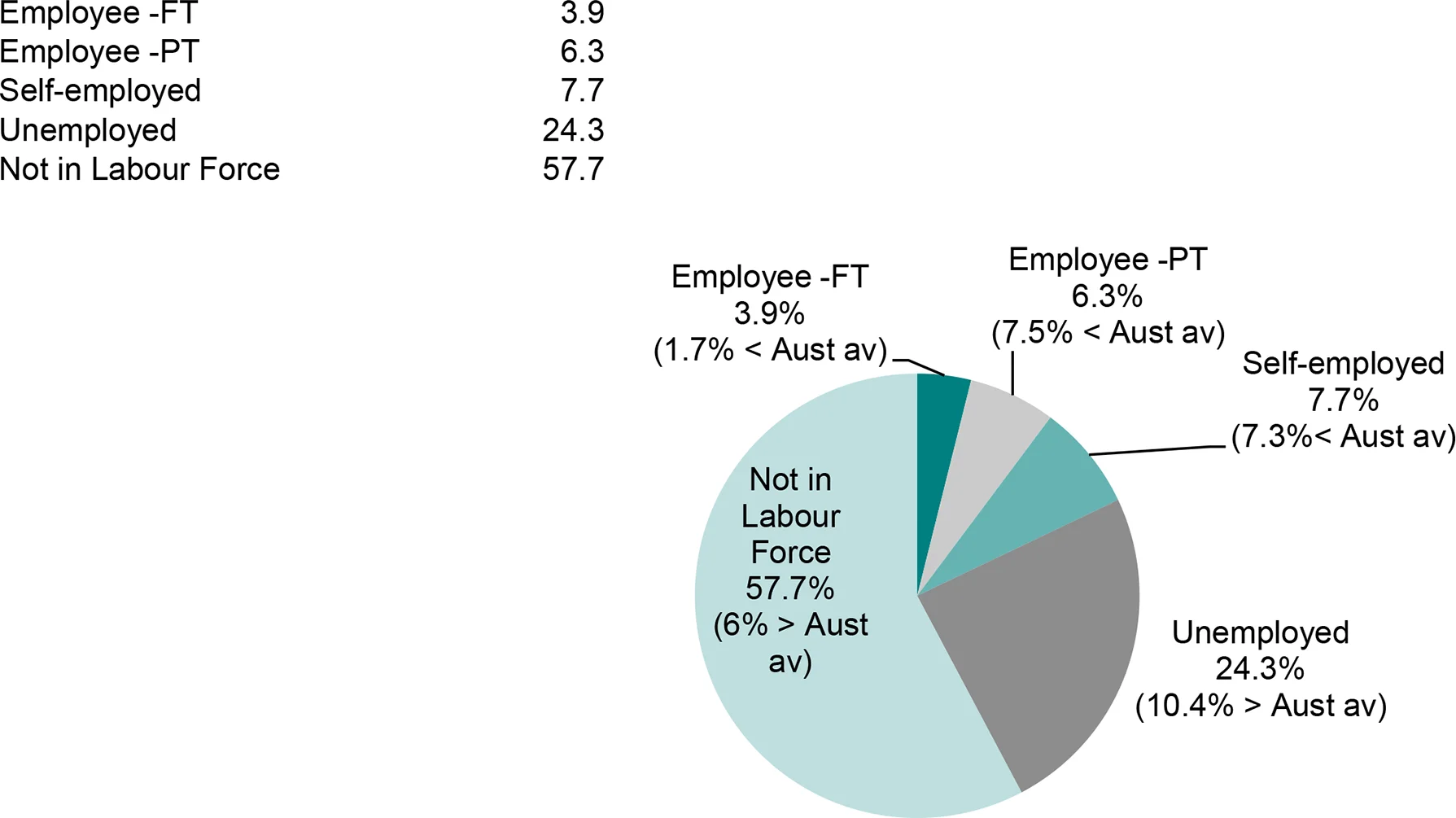
| Employee – full-time | 1.9 | 3.9 | 4.7 | 3.8 | 1.2 | 3.8 | 5.6 |
| Employee – part-time | 17 | 6.3 | 16.2 | 8.5 | 16.9 | 15 | 13.8 |
| Self employed | 14.3 | 7.7 | 18.9 | 3.5 | 4.7 | 15.6 | 15 |
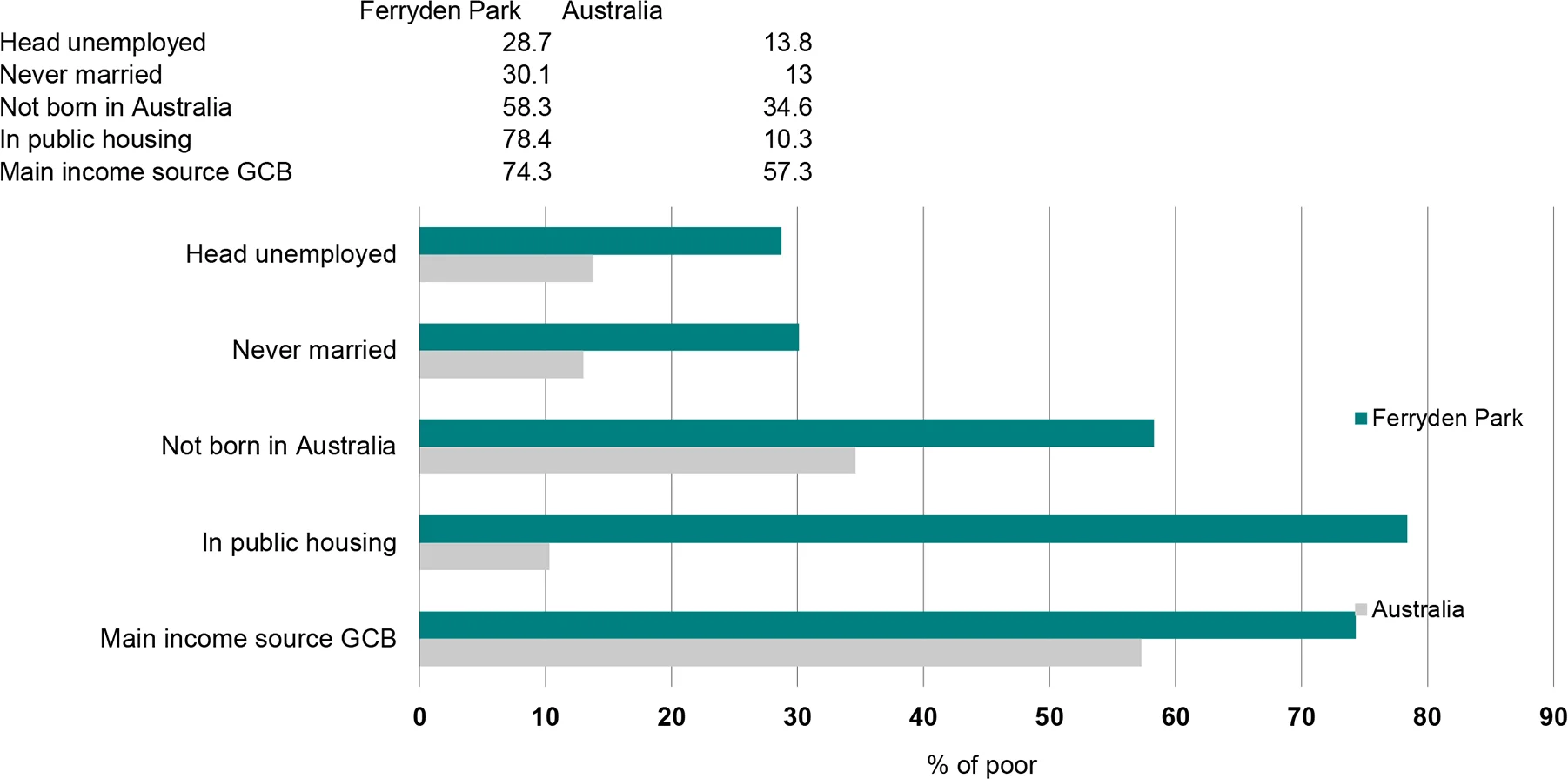
| Unemployed | 24.5 | 24.3 | 16.3 | 28.7 | 26.6 | 12.2 | 13.8 |
| Not in the labour force | 42.3 | 57.7 | 43.8 | 55.6 | 50.7 | 53.4 | 51.7 |
| 100 | 100 | 100 | 100 | 100 | 100 | 100 | |
| Principal source of income for the household | |||||||
| Wage and salary | 9.9 | 7.6 | 17.1 | 10.6 | 13.4 | 13.1 | 16.3 |
| Self-employed | 7 | 3.5 | 9.2 | 0.3 | 5.1 | 10 | 7.6 |
| Other | 11.2 | 28.6 | 8.7 | 11.8 | 19.1 | 8.7 | 12.7 |
| Government cash benefits | 68.3 | 60.2 | 59.6 | 74.3 | 56.8 | 63.6 | 57.3 |
| Zero or negative income | 3.5 | 0.1 | 5.4 | 3 | 5.5 | 4.7 | 6 |
| 100 | 100 | 100 | 100 | 100 | 100 | 100 | |
| Occupation of the reference person | |||||||
| NA (ie not working in occupation) | 66.9 | 82 | 60.2 | 84.3 | 77.3 | 65.6 | 65.6 |
| Managers and professionals | 9 | 12.6 | 17.6 | 2.9 | 8.7 | 13.9 | 13.7 |
| Tradespersons | 4.7 | 0 | 3.1 | 1.6 | 0.1 | 3.9 | 3.1 |
| Clerical, sales and service | 10.8 | 0.9 | 9.8 | 4.8 | 6.7 | 9.8 | 9.8 |
| Labourers, production and transport workers | 8.7 | 4.5 | 9.4 | 6.4 | 7.2 | 6.8 | 7.8 |
| 100 | 100 | 100 | 100 | 100 | 100 | 100 | |
| Tenure type | |||||||
| Owner | 43.8 | 13.9 | 42.4 | 10.9 | 18.6 | 43.2 | 34.9 |
| Purchaser | 15.6 | 10.1 | 26.4 | 7.7 | 7.3 | 23.8 | 22.8 |
| Public housing | 2.1 | 36.9 | 22.7 | 78.4 | 14.6 | 3.7 | 10.3 |
| Private renter | 28.8 | 38.4 | 8.4 | 2.3 | 55 | 21.9 | 27.1 |
| Other, rent-free | 9.7 | 0.7 | 0 | 0.7 | 4.5 | 7.4 | 5 |
| 100 | 100 | 100 | 100 | 100 | 100 | 100 | |
| Marital status of the reference person | |||||||
| Never Married | 13.1 | 30.9 | 6.1 | 30.1 | 46.9 | 8.8 | 13 |
| Separated/divorced/widowed | 26.6 | 19 | 16.7 | 20 | 14 | 17.1 | 23.1 |
| Married | 60.3 | 50.1 | 77.2 | 49.9 | 39 | 74.1 | 63.9 |
| 100 | 100 | 100 | 100 | 100 | 100 | 100 | |
| Household type | |||||||
| Single person | 23.7 | 21.6 | 12.3 | 20.6 | 47.1 | 16.1 | 15.4 |
| Couple only | 14.1 | 7.8 | 20.4 | 13.2 | 9.3 | 16.2 | 15.4 |
| Couple with children | 42.7 | 39.2 | 49.6 | 32.8 | 24.2 | 53.8 | 40.7 |
| Sole parent | 14.5 | 20.3 | 10.4 | 28.3 | 9.5 | 9.9 | 20 |
| Multiple families | 5 | 11.1 | 7.3 | 5.1 | 10 | 4 | 8.5 |
| 100 | 100 | 100 | 100 | 100 | 100 | 100 | |
| Number of dependents in the household | |||||||
| None | 46 | 39 | 39.8 | 37.3 | 68.2 | 37.9 | 38.3 |
| One | 6.6 | 20.2 | 13 | 18.7 | 18 | 12.7 | 13.4 |
| Two | 15.8 | 39.7 | 15.5 | 31.7 | 13.5 | 20.4 | 22.2 |
| Three | 20 | 0 | 21.2 | 1 | 0.3 | 21.5 | 18.6 |
| Four | 11.5 | 1 | 8.1 | 11.3 | 0 | 7.2 | 6.4 |
| Five or more | 0.1 | 0 | 2.4 | 0 | 0 | 0.2 | 1 |
| 100 | 100 | 100 | 100 | 100 | 100 | 100 | |
| Country of birth of the reference person | |||||||
| Australia | 81.7 | 29.4 | 76.2 | 41.7 | 51.4 | 86.6 | 65.4 |
| Other | 4.4 | 12.8 | 5.2 | 28.4 | 10.3 | 2.7 | 8.2 |
| Europe/former USSR | 13 | 24.6 | 13.7 | 18 | 19.6 | 10.1 | 14.6 |
| Asia | 0.8 | 33.2 | 5 | 11.9 | 18.6 | 0.6 | 11.7 |
| 100 | 100 | 100 | 100 | 100 | 100 | 100 | |
Source: 1998-99 HES and Marketinfo/2001 weights.
Using the Henderson half average poverty line.
| 2834 | 3053 | 4671 | 5010 | 6000 | 7215 | Aust-ralia | |
|---|---|---|---|---|---|---|---|
| Average total income (annual) | 25 164 | 40 011 | 28 955 | 22 480 | 36 995 | 27 568 | 45 574 |
| Average disposable income (annual) | 21 999 | 31 740 | 25 471 | 20 600 | 29 188 | 23 993 | 36 581 |
| Age of the household reference person | |||||||
| Less than 25 years | 3.5 | 21.7 | 1.9 | 7.5 | 16.2 | 3.8 | 4.2 |
| 25-34 years | 22.1 | 28.1 | 14.1 | 22.4 | 27.9 | 18.3 | 20.2 |
| 35-44 years | 22.8 | 21.5 | 32.1 | 26.6 | 21.4 | 29.8 | 29.1 |
| 45-54 years | 19.8 | 14.5 | 23.1 | 16.3 | 17.9 | 19.6 | 22.9 |
| 55-64 years | 18 | 7.3 | 15.3 | 11.3 | 7.3 | 14.2 | 11.4 |
| 65 years or more | 13.9 | 6.9 | 13.6 | 15.9 | 9.3 | 14.2 | 12.2 |
| Sex of the reference person | |||||||
| Male | 55.9 | 55.7 | 58.2 | 53.1 | 64 | 56.3 | 63 |
| Female | 44.1 | 44.3 | 41.8 | 46.9 | 36 | 43.7 | 37 |
| Labour force status of reference person | |||||||
| Employee – full-time | 22.3 | 41 | 29.5 | 26.4 | 44.8 | 28 | 49.6 |
| Employee – part-time | 14.8 | 12.7 | 12.6 | 15.9 | 11 | 14.6 | 10.6 |
| Self employed | 8.8 | 2.8 | 12 | 1.7 | 3.5 | 10.7 | 7.8 |
| Unemployed | 9.3 | 7 | 5 | 9 | 6.9 | 3.5 | 2.4 |
| Not in the labour force | 44.8 | 36.6 | 40.8 | 47 | 33.8 | 43.1 | 29.6 |
| Principal source of income for the household | |||||||
| Wage and salary | 34.4 | 50.4 | 42.1 | 37.2 | 54.7 | 38.9 | 61.4 |
| Self-employed | 6.9 | 2 | 10.7 | 0.6 | 3.9 | 10.2 | 6.8 |
| Other | 8.5 | 12.6 | 7.4 | 4.5 | 15.9 | 8.3 | 6.6 |
| Government cash benefits | 49.3 | 35 | 38.7 | 56.9 | 24.5 | 41.7 | 24.6 |
| Zero or negative income | 0.9 | 0 | 1.2 | 0.9 | 1.1 | 1 | 0.6 |
| Occupation of the reference person | |||||||
| NA (ie not working in occupation) | 54.1 | 43.6 | 45.9 | 56 | 40.7 | 46.6 | 32 |
| Managers and professionals | 12.3 | 36.4 | 18.3 | 7 | 35.3 | 20.7 | 32.3 |
| Tradespersons | 6.3 | 2.2 | 6.9 | 7.3 | 3.2 | 10.3 | 10.1 |
| Clerical, sales and service | 12.1 | 10.6 | 9.9 | 6.1 | 11.2 | 9.8 | 13.1 |
| Labourers, production and transport workers | 15.2 | 7.2 | 19 | 23.6 | 9.6 | 12.6 | 12.6 |
| Tenure type | |||||||
| Owner | 57.8 | 14.9 | 45.8 | 11.2 | 19.6 | 45 | 36.9 |
| Purchaser | 10.9 | 10.6 | 32.1 | 12.9 | 16.7 | 29.8 | 33.8 |
| Public housing | 1.9 | 21 | 17.5 | 68 | 4.8 | 2.8 | 5 |
| Private renter | 22.9 | 52.1 | 4.6 | 7.6 | 56.5 | 18.7 | 22.2 |
| Other, rent-free | 6.4 | 1.3 | 0 | 0.4 | 2.3 | 3.6 | 2.2 |
| Marital status of the reference person | |||||||
| Never Married | 14.2 | 36 | 5 | 21 | 38.1 | 7.8 | 10.4 |
| Separated/divorced/widowed | 24.1 | 17.4 | 14.8 | 22.5 | 16.1 | 15.6 | 16.4 |
| Married | 61.7 | 46.6 | 80.2 | 56.5 | 45.8 | 76.6 | 73.2 |
| Household type | |||||||
| Single person | 20.6 | 17 | 7.5 | 14.2 | 33.1 | 12.2 | 9.6 |
| Couple only | 23.5 | 14.6 | 26.7 | 17.1 | 22.9 | 27.6 | 19.7 |
| Couple with children | 32.6 | 26.1 | 45.5 | 34.1 | 20.5 | 45.4 | 45.4 |
| Sole parent | 12.1 | 14 | 9.1 | 24.5 | 7.4 | 8.9 | 11.5 |
| Multiple families | 11.2 | 28.3 | 11.2 | 10.2 | 16.1 | 5.9 | 13.7 |
| Number of dependents in the household | |||||||
| None | 60.3 | 59.5 | 46.9 | 46.1 | 73 | 49.1 | 45.3 |
| One | 10.7 | 17.8 | 11.6 | 19.2 | 19.2 | 13 | 16.5 |
| Two | 13.6 | 21.5 | 19.1 | 23.3 | 7.3 | 20.8 | 21.7 |
| Three | 11.4 | 0.3 | 13.4 | 3 | 0.4 | 12.8 | 11.9 |
| Four | 3.8 | 0.8 | 6 | 7.1 | 0 | 3.7 | 3.5 |
| Five or more | 0.2 | 0.2 | 3 | 1.3 | 0 | 0.6 | 1.1 |
| Country of birth of the reference person | |||||||
| Australia | 75.7 | 47.6 | 78 | 50 | 55.7 | 87.4 | 69.2 |
| Other | 4.9 | 12.3 | 5.6 | 13.9 | 12.2 | 3.1 | 7.3 |
| Europe/former USSR | 19 | 17.3 | 14.2 | 16.9 | 16.4 | 9.2 | 16.1 |
| Asia | 0.3 | 22.8 | 2.2 | 19.2 | 15.7 | 0.4 | 7.3 |
Source: 1998-99 HES and Marketinfo/2001 weights.
| 2088 | 3186 | 4069 | 5725 | 6015 | 7053 | Australia | |
|---|---|---|---|---|---|---|---|
| Average total income (annual) | 97 677 | 87 880 | 79 073 | 87 412 | 88 544 | 51 203 | 45 574 |
| Average disposable income (annual) | 67 953 | 62 773 | 58 338 | 63 243 | 63 901 | 40 572 | 36 581 |
| Age of the household reference person | |||||||
| Less than 25 years | 4.5 | 2.4 | 3 | 8.4 | 2.3 | 2.1 | 4.2 |
| 25-34 years | 21.5 | 10.8 | 9.7 | 37.2 | 7.4 | 8.3 | 20.2 |
| 35-44 years | 24.9 | 28.1 | 27.9 | 34.5 | 25.3 | 29.3 | 29.1 |
| 45-54 years | 25.5 | 30.9 | 33.6 | 13.9 | 32.6 | 32.5 | 22.9 |
| 55-64 years | 12 | 12.6 | 15.4 | 4 | 17.3 | 13 | 11.4 |
| 65 years or more | 11.6 | 15.3 | 10.4 | 1.9 | 15.2 | 14.9 | 12.2 |
| Sex of the reference person | |||||||
| Male | 68.7 | 73.3 | 75 | 90.1 | 80.2 | 64.2 | 63 |
| Female | 31.3 | 26.7 | 25 | 9.9 | 19.8 | 35.8 | 37 |
| Labour force status of the reference person | |||||||
| Employee – full-time | 69 | 65.4 | 66.8 | 85.8 | 63.4 | 54.5 | 49.6 |
| Employee – part-time | 7 | 5 | 9.3 | 3.2 | 6.7 | 10.3 | 10.6 |
| Self employed | 6.3 | 6.3 | 5.9 | 6.4 | 8.2 | 6 | 7.8 |
| Unemployed | 0.4 | 0.9 | 0.8 | 0.3 | 0.3 | 1.6 | 2.4 |
| Not in the labour force | 17.2 | 22.5 | 17.1 | 4.3 | 21.4 | 27.6 | 29.6 |
| Principal source of income for the household | |||||||
| Wage and salary | 73.3 | 71.5 | 75.9 | 88.3 | 70.5 | 64.3 | 61.4 |
| Self-employed | 7.6 | 7.3 | 5.8 | 5.6 | 9.1 | 5.4 | 6.8 |
| Other | 10 | 12.3 | 9.2 | 2 | 14.7 | 10 | 6.6 |
| Government cash benefits | 9.1 | 8.9 | 9.1 | 4 | 5.7 | 19.8 | 24.6 |
| Zero or negative income | 0 | 0 | 0.1 | 0 | 0.1 | 0.5 | 0.6 |
| Occupation of the reference person | |||||||
| NA (ie not working in occupation) | 17.6 | 23.4 | 17.9 | 4.6 | 21.7 | 29.2 | 32 |
| Managers and professionals | 67.7 | 67.1 | 64.5 | 33.1 | 66.1 | 54.5 | 32.3 |
| Tradespersons | 3.7 | 2 | 5.1 | 21.5 | 2.2 | 4.5 | 10.1 |
| Clerical, sales and service | 7.6 | 6.3 | 9.3 | 6.1 | 6.8 | 9.8 | 13.1 |
| Labourers, production and transport workers | 3.3 | 1.2 | 3.2 | 34.7 | 3.2 | 2.1 | 12.6 |
| Tenure type | |||||||
| Owner | 40.7 | 51.7 | 46.6 | 23 | 58.9 | 45.1 | 36.9 |
| Purchaser | 21 | 25.1 | 38.1 | 36.7 | 28.7 | 39.9 | 33.8 |
| Public housing | 0.9 | 0.2 | 0.1 | 0 | 10.1 | 2.2 | 5 |
| Private renter | 35.9 | 20.9 | 13.8 | 38.8 | 2.3 | 11.7 | 22.2 |
| Other, rent-free | 1.5 | 2 | 1.4 | 1.5 | 0 | 1.2 | 2.2 |
| Marital status of the reference person | |||||||
| Never Married | 17.9 | 10.1 | 6.7 | 5 | 6.8 | 7.8 | 10.4 |
| Separated/divorced/widowed | 14.5 | 15.3 | 11 | 7.6 | 9.3 | 17.2 | 16.4 |
| Married | 67.6 | 74.7 | 82.3 | 87.5 | 83.9 | 75 | 73.2 |
| Household type | |||||||
| Single person | 16.6 | 11.4 | 4.3 | 5 | 6.3 | 8.7 | 9.6 |
| Couple only | 25 | 22.2 | 18.5 | 17.9 | 24.1 | 20.9 | 19.7 |
| Couple with children | 35 | 47.1 | 56.5 | 64.3 | 54.8 | 48.6 | 45.4 |
| Sole parent | 7.5 | 7.1 | 9 | 4.2 | 6.1 | 10.8 | 11.5 |
| Multiple families | 15.9 | 12.3 | 11.8 | 8.5 | 8.7 | 11 | 13.7 |
| Number of dependents in the household | |||||||
| None | 54.7 | 48.3 | 38.4 | 34.7 | 42.4 | 44 | 45.3 |
| One | 15.1 | 17.3 | 18.1 | 12 | 15.7 | 15.9 | 16.5 |
| Two | 20.6 | 21.4 | 25.1 | 34 | 22.2 | 24.5 | 21.7 |
| Three | 8.3 | 12.6 | 13.7 | 18.5 | 18.9 | 11.6 | 11.9 |
| Four | 1.2 | 0.4 | 3.7 | 0.8 | 0.8 | 3 | 3.5 |
| Five or more | 0 | 0 | 0.9 | 0 | 0 | 1 | 1.1 |
| Country of birth of the reference person | |||||||
| Australia | 57.5 | 73.5 | 66.1 | 82.2 | 67.2 | 71.7 | 69.2 |
| Other | 12.1 | 7.8 | 6.8 | 7.9 | 9.4 | 5.5 | 7.3 |
| Europe/former USSR | 14.6 | 13.6 | 17.8 | 9.7 | 18 | 19 | 16.1 |
| Asia | 15.9 | 5 | 9.3 | 0.2 | 5.4 | 3.8 | 7.3 |
Source: 1998-99 HES and Marketinfo/2001 weights.