
This article contains 3 figures and 10 tables.
Figures
Tables
| Alternative | Reference | Difference | |
|---|---|---|---|
| Income tax, municipal level | 237,079 | 220,840 | 16,238 |
| Income tax, state level | 136,401 | 136,401 | 0 |
| Social insurance tax | 178,102 | 178,102 | 0 |
| Bracket tax | 100,732 | 100,732 | 0 |
| Wealth tax, municipal level | 20,248 | 20,248 | 0 |
| Wealth tax, state level | 9,731 | 9,731 | 0 |
| - Tax red., housing savings scheme for young taxpayers | 580 | 580 | 0 |
| - Tax red., pensioners | 13,171 | 13,110 | 61 |
| - Tax red. in the north (North-Troms and Finnmark) | 1,133 | 1,119 | 14 |
| Total taxes | 667,409 | 651,246 | 16,163 |
| - Cash-for-care | 1,377 | 1,377 | 0 |
| - Child benefit | 22,171 | 22,171 | 0 |
| - Additional child benefit (small children, single parents) | 44 | 44 | 0 |
| Total | 643,817 | 627,654 | 16,163 |
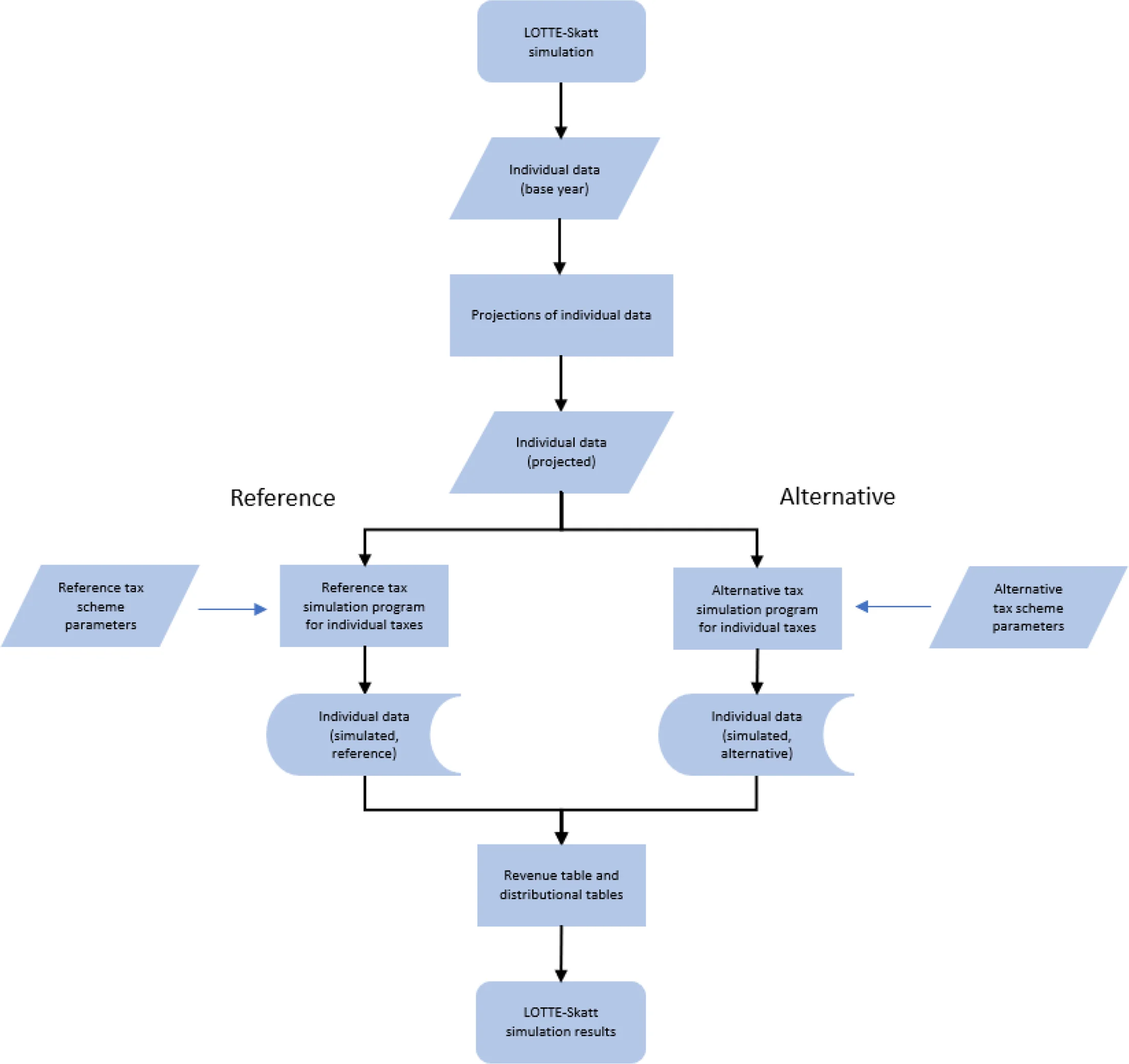
Notes: Standard output revenue table from a LOTTE-Skatt simulation. Simulation alternative compared to a 2023 reference using 2020 data (10% sample) projected to 2023.
| LOTTE-Skatt | Tax reg. | Diff. in % | |
|---|---|---|---|
| Income tax, municipal level | 254,589 | 254,199 | 0.15 |
| Income tax, state level | 122,580 | 122,382 | 0.16 |
| Social insurance tax | 165,319 | 164,829 | 0.30 |
| Bracket tax | 81,829 | 81,772 | 0.07 |
| Wealth tax, municipal level | 14,989 | 14,911 | 0.52 |
| Wealth tax, state level | 3,212 | 3,199 | 0.40 |
| - Tax reduction, housing savings scheme for young taxpayers | 1,003 | 0,966 | 3.84 |
| - Tax reduction, pensioners | 14,213 | 14,229 | -0.11 |
| - Tax reduction in the north (North-Troms and Finnmark) | 1,069 | 1,068 | 0.10 |
| Total | 626,233 | 625,029 | 0.19 |
Notes: Both the simulated output from LOTTE-Skatt and the output from administrative tax registers are based on the population of all residents in 2021.
| Total tax revenue | Diff. to benchmark | |
|---|---|---|
| Benchmark: 2023 tax rules without a 5th bracket | 578,134 | - |
| 2023 tax rules: | ||
| Direct (non-behavioral) effect | 578,402 | 268 |
| Intensive margin behavioral effect | -106 | |
| Extensive margin behavioral effect | -6 | |
| Direct and behavioral effects | 578,290 | 156 |
| Behavioral counteracting effect ratio | 0.42 |
Notes: Simulations generated by the Norwegian tax-benefit model LOTTE-Skatt, data for 2020 projected to 2023. Behavioral effects are taken into account with an ETI estimate of 0.2 at the intensive margin and 0.1 at the extensive margin. Source: Jia et al. (2023).
| Female | Male | Female | Male | |
|---|---|---|---|---|
| Own wage | Own wage | Cross wage | Cross wage | |
| Individuals in couple | ||||
| Participation (ext. margin) | 0.135 | - | -0.048 | - |
| Hours cond. on working (int. margin) | 0.197 | 0.095 | -0.043 | -0.009 |
| Total elasticity | 0.332 | 0.095 | -0.091 | -0.009 |
| Single individuals | ||||
| Participation (ext. margin) | 0.012 | - | ||
| Hours cond. on working (int. margin) | 0.057 | 0.009 | ||
| Total elasticity | 0.069 | 0.009 |
Notes: The elasticities reflect the simulated percentage change (average across individuals) in the probability of participation (extensive margin) and working hours conditional on working (intensive margin) when the hourly wage rate is increased by one percent for all wage earners. Note that due to high male participation rates, we do not estimate extensive margin responses for males.
| Tax change | Self-financing ratio, pct |
|---|---|
| Reduced rate bracket tax, bracket 3 | 10 |
| Increased threshold bracket tax, bracket 3 | 9 |
| Reduced rate ordinary income | 6 |
| Reduced rate social insurance tax | 5 |
| Reduced rate bracket tax, bracket 2 | 4 |
| Increased threshold bracket tax, bracket 2 | 2 |
| Increased threshold for maximum deduction in minimum standard deduction | 1 |
| Reduced rate bracket tax, bracket 1 | 0 |
| Increased threshold bracket tax, bracket 1 | 0 |
| Increased personal allowance | 0 |
| Increased rate minimum standard deduction | -16 |
Notes: For a tax decrease, the self-financing ratio is the ratio between the effect on revenue due to labor supply adjustments and the initial static (or mechanical) revenue effect estimate (standard tax-benefit model calculation). Source: Finansdepartementet (2023).
| Pre-reform working hours | Post-reform working hours | Difference, % | |
| Single females | 35.20 (0.321) | 35.27 (0.322) | 0.18 |
| Single males | 38.95 (0.039) | 38.97 (0.040) | 0.04 |
| Females in couple | 32.13 (0.068) | 32.25 (0.068) | 0.36 |
| Males in couple | 38.60 (0.013) | 38.64 (0.014) | 0.11 |
Notes: Standard errors are obtained by non-parametric bootstrapping, 30 repetitions. Source: Thoresen and Vattø (2015).
| Discrete choice labor supply simulations, working hours | Panel data information | ||
|---|---|---|---|
| Working hours | Earned income | ||
| Single females | 0.018 (0.0005) | 0.032 (0.0037) | 0.020 (0.0051) |
| Single males | 0.062 (0.0027) | 0.023 (0.0055) | 0.039 (0.0054) |
| Females in couple | 0.026 (0.0001) | 0.051 (0.0046) | 0.031 (0.0045) |
| Males in couple | 0.015 (0.0005) | 0.016 (0.0059) | 0.053 (0.0034) |
| Weighted average | 0.026 (0.0012) | 0.028 (0.0053) | 0.041 (0.0043) |
Notes: The weighted averages are calculated by accounting for the number of observations in each group. Standard errors are obtained by using the delta method. Source: Thoresen and Vattø (2015).
| Household type | Food | Wine | Electricity | Clothes | Air travel |
|---|---|---|---|---|---|
| Singles | 31,436 | 3,515 | 15,665 | 12,798 | 3,439 |
| Couples | 57,335 | 7,771 | 24,551 | 34,294 | 9,564 |
| Couples with one child | 66,942 | 7,478 | 26,881 | 41,835 | 9,862 |
| Couples with two children | 78,713 | 7,671 | 30,003 | 50,763 | 10,084 |
| Couples, more than two children | 90,425 | 6,475 | 32,213 | 55,961 | 10,084 |
| Others | 66,045 | 6,755 | 26,101 | 36,970 | 8,966 |
| All households | 51,617 | 5,736 | 21,986 | 28,465 | 7,035 |
Notes: Average household expenditure for different household types and consumer goods in 2023, obtained by the model LOTTE-Konsum. Children defined as individuals less than 18 years of age.
| Decile | Food | Wine | Electricity | Clothes | Air travel |
|---|---|---|---|---|---|
| 1 | 68 | 7 | 64 | 31 | 9 |
| 2 | 79 | 31 | 73 | 56 | 34 |
| 3 | 85 | 49 | 81 | 67 | 51 |
| 4 | 90 | 62 | 86 | 75 | 64 |
| 5 | 94 | 75 | 91 | 84 | 76 |
| 6 | 99 | 89 | 97 | 93 | 90 |
| 7 | 105 | 107 | 105 | 104 | 107 |
| 8 | 112 | 130 | 114 | 119 | 128 |
| 9 | 121 | 163 | 127 | 141 | 159 |
| 10 | 148 | 287 | 163 | 231 | 281 |
| All | 100 | 100 | 100 | 100 | 100 |
Notes: All individuals are ranked according to total household expenditure divided by the number of household members in 2023. Change in tax burden is measured as change in real expenditure per household member due to a price increase on a specific good, where real expenditure is defined as total household expenditure divided by a household-specific price index. We change the tax burden for each good by NOK 100 on average by the use of the model LOTTE-Konsum.
| Labor supply responses | MPC | Personal income tax, labor supply | Direct effect, commodity tax | Commodity tax, labor supply | Payroll tax, labor supply | Overall offsetting effect |
|---|---|---|---|---|---|---|
| 0.5 | 0.27 | 0.09 | 0.04 | 0.09 | 0.48 | |
| Low response | 0.7 | 0.27 | 0.12 | 0.05 | 0.09 | 0.53 |
| 0.9 | 0.27 | 0.15 | 0.06 | 0.09 | 0.58 | |
| 0.5 | 0.34 | 0.09 | 0.05 | 0.12 | 0.59 | |
| Benchmark: | 0.7 | 0.34 | 0.12 | 0.06 | 0.12 | 0.64 |
| middle response | 0.9 | 0.34 | 0.15 | 0.08 | 0.12 | 0.70 |
| 0.5 | 0.39 | 0.09 | 0.05 | 0.13 | 0.65 | |
| High response | 0.7 | 0.39 | 0.12 | 0.07 | 0.13 | 0.70 |
| 0.9 | 0.39 | 0.15 | 0.09 | 0.13 | 0.76 |
Notes: Results are shown for three assumptions about labor supply effects (low, middle, and high) and for three assumptions about the marginal propensity to consume, MPC (0.5, 0.7, and 0.9). The overall offsetting revenue effect reflects contributions from labor supply alone, increased commodity taxation attributable to increased disposable income, and increased commodity and payroll tax due to labor supply adjustments. Source: Thoresen et al. (2010).