
This article contains 6 figures and 18 tables.
Figures
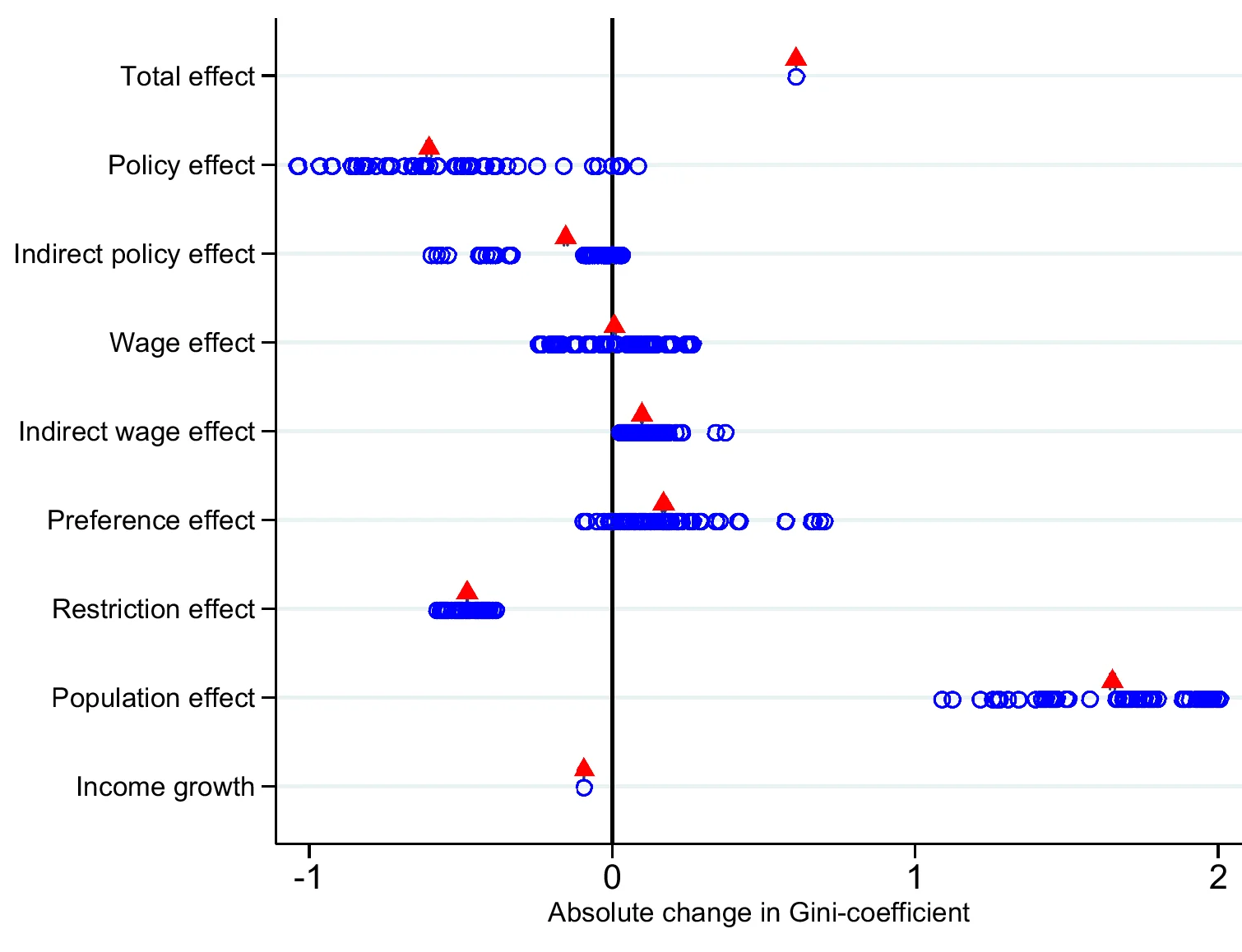
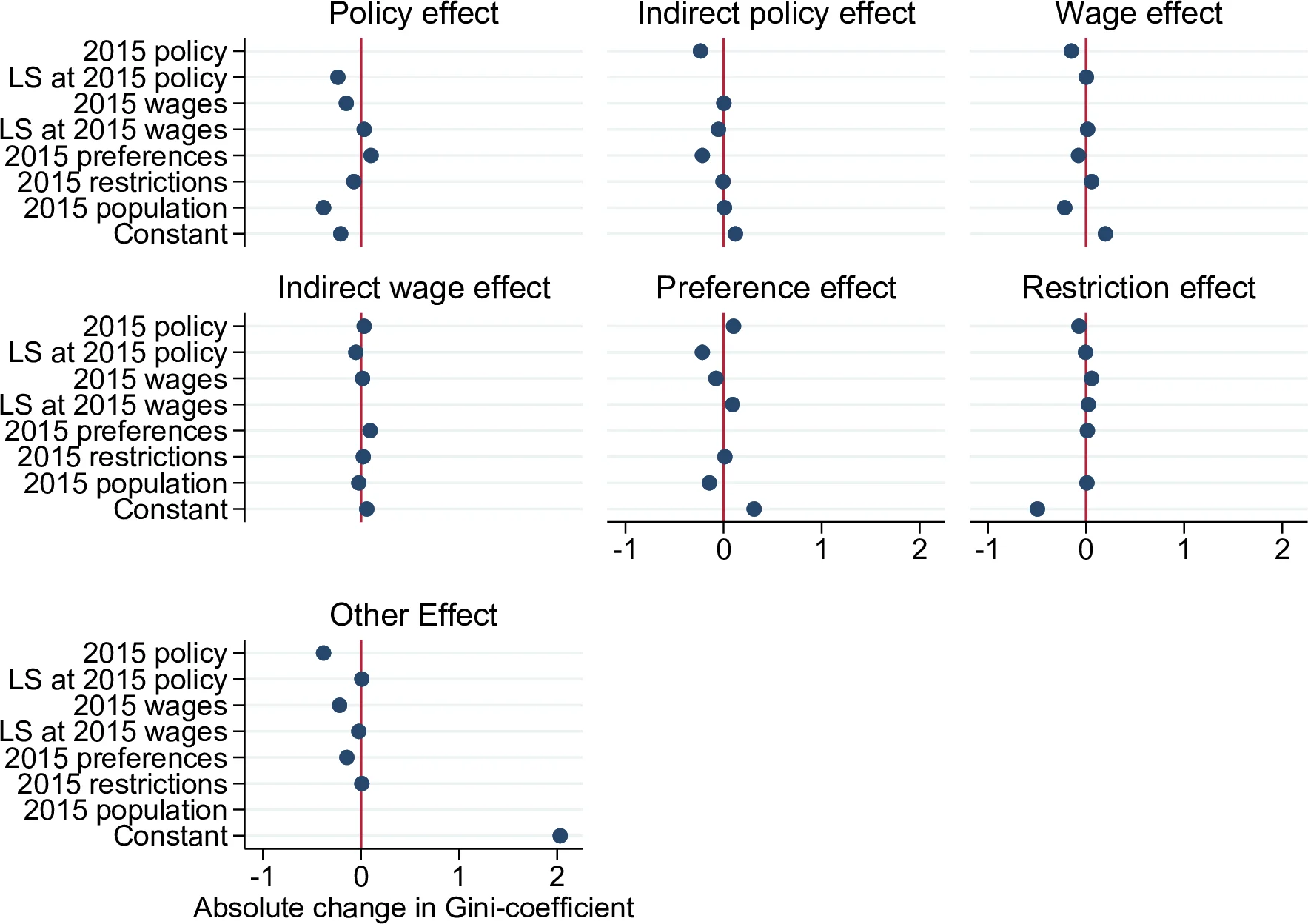
Tables
| Employment change in 1000 | Working hour category | FTE | |||||||
|---|---|---|---|---|---|---|---|---|---|
| Partial effect | 0 | 10 | 15 | 20 | 30 | 40 | 50 | ||
| Base period | Men | 2,073 | 42 | 26 | 125 | 281 | 11,312 | 2,105 | 14,237 |
| Women | 5,375 | 1,228 | 664 | 2,203 | 2,074 | 6,581 | 561 | 10,496 | |
| Total | 7,448 | 1,270 | 690 | 2,328 | 2,355 | 17,893 | 2,667 | 24,734 | |
| Indirect policy | Men | −175 | −18 | −1 | −5 | −3 | +126 | +75 | +210 |
| Women | −186 | −56 | −20 | −3 | +35 | +198 | +33 | +242 | |
| Total | −361 | −74 | −21 | −8 | +32 | +324 | +107 | +452 | |
| Indirect wage | Men | +124 | +11 | +6 | +8 | +2 | −84 | −66 | −156 |
| Women | +154 | +26 | +12 | −10 | −34 | −121 | −26 | −174 | |
| Total | +278 | +36 | +18 | −2 | −32 | −206 | −92 | −330 | |
| Preference | Men | +156 | +32 | +27 | +46 | +115 | −480 | +105 | −223 |
| Women | −490 | −12 | +15 | +155 | +749 | −703 | +285 | +296 | |
| Total | −334 | +20 | +43 | +201 | +864 | −1183 | +390 | +73 | |
| Restriction | Men | −789 | +22 | +22 | +35 | +60 | +574 | +75 | +744 |
| Women | −431 | +42 | +34 | +90 | +125 | +130 | +10 | +304 | |
| Total | −1220 | +65 | +56 | +126 | +186 | +704 | +84 | +1049 | |
| Population | Men | +66 | −20 | −12 | −41 | −91 | −320 | +106 | −286 |
| Women | −655 | −269 | +26 | −361 | +146 | +873 | +99 | +869 | |
| Total | −589 | −289 | +14 | −402 | +56 | +553 | +204 | +582 | |
| Total changes | Men | −617 | +27 | +42 | +43 | +84 | −185 | +294 | +289 |
| Women | −1,609 | −269 | +67 | −128 | +1,022 | +377 | +400 | +1,537 | |
| Total | −2,226 | −242 | +109 | −85 | +1,105 | +192 | +694 | +1,826 | |
Note: FTE = Full-time equivalent.
Source: IAB-MSM; author’s own calculation.
| 2004 | 2015 | |
|---|---|---|
| Household characteristics | ||
| Household type | ||
| Singles | 39.69% | 46.39% |
| Single parents | 9.20% | 10.05% |
| Couples without children | 28.42% | 27.06% |
| Couples with children | 22.70% | 16.50% |
| Household size | ||
| 1 person | 38.30% | 41.88% |
| 2 persons | 33.81% | 34.05% |
| 3 persons | 14.38% | 13.97% |
| 4 persons | 9.98% | 7.73% |
| 5 or more persons | 3.53% | 2.37% |
| Individual characteristics | ||
| Age | ||
| 0 - 16 years | 17.50% | 15.34% |
| 17 - 65 years | 63.42% | 62.62% |
| > 65 years | 19.08% | 22.04% |
| Nationality (of adults) | ||
| German | 92.40% | 90.90% |
| Other | 7.60% | 9.10% |
| Educational degree (25 - 65 years) | ||
| Low degree | 37.25% | 25.66% |
| Medium degree | 39.78% | 43.50% |
| High degree | 22.97% | 30.84% |
| Vocational degree (25 - 65 years) | ||
| Vocational degree | 86.28% | 85.85% |
| No vocational degree | 13.72% | 14.15% |
| Employment status (25 - 65 years) | ||
| Blue collar | 23.36% | 17.92% |
| White collar | 35.66% | 48.42% |
| Self-employed | 6.56% | 6.03% |
| Civil servant | 4.45% | 4.81% |
| Not employed | 29.29% | 21.58% |
| Other | 0.68% | 1.24% |
IAB-MSM = author’s own calculation;
Note: Population shares after household selection with adjusted SOEP weights.
| Inequality change | |||||
|---|---|---|---|---|---|
| Partial effect | Gini | Atkinson | P90/P10 | P90/P50 | P50/P10 |
| Indirect policy | -1.14% | -1.27% | -2.81% | -0.64% | -1.95% |
| Wage | +2.56% | +7.47% | +7.79% | +2.64% | +4.72% |
| Indirect wage | +1.27% | +0.61% | +1.27% | +0.32% | +0.86% |
| Preference | +0.76% | +5.73% | +8.95% | +2.14% | +6.38% |
| Restriction | -4.33% | -0.22% | -0.27% | -0.39% | +0.11% |
| Population | +2.89% | +5.21% | +3.94% | +5.18% | -1.31% |
| Total employment | -3.44% | +4.85% | +7.14% | 1.43% | +5.40% |
| Total change | +2.01% | +17.52% | +18.88% | +9.25% | +8.81% |
Note: Inflexible households are excluded. For Atkinson and percentile ratios households without income from employment are excluded.
The five columns present the Shorrock-Shapley value of the change in inequality measured with the Gini-coefficient, the Atkinson-index with inequality aversion parameter ∈ = 0.5, and the ratios between the 90th and 10th, the 90th and 50th, and the 50th and 10th income percentiles in percent.
Source: IAB-MSM; author’s own calculation.
| Inequality change | |||||
|---|---|---|---|---|---|
| Partial effect | Gini | Atkinson | P90/P10 | P90/P50 | P50/P10 |
| Policy | -2.30% | -2.91% | -3.33% | -2.39% | -1.07% |
| Indirect policy | -0.57% | -1.46% | -0.47% | +0.01% | -0.47% |
| Wage | +0.04% | +0.16% | +0.00% | +0.00% | +0.00% |
| Indirect wage | +0.38% | +0.65% | -0.06% | -0.01% | -0.05% |
| Preference | +0.65 | +0.32% | -1.42% | -0.01% | -1.41% |
| Restriction | -1.84% | -3.72% | +0.10% | -0.02% | +0.11% |
| Population | +6.31% | +6.47% | +8.27% | +4.66% | +3.80% |
| Growth | -0.34% | -0.97% | -4.70% | -0.47% | -4.25% |
| Total employment | -1.38% | -4.21% | -1.85% | -0.03% | -1.81% |
| Total change | +2.33% | -1.46% | -1.62% | +1.78% | -3.34% |
Note: The five columns present the Shorrock-Shapley value of the change in inequality measured with the Gini-coefficient, the Atkinson-index with inequality aversion parameter ∈ = 0.5, and the ratios between the 90th and 10th, the 90th and 50th, and the 50th and 10th income percentiles.
Source: IAB-MSM; author’s own calculation.
| Selection step | 2004 | 2015 | ||
|---|---|---|---|---|
| N | N | |||
| Initial number of private households in GSOEP | 11,795 | (-) | 15,996 | (-) |
| Exclusion of households without interviewed head of HH and/or partner | 11,721 | 74 | 15,952 | 44 |
| Exclusion of couple households with survey non-response of partner | 11,067 | 654 | 14,051 | 2,126 |
| Households interviewed in the simulation year and the following year | 9,905 | 1,162 | 11,614 | 1,433 |
| Exclusion of households with missing information on worked hours, wages and other income variables | 9,112 | 972 | 8,949 | 3,972 |
| Excluded households | 728 | 1,945 | ||
| Households considered for income simulation | 9,112 | 10,594 | ||
| Households considered for inequality analysis | 11,067 | 14,051 | ||
Note: N = remaining number of households, = change in numbers of households in the respective selection step. Exclusions are overestimated, if one simply counts the households affected by a certain condition, since households may be affected more than once.
Source: IAB-MSM; author’s own presentation.
| Model stage | Income components | Determined in tax and transfer module? | |
|---|---|---|---|
| 1 | Earned income | no | |
| + | Self-employed income | no | |
| + | Capital income | no | |
| + | Rental income | no | |
| + | Other income sources (pensions) | no | |
| 2 | - | Social security contributions | yes |
| - | Income tax | yes | |
| - | Alimony payments | yes | |
| 3 | + | Child benefit | yes |
| + | Child-raising allowance | yes | |
| + | Unemployment benefits | yes | |
| + | Federal student support, stipends, claims to maintenance, widow’s allowance, maternity allowance, reduced hours compensation | no | |
| 4 | + | Housing allowance | yes |
| + | Supplementary child allowance | yes | |
| + | Social assistance for employable persons (SGB II) | yes | |
| + | Social assistance for unemployable persons (SGB XII) | yes | |
| = | Net household income | yes |
| Policy parameter | 2004 | αρ2004 | 2015 |
|---|---|---|---|
| Benefits | |||
| Unemployment Benefit (share of previous net income) | 60% (67%)* | 60% (67%)* | |
| Unemployment Assistance (share of previous net income) | 53% (57%)* | ||
| Social Assistance | 291€*̂* | 349€ | 404€ |
| Unemployment Benefit II | 404€ | ||
| Income tax | |||
| Marginal tax burden in 1st progressive zone | 16% - 24.05% | 14% - 23.97% | |
| Marginal tax burden in 2nd progressive zone | 24.05% - 45% | 23.97% - 42% | |
| Marginal burden in 1st linear zone | 45% | 42% | |
| Marginal burden in 2nd linear zone (rich tax) | 45% | ||
| Basic tax allowance | 7,664€ | 9,187€ | 8,472€ |
| Lower threshold of 2nd progressive zone | 12,739€ | 15,271€ | 13, 469€ |
| Lower threshold of 1st linear zone | 52,151€ | 62,515€ | 52,881€ |
| Lower threshold of 2nd linear zone (rich tax) | 250,730€ | ||
| Social security contributions | |||
| Contributions to statutory pension insurance | 19.5% | 18.7% | |
| Contributions to statutory unemployment insurance | 6.5% | 3.0% | |
| Contributions to statutory health insurance | 14.2% | 15.5% | |
| Contributions to statutory long-term care insurance | 1.7% | 2.6% (2.35%)* | |
| Upper threshold of marginal employment (SSC free jobs) | 400€ | 479€ | 450€ |
| Upper threshold of contributions to statutory pension insurance | 5,150€ (4,350€)*̂** | 6,173€ (5,214€)*̂** | 6,700€ (6,150€)*̂** |
| Upper threshold of contributions to statutory unemployment insurance | 5,150€ (4,350€)*̂** | 6,173€ (5,214€)*̂** | 6,700€ (6,150€)*̂** |
| Upper threshold of contributions to statutory health insurance | 3,488€ | 4,181€ | 4,125€ |
| Upper threshold of contributions to statutory long-term care insurance | 3,488€ | 4.181€ | 4,125€ |
Note: The Table includes only the most important policy parameter. Uprating parameter is set to 1.1987 according to consumer price inflation between 2004 and 2015.
∗ with children.
∗∗ unweighted average over all federal states.
∗∗∗East Germany.
Source: IAB-MSM; author’s own presentation.
| 2004 | 2015 | |||
|---|---|---|---|---|
| b | se | b | se | |
| Log hourly wages | ||||
| Years in education | 0.0603 | (0.0068) | 0.0951 | (0.0055) |
| Full-time | -0.0157 | (0.0061) | 0.0011 | (0.0041) |
| Part-time | -0.0228 | (0.0084) | -0.0060 | (0.0062) |
| Human capital dep. | -0.2667 | (0.0627) | -0.0622 | (0.0654) |
| Human capital dep. sq. | 0.0691 | (0.0209) | -0.0438 | (0.0318) |
| Tenure | 0.0116 | (0.0048) | 0.0198 | (0.0039) |
| Tenure sq. | -0.0180 | (0.0121) | -0.0216 | (0.0112) |
| Age | 0.1133 | (0.0496) | 0.0444 | (0.0510) |
| Age sq. | -0.2132 | (0.1186) | -0.0576 | (0.1219) |
| Age cub. | 0.1496 | (0.0920) | 0.0065 | (0.0931) |
| Married | 0.0812 | (0.0382) | 0.0693 | (0.0319) |
| Separated | 0.1510 | (0.0733) | 0.0363 | (0.0969) |
| Divorced | 0.0744 | (0.0478) | 0.0561 | (0.0484) |
| Children 0-3 | -0.0035 | (0.0443) | -0.0413 | (0.0386) |
| Children 4-6 | 0.0346 | (0.0502) | 0.0618 | (0.0315) |
| Berlin | 0.1924 | (0.0401) | 0.0841 | (0.0326) |
| Constant | -0.1285 | (0.6634) | 0.3731 | (0.6789) |
| Selection | ||||
| Low education | 0.4902 | (0.6294) | 0.6708 | (0.5615) |
| Medium education | 0.8935 | (0.6048) | 0.4006 | (0.4904) |
| High education | -1.1962 | (0.6265) | -0.5408 | (0.5210) |
| Vocational degree | 1.1709 | (0.5873) | 0.8428 | (0.4529) |
| University degree | 1.6311 | (0.5976) | 0.4673 | (0.4678) |
| Experience | 0.0468 | (0.0192) | -0.0093 | (0.0139) |
| Human capital dep. | -1.9419 | (0.1342) | -1.5065 | (0.1313) |
| Human capital dep. sq. | 0.2821 | (0.0338) | 0.1424 | (0.0327) |
| Age 26-30 | 0.3566 | (0.2406) | 1.0566 | (0.2412) |
| Age 31-35 | 0.3749 | (0.2898) | 1.0539 | (0.2741) |
| Age 36-40 | 0.0762 | (0.3671) | 1.4974 | (0.2935) |
| Age 41-55 | -0.2919 | (0.4088) | 1.5560 | (0.3563) |
| Age 46-50 | -0.3446 | (0.5127) | 1.5454 | (0.3789) |
| Age 51-55 | -0.3164 | (0.5918) | 1.5913 | (0.4496) |
| Age 56-60 | -1.2568 | (0.6874) | 1.6276 | (0.5054) |
| Age 61-65 | -2.1426 | (0.8132) | 0.4614 | (0.5823) |
| Married | 0.0600 | (0.1564) | 0.2883 | (0.1353) |
| Separated | -0.3616 | (0.2619) | -0.3547 | (0.2593) |
| Divorced | -0.3332 | (0.2135) | -0.2595 | (0.2101) |
| Children 0-3 | 0.2660 | (0.2056) | 0.1530 | (0.1789) |
| Children 4-6 | 0.3129 | (0.2041) | 0.0436 | (0.1529) |
| kind16 | 0.1424 | (0.1390) | 0.1742 | (0.1301) |
| kind17 | 0.0792 | (0.2264) | -0.2543 | (0.2935) |
| Disability | 0.0049 | (0.0035) | -0.0069 | (0.0035) |
| Other income | -0.8729 | (0.1037) | -0.4768 | (0.0610) |
| Other income sq. | 0.8984 | (0.1605) | 0.2678 | (0.0457) |
| Constant | 0.8389 | (0.5615) | 0.5111 | (0.4932) |
| Rho | -0.4362 | (0.1301) | 0.1927 | (0.0843) |
| Sigma | -0.9927 | (0.0345) | -1.0116 | (0.0267) |
| N | 1621 | 1588 | ||
| Log-likelihood | -807.4515 | -843.6526 | ||
∗ p < 0.05, ∗∗ p < 0.01, ∗∗∗ p < 0.001.
Source: IAB-MSM; author’s own presentation.
| 2004 | 2015 | |||
|---|---|---|---|---|
| b | se | b | se | |
| Log hourly wages | ||||
| Years in education | 0.0516 | (0.0082) | 0.0824 | (0.0062) |
| Full-time | -0.0045 | (0.0023) | -0.0010 | (0.0020) |
| Part-time | -0.0204 | (0.0054) | -0.0271 | (0.0033) |
| Human capital dep. | -0.2090 | (0.0380) | -0.1243 | (0.0396) |
| Human capital dep. sq. | 0.0341 | (0.0189) | -0.0002 | (0.0224) |
| Tenure | 0.0158 | (0.0020) | 0.0165 | (0.0019) |
| Tenure sq. | -0.0258 | (0.0054) | -0.0131 | (0.0049) |
| German | -0.1633 | (0.0895) | 0.1170 | (0.0706) |
| Years in edu. x German | 0.0144 | (0.0082) | -0.0020 | (0.0062) |
| Age | 0.0766 | (0.0252) | 0.0283 | (0.0237) |
| Age sq. | -0.1281 | (0.0610) | -0.0137 | (0.0570) |
| Age cub. | 0.0806 | (0.0477) | -0.0214 | (0.0444) |
| Married | 0.0512 | (0.0181) | 0.0757 | (0.0171) |
| Separated | 0.0369 | (0.0399) | -0.0251 | (0.0399) |
| Divorced | -0.0340 | (0.0304) | 0.0618 | (0.0253) |
| Children 0-3 | 0.0447 | (0.0188) | 0.0340 | (0.0159) |
| Children 4-6 | 0.0796 | (0.0186) | 0.0320 | (0.0146) |
| Constant | 0.6172 | (0.3467) | 0.8913 | (0.3218) |
| Selection | ||||
| Low education | 0.5609 | (0.2122) | 0.6813 | (0.1914) |
| Medium education | 0.4134 | (0.2057) | 0.0442 | (0.1637) |
| High education | -0.5462 | (0.2068) | -0.6239 | (0.1869) |
| Vocational degree | 0.7051 | (0.1706) | 0.7336 | (0.1527) |
| University degree | 1.3824 | (0.1978) | 0.6433 | (0.1640) |
| Experience | 0.0302 | (0.0101) | 0.0121 | (0.0074) |
| Human capital dep. | -1.4975 | (0.0888) | -1.0907 | (0.0744) |
| Human capital dep. sq. | 0.1654 | (0.0246) | 0.0543 | (0.0210) |
| Age 26-30 | 0.3408 | (0.1358) | 0.3479 | (0.1181) |
| Age 31-35 | 0.5568 | (0.1722) | 0.7908 | (0.1389) |
| Age 36-40 | 0.7194 | (0.1937) | 0.7753 | (0.1624) |
| Age 41-45 | 0.5321 | (0.2516) | 0.7208 | (0.1887) |
| Age 46-50 | 0.3618 | (0.2857) | 0.7677 | (0.2094) |
| Age 51-55 | 0.0793 | (0.3233) | 0.8887 | (0.2432) |
| Age 56-60 | -0.5898 | (0.3684) | 0.3145 | (0.2805) |
| Age 61-65 | -1.6890 | (0.4238) | -0.6393 | (0.3148) |
| Married | 0.0462 | (0.1074) | 0.2685 | (0.0853) |
| Separated | 0.0636 | (0.2106) | 0.0794 | (0.1974) |
| Divorced | -0.2688 | (0.1496) | 0.1803 | (0.1256) |
| Children 0-3 | 0.3631 | (0.1471) | -0.1461 | (0.0924) |
| Children 4-6 | 0.1316 | (0.1381) | 0.0574 | (0.0886) |
| kind16 | -0.0639 | (0.0828) | 0.1688 | (0.0703) |
| kind17 | 0.0076 | (0.1635) | 0.0538 | (0.1412) |
| Disability | -0.0046 | (0.0019) | -0.0058 | (0.0016) |
| Other income | -0.3942 | (0.0286) | -0.5168 | (0.0509) |
| Other income sq. | 0.0869 | (0.0066) | 0.2913 | (0.0769) |
| Constant | 0.6765 | (0.1891) | 0.8362 | (0.1782) |
| Rho | -0.1286 | (0.0693) | 0.0578 | (0.0559) |
| Sigma | -1.1161 | (0.0157) | -1.0366 | (0.0165) |
| N | 4440 | 5674 | ||
| Log-likelihood | -1.93e+03 | -3.03e+03 | ||
∗ p < 0.05, ∗∗ p < 0.01, ∗∗∗ p < 0.001.
Source: IAB-MSM; author’s own presentation.
| 2004 | 2015 | |||
|---|---|---|---|---|
| b | se | b | se | |
| Log hourly wages | ||||
| Years in education | 0.0776 | (0.0055) | 0.0816 | (0.0044) |
| Full-time | -0.0062 | (0.0046) | 0.0043 | (0.0030) |
| Part-time | -0.0116 | (0.0053) | -0.0002 | (0.0033) |
| Human capital dep. | -0.1117 | (0.0570) | -0.0861 | (0.0486) |
| Human capital dep. sq. | 0.0041 | (0.0171) | -0.0000 | (0.0179) |
| Tenure | 0.0266 | (0.0049) | 0.0151 | (0.0036) |
| Tenure sq. | -0.0330 | (0.0133) | -0.0046 | (0.0094) |
| Age | 0.0325 | (0.0498) | 0.0942 | (0.0437) |
| Age sq. | -0.0074 | (0.1241) | -0.1803 | (0.1032) |
| Age cub. | -0.0323 | (0.0990) | 0.1053 | (0.0785) |
| Married | 0.0314 | (0.0324) | 0.0153 | (0.0236) |
| Separated | -0.0125 | (0.0838) | 0.0293 | (0.0519) |
| Divorced | -0.0790 | (0.0450) | 0.0311 | (0.0341) |
| Children 0-3 | 0.0754 | (0.0630) | 0.1327 | (0.0470) |
| Children 4-6 | 0.1813 | (0.0472) | 0.0507 | (0.0313) |
| Berlin | 0.1605 | (0.0357) | 0.1279 | (0.0242) |
| Constant | 0.3610 | (0.6300) | -0.2300 | (0.5868) |
| Selection | ||||
| Low education | 6.2022 | (.) | 1.0227 | (0.4361) |
| Medium education | 6.8002 | (0.3552) | -0.0080 | (0.4148) |
| High education | 6.0726 | (0.3613) | -0.5879 | (0.4379) |
| Vocational degree | 7.3540 | (0.2934) | 0.6630 | (0.3758) |
| University degree | 7.4677 | (0.3056) | 0.7411 | (0.3820) |
| Experience | 0.0340 | (0.0144) | 0.0434 | (0.0101) |
| Human capital dep. | -1.2067 | (0.1292) | -0.8093 | (0.1110) |
| Human capital dep. sq. | 0.0661 | (0.0352) | 0.0066 | (0.0264) |
| Age 26-30 | 0.3526 | (0.1868) | 0.3127 | (0.2054) |
| Age 31-35 | 0.6714 | (0.2449) | 0.7782 | (0.2280) |
| Age 36-40 | 0.5558 | (0.2955) | 0.5030 | (0.2469) |
| Age 41-45 | 0.4479 | (0.3256) | 0.7872 | (0.2815) |
| Age 46-50 | 0.2952 | (0.4109) | 0.0829 | (0.2946) |
| Age 51-55 | 0.0616 | (0.4571) | 0.1606 | (0.3385) |
| Age 56-60 | -0.2991 | (0.5244) | -0.4119 | (0.3885) |
| Age 61-65 | -1.7425 | (0.6272) | -1.8400 | (0.4396) |
| Married | 0.2471 | (0.1456) | 0.3586 | (0.1065) |
| Separated | -0.0537 | (0.3317) | 0.5252 | (0.2443) |
| Divorced | -0.1005 | (0.2036) | 0.0039 | (0.1545) |
| Children 0-3 | -0.4611 | (0.1800) | -0.6359 | (0.1314) |
| Children 4-6 | 0.7355 | (0.1640) | 0.5462 | (0.1309) |
| Children 7-16 | 0.2113 | (0.1305) | 0.2881 | (0.1075) |
| Children 17-18 | 0.0907 | (0.1894) | 0.1543 | (0.2345) |
| Disability | -0.0046 | (0.0037) | -0.0091 | (0.0028) |
| Other income | -0.6274 | (0.0921) | -0.5656 | (0.0694) |
| Other income sq. | 0.6135 | (0.1433) | 0.4503 | (0.0966) |
| Constant | -5.9186 | (0.3300) | 0.4937 | (0.3798) |
| Rho | -0.0159 | (0.1403) | 0.0038 | (0.0921) |
| Sigma | -1.0508 | (0.0291) | -1.0927 | (0.0304) |
| N | 1831 | 2025 | ||
| Log-likelihood | -845.8183 | -1.01e+03 | ||
* p < 0.05, ∗∗ p < 0.01, ∗∗∗ p < 0.001.
Source: IAB-MSM; author’s own presentation.
| 2004 | 2015 | |||
|---|---|---|---|---|
| b | se | b | se | |
| Log hourly wages | ||||
| Years in education | 0.0748 | (0.0086) | 0.0759 | (0.0068) |
| Full-time | 0.0032 | (0.0017) | 0.0023 | (0.0013) |
| Part-time | -0.0044 | (0.0023) | -0.0051 | (0.0016) |
| Human capital dep. | -0.0325 | (0.0245) | -0.0495 | (0.0191) |
| Human capital dep. sq. | -0.0005 | (0.0087) | 0.0015 | (0.0064) |
| Tenure | 0.0190 | (0.0025) | 0.0248 | (0.0019) |
| Tenure sq. | -0.0241 | (0.0074) | -0.0323 | (0.0054) |
| German | 0.0402 | (0.0983) | 0.0571 | (0.0863) |
| Years in edu. x German | -0.0016 | (0.0090) | 0.0017 | (0.0071) |
| Age | 0.0243 | (0.0283) | 0.0502 | (0.0231) |
| Age sq. | 0.0042 | (0.0703) | -0.0770 | (0.0550) |
| Age cub. | -0.0443 | (0.0560) | 0.0314 | (0.0425) |
| Married | -0.0285 | (0.0198) | -0.0277 | (0.0152) |
| Separated | -0.0222 | (0.0437) | -0.0155 | (0.0328) |
| Divorced | 0.0309 | (0.0257) | -0.0379 | (0.0190) |
| Children 0-3 | 0.1029 | (0.0549) | 0.0688 | (0.0312) |
| Children 4-6 | 0.0208 | (0.0342) | 0.0695 | (0.0201) |
| Constant | 0.7980 | (0.3768) | 0.5628 | (0.3134) |
| Selection | ||||
| Low education | 0.5297 | (0.1804) | 0.2108 | (0.1681) |
| Medium education | 0.4186 | (0.1849) | 0.2049 | (0.1613) |
| High education | -0.7122 | (0.2003) | -0.2802 | (0.1752) |
| Vocational degree | 0.7217 | (0.1611) | 0.7066 | (0.1493) |
| University degree | 0.9938 | (0.1712) | 0.8390 | (0.1536) |
| Experience | 0.0042 | (0.0049) | 0.0016 | (0.0038) |
| Human capital dep. | -0.6856 | (0.0596) | -0.2717 | (0.0478) |
| Human capital dep. sq. | -0.0253 | (0.0134) | -0.0944 | (0.0113) |
| Age 26-30 | 0.6996 | (0.1126) | 0.3663 | (0.0934) |
| Age 31-35 | 0.9727 | (0.1226) | 0.7185 | (0.1020) |
| Age 36-40 | 1.0663 | (0.1299) | 0.8993 | (0.1099) |
| Age 41-45 | 1.0626 | (0.1443) | 1.1341 | (0.1146) |
| Age 46-50 | 0.9881 | (0.1550) | 1.1266 | (0.1224) |
| Age 51-55 | 0.7691 | (0.1673) | 1.0450 | (0.1322) |
| Age 56-60 | 0.6069 | (0.1794) | 0.8570 | (0.1478) |
| Age 61-65 | -0.4658 | (0.2170) | 0.0948 | (0.1695) |
| Married | 0.1655 | (0.0789) | -0.0021 | (0.0570) |
| Separated | -0.0561 | (0.1660) | -0.1495 | (0.1205) |
| Divorced | 0.0004 | (0.1039) | -0.0265 | (0.0743) |
| Children 0-3 | -1.2915 | (0.1023) | -0.9322 | (0.0664) |
| Children 4-6 | 0.2875 | (0.0877) | 0.3254 | (0.0614) |
| Children 7-16 | 0.1757 | (0.0678) | 0.1959 | (0.0481) |
| Children 17-18 | 0.0045 | (0.1277) | -0.1579 | (0.0822) |
| Disability | -0.0087 | (0.0019) | -0.0085 | (0.0012) |
| Other income | -0.1455 | (0.0184) | -0.2526 | (0.0236) |
| Other income sq. | 0.0160 | (0.0021) | 0.1365 | (0.0234) |
| Constant | 0.0767 | (0.1681) | 0.1098 | (0.1603) |
| Rho | -0.0639 | (0.0879) | 0.0917 | (0.0695) |
| Sigma | -1.0406 | (0.0215) | -1.0411 | (0.0151) |
| N | 5078 | 7259 | ||
| Log-likelohood | -2.73e+03 | -4.47e+03 | ||
∗ p < 0.05, ∗∗ p < 0.01, ∗∗∗ p < 0.001.
Source: IAB-MSM; author’s own presentation.
| 2004 | 2015 | |||
|---|---|---|---|---|
| Women | Men | Women | Men | |
| Regional unemployment rate | 0.0593 | 0.0320 | 0.0822 | 0.0616 |
| (0.0079) | (0.0063) | (0.0140) | (0.0136) | |
| Age | -0.0740 | 0.0025 | -0.0783 | -0.0527 |
| (0.0062) | (0.0073) | (0.0069) | (0.0082) | |
| Age sq. | 0.0008 | 0.0000 | 0.0008 | 0.0007 |
| (0.0001) | (0.0001) | (0.0001) | (0.0001) | |
| Nationality | ||||
| German | Reference | |||
| OECD | 0.2640 | 0.0643 | 0.1651 | -0.2239 |
| (0.1917) | (0.1842) | (0.1697) | (0.2154) | |
| Other | 0.3403 | 0.2539 | 0.3372 | -0.0879 |
| (0.1737) | (0.1625) | (0.1060) | (0.1513) | |
| Educational degree | ||||
| Low degree | Reference | |||
| Medium degree | -0.2089 | -0.2914 | -0.2340 | -0.2797 |
| (0.0917) | (0.0835) | (0.0824) | (0.0894) | |
| High degree | -0.5648 | -0.8269 | -0.4637 | -0.4932 |
| (0.1348) | (0.1283) | (0.1107) | (0.1166) | |
| No vocational degree | 0.1027 | 0.1806 | 0.2892 | 0.2042 |
| (0.1002) | (0.1414) | (0.0846) | (0.1060) | |
| Previous employment | ||||
| Employed in t-1 | -1.2011 | -1.8202 | -0.4772 | -1.3053 |
| (0.1714) | (0.1030) | (0.1663) | (0.2121) | |
| Employed in t-2 | 0.0593 | -0.1668 | -0.5057 | -0.2350 |
| (0.1621) | (0.1108) | (0.1766) | (0.1904) | |
| Employed in t-3 | 0.0480 | -0.3755 | -0.0785 | -0.0751 |
| (0.1191) | (0.1075) | (0.1741) | (0.1368) | |
| 3446 | 3659 | 4288 | 4108 | |
| Pseudolikelihood | -788.5288 | -536.3061 | -787.5285 | -563.0143 |
∗ p < 0.05, ∗∗ p < 0.01, ∗∗∗ p < 0.001.
Note: t statistics in parentheses.
Source: IAB-MSM; author’s own presentation.
| 2004 | 2015 | |||
|---|---|---|---|---|
| Coef. | s.e. | Coef. | s.e. | |
| Consumption | -0.6219 | (1.4808) | 7.9233 | (2.8858) |
| Consumption sq. | -0.04069 | (0.0555) | 0.1869 | (0.0707) |
| Consumption x Leisure | 0.09482 | (0.3565) | -1.4357 | (0.7193) |
| Leisure | 92.545 | (11.0540) | 85.453 | (10.1909) |
| Leisure sq. | -12.247 | (1.4535) | -9.8510 | (1.3204) |
| Leisure x | ||||
| High education | -0.6056 | (0.5755) | -0.4818 | (0.4998) |
| Low education | 1.8243 | (0.5659) | 0.5176 | (0.4642) |
| East Germany | 1.3023 | (0.4798) | 0.2647 | (0.3847) |
| German nationality | 0.3709 | (1.1765) | 0.5161 | (0.4825) |
| Age | -0.6355 | (1.7146) | -3.9675 | (1.0906) |
| Age sq. | 12.437 | (20.4404) | 48.661 | (12.6555) |
| Fixed costs of work | 3.9099 | (0.6724) | 3.5089 | (0.4943) |
| Fixed costs of full-time | -3.1132 | (0.3355) | -3.2498 | (0.3006) |
| N | 602 | 724 | ||
| Log-likelihood | -502.42 | -675.89 | ||
| 0.9668 | 0.02999 | |||
∗ p < 0.05, ∗∗ p < 0.01, ∗∗∗ p < 0.001 .
Source: IAB-MSM; author’s own presentation.
| 2004 | 2015 | |||
|---|---|---|---|---|
| Coef. | s.e. | Coef. | s.e. | |
| Consumption | 0.5100 | (0.8057) | 3.2805 | (1.5159) |
| Consumption sq. | 0.1637 | (0.0568) | 0.2923 | (0.1191) |
| Consumption x Leisure | 0.1027 | (0.1974) | -0.08498 | (0.3837) |
| Leisure | 113.22 | (8.8914) | 89.797 | (6.4361) |
| Leisure sq. | -13.687 | (1.0840) | -11.075 | (0.8002) |
| Leisure x | ||||
| High education | -0.9524 | (0.5770) | -0.4796 | (0.3976) |
| Low education | 0.5652 | (0.5740) | 0.8085 | (0.4143) |
| East Germany | 0.3233 | (0.5053) | 0.2691 | (0.3548) |
| German nationality | 0.9445 | (0.9306) | -1.1898 | (0.4508) |
| Age | -5.1194 | (1.4995) | -2.0370 | (1.0574) |
| Age sq. | 74.421 | (17.8229) | 34.874 | (11.9136) |
| Fixed costs of work | 2.8597 | (0.4106) | 3.2088 | (0.2792) |
| Fixed costs of full-time | -2.4068 | (0.2324) | -1.4462 | (0.1557) |
| N | 525 | 862 | ||
| Log-likelihood | -564.09 | -1125.8 | ||
| 0.03401 | 0.01226 | |||
∗ p < 0.05, ∗∗ p < 0.01, ∗∗∗ p < 0.001.
Source: IAB-MSM; author’s own presentation.
| 2004 | 2015 | |||
|---|---|---|---|---|
| Coef. | s.e. | Coef. | s.e. | |
| Consumption | -0.4519 | (1.5239) | 0.1529 | (3.5820) |
| Consumption sq. | 0.08838 | (0.3872) | 0.2725 | (0.0987) |
| Consumption x Leisure | 0.4187 | (0.3614) | 0.3794 | (0.9028) |
| Leisure | 103.88 | (12.4890) | 111.48 | (10.3108) |
| Leisure sq. | -13.111 | (1.3576) | -13.358 | (1.1540) |
| Leisure x | ||||
| East Germany | -1.6070 | (0.6184) | -1.3669 | (0.4225) |
| German nationality | 2.0888 | (0.9744) | 0.04071 | (0.6061) |
| High education | 0.1565 | (0.8211) | -1.1287 | (0.5198) |
| Low education | 2.2245 | (0.6427) | 1.4929 | (0.4592) |
| Age | -2.3404 | (3.2685) | -3.6618 | (2.1359) |
| Age sq. | 25.516 | (41.0984) | 43.342 | (25.2813) |
| Children 0-3 | 4.9634 | (1.1028) | 3.8055 | (0.7702) |
| Children 4-6 | 2.8139 | (0.6554) | 1.4972 | (0.4876) |
| Children 7-16 | 0.6357 | (0.3874) | 0.6774 | (0.3138) |
| Children >16 | 1.3024 | (0.5400) | 0.6987 | (0.5192) |
| Fixed costs of work | 2.8658 | (0.3697) | 2.6273 | (0.2451) |
| Fixed costs of full-time | -1.2038 | (0.2668) | -0.9790 | (0.1860) |
| N | 299 | 634 | ||
| Log-likelihood | -445.12 | -999.52 | ||
| 0.004300 | 0.0004507 | |||
∗ p < 0.05, ∗∗ p < 0.01, ∗∗∗ p < 0.001.
Source: IAB-MSM; author’s own presentation.
| 2004 | 2015 | |||
|---|---|---|---|---|
| Coef. | s.e. | Coef. | s.e. | |
| Consumption | 0.6217 | (1.4490) | 7.9105 | (1.6243) |
| Consumption sq. | 0.4029 | (0.0702) | 0.4141 | (0.0694) |
| Consumption x Leisure | 0.3898 | (0.3162) | -1.0822 | (0.3507) |
| Leisure | 84.463 | (5.9911) | 84.997 | (5.6047) |
| Leisure sq. | -10.587 | (0.7109) | -10.476 | (0.6454) |
| Leisure x | ||||
| Woman | 5.9726 | (0.5172) | 4.7809 | (0.4087) |
| Leisure of spouse | 0.4631 | (0.2316) | 0.4475 | (0.2367) |
| East Germany | 1.1401 | (0.6794) | 0.3378 | (0.5699) |
| East Germany - Woman | -2.9637 | (0.7627) | -1.4917 | (0.6606) |
| German nationality | -1.1034 | (0.5468) | -0.7173 | (0.4119) |
| High education - Woman | -1.1636 | (0.3744) | -0.6819 | (0.3201) |
| High education - Man | -0.05177 | (0.3317) | 0.06458 | (0.3113) |
| Low education - Woman | 1.0177 | (0.4058) | 0.5498 | (0.3899) |
| Low education - Man | -0.3108 | (0.4779) | 0.2260 | (0.4211) |
| Age | -4.4804 | (1.2896) | -3.6811 | (1.0843) |
| Age sq. | 63.590 | (14.8757) | 52.129 | (11.9375) |
| Children 0-3 | 4.0337 | (0.5750) | 2.7117 | (0.4410) |
| Children 4-6 | 1.5221 | (0.4286) | 0.9293 | (0.3156) |
| Children 7-16 | 0.8736 | (0.2014) | 0.6289 | (0.1799) |
| Children >16 | 0.5671 | (0.2194) | 0.3523 | (0.2805) |
| Fixed costs of work | 2.6902 | (0.2091) | 2.7418 | (0.1963) |
| Fixed costs of full-time | -1.7784 | (0.1535) | -1.4269 | (0.1386) |
| N | 1050 | 1151 | ||
| Log-likelihood | -1431.3 | -1624.8 | ||
| 0.001633 | 0.001862 | |||
∗ p < 0.05, ∗∗ p < 0.01, ∗∗∗ p < 0.001.
Source: IAB-MSM; author’s own presentation.
| 2004 | 2015 | |||
|---|---|---|---|---|
| Coef. | s.e. | Coef. | s.e. | |
| Consumption | 1.4838 | (0.5294) | 12.561 | (2.0692) |
| Consumption sq. | 0.1944 | (0.0385) | 0.3553 | (0.0516) |
| Consumption x Leisure man | 0.009652 | (0.0925) | -1.0063 | (0.3598) |
| Consumption x Leisure woman | -0.02770 | (0.0853) | -1.2710 | (0.2936) |
| Leisure man | 94.432 | (7.2397) | 93.569 | (5.7676) |
| Leisure man sq. | -10.843 | (0.9208) | -10.851 | (0.6849) |
| Leisure man x | ||||
| East Germany | -4.6848 | (3.1804) | -2.8742 | (2.9422) |
| German nationality - Man | -0.9338 | (0.4397) | -0.6835 | (0.3021) |
| High education - Man | -1.2707 | (0.2680) | 0.1922 | (0.2509) |
| Low education - Man | 0.7592 | (0.2948) | 0.4963 | (0.2573) |
| Age - Man | -3.7896 | (0.9974) | -2.4464 | (0.8087) |
| Age sq. - Man | 53.132 | (11.3029) | 32.686 | (9.0016) |
| Leisure woman | 101.64 | (4.4523) | 91.721 | (4.3630) |
| Leisure woman sq. | -12.132 | (0.4732) | -10.546 | (0.4320) |
| Leisure woman x | ||||
| East Germany | -7.4150 | (3.0151) | -5.0222 | (2.7395) |
| German nationality - Woman | -0.3894 | (0.3941) | -0.8842 | (0.2679) |
| High education - Woman | -1.2869 | (0.2164) | -0.7146 | (0.1953) |
| Low education - Woman | 0.1559 | (0.2384) | 0.6132 | (0.2345) |
| Age - Woman | -2.1765 | (0.8896) | -2.0661 | (0.7590) |
| Age sq. - Woman | 42.169 | (10.6571) | 32.285 | (8.7851) |
| Children 0-3 | 6.9415 | (0.3614) | 5.0673 | (0.2656) |
| Children 4-6 | 3.1790 | (0.2612) | 1.5697 | (0.1733) |
| Children 7-16 | 1.7139 | (0.1183) | 1.3189 | (0.0999) |
| Children >16 | 0.7215 | (0.1306) | 0.7273 | (0.1676) |
| Leisure man x Leisure woman | -1.0564 | (0.4114) | -1.0340 | (0.4519) |
| Leisure man x Leisure woman x | ||||
| East Germany | 1.2956 | (0.8144) | 0.8652 | (0.7362) |
| German couple | -0.05897 | (0.1072) | 0.1427 | (0.0693) |
| Fixed costs of work - Man | 4.5919 | (0.4411) | 4.0863 | (0.3150) |
| Fixed costs of work - Woman | 2.1989 | (0.1077) | 2.2333 | (0.0979) |
| Fixed costs of full-time - Man | -3.7534 | (0.2227) | -3.0504 | (0.1560) |
| Fixed costs of full-time - Woman | -1.5968 | (0.0953) | -0.8672 | (0.0869) |
| N | 2879 | 3154 | ||
| Log-likelihood | -6504.1 | -7677.6 | ||
| 0.01353 | 0.002498 | |||
∗ p < 0.05, ∗∗ p < 0.01, ∗∗∗ p < 0.001.
Source: IAB-MSM; author’s own presentation.
| Policy | I. pol. | Wage | I. wage | Pref. | Restr. | Other | |
|---|---|---|---|---|---|---|---|
| 2015 policy | -0.235*** (-9.84) | -0.150*** (-17.56) | 0.032** (2.88) | 0.102*** (3.85) | -0.072*** (-15.84) | -0.381*** (-24.05) | |
| LS 2015 policy | -0.235*** (-8.96) | 0.003 (0.40) | -0.052*** (-4.65) | -0.216*** (-8.09) | -0.005 (-1.11) | 0.009 (0.55) | |
| 2015 wages | -0.150*** (-5.71) | 0.003 (0.14) | 0.016 (1.41) | -0.077** (-2.90) | 0.057*** (12.49) | -0.217*** (-13.72) | |
| LS 2015 wages | 0.032 (1.23) | -0.052* (-2.19) | 0.016 (1.85) | 0.093*** (3.50) | 0.023*** (5.05) | -0.022 (-1.41) | |
| 2015 preferences | 0.102*** (3.90) | -0.216*** (-9.03) | -0.077*** (-9.07) | 0.093*** (8.32) | 0.014** (3.03) | -0.144*** (-9.07) | |
| 2015 restrictions | -0.072** (-2.76) | -0.005 (-0.21) | 0.057*** (6.69) | 0.023* (2.05) | 0.014 (0.52) | 0.009 (0.58) | |
| 2015 population | -0.381*** (-14.51) | 0.009 (0.37) | -0.217*** (-25.48) | -0.022 (-1.99) | -0.144*** (-5.39) | 0.009* (2.02) | |
| Constant | -0.206*** (-5.93) | 0.121*** (3.84) | 0.197*** (17.49) | 0.059*** (3.99) | 0.312*** (8.84) | -0.496*** (-82.06) | 2.031*** (96.91) |
| N | 64 | 64 | 64 | 64 | 64 | 64 | 64 |
| r2 | 0.859 | 0.763 | 0.950 | 0.657 | 0.696 | 0.887 | 0.937 |
∗ p < 0.05, ∗∗ p < 0.01, ∗∗∗ p < 0.001.
Note: t statistics in parentheses.
Source: IAB-MSM; author’s own presentation.